


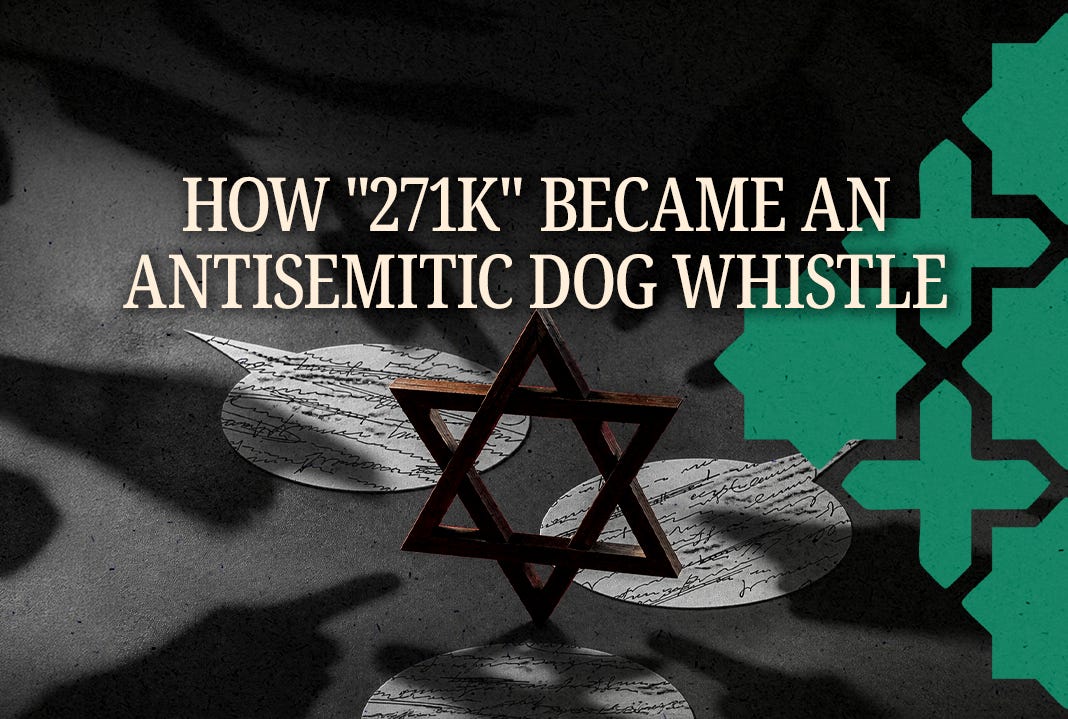
A strange number has recently begun appearing online beneath videos about Jewish history, antisemitism, and the Holocaust.
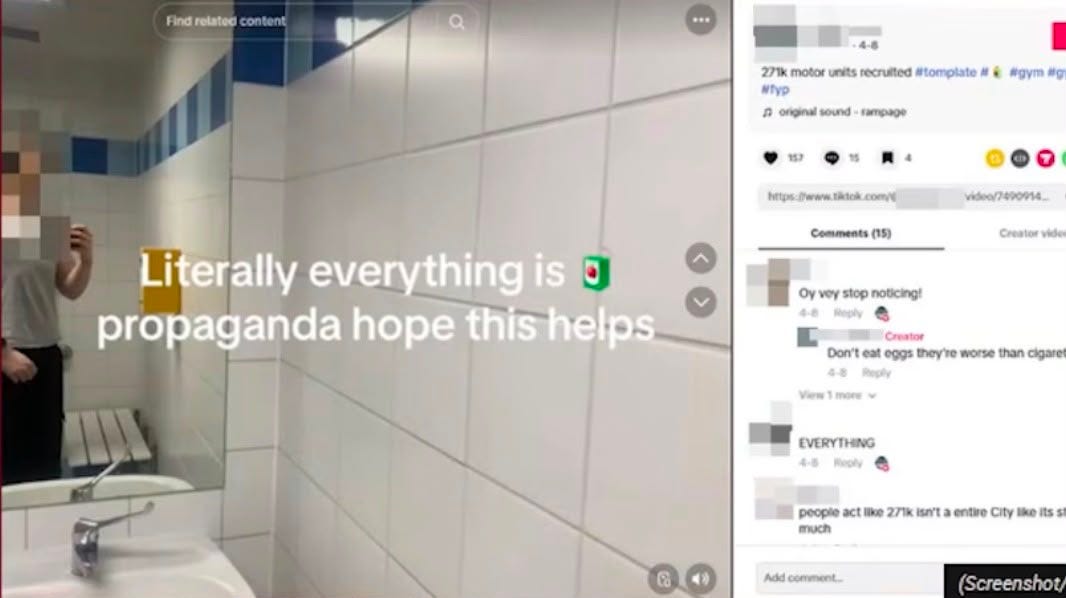
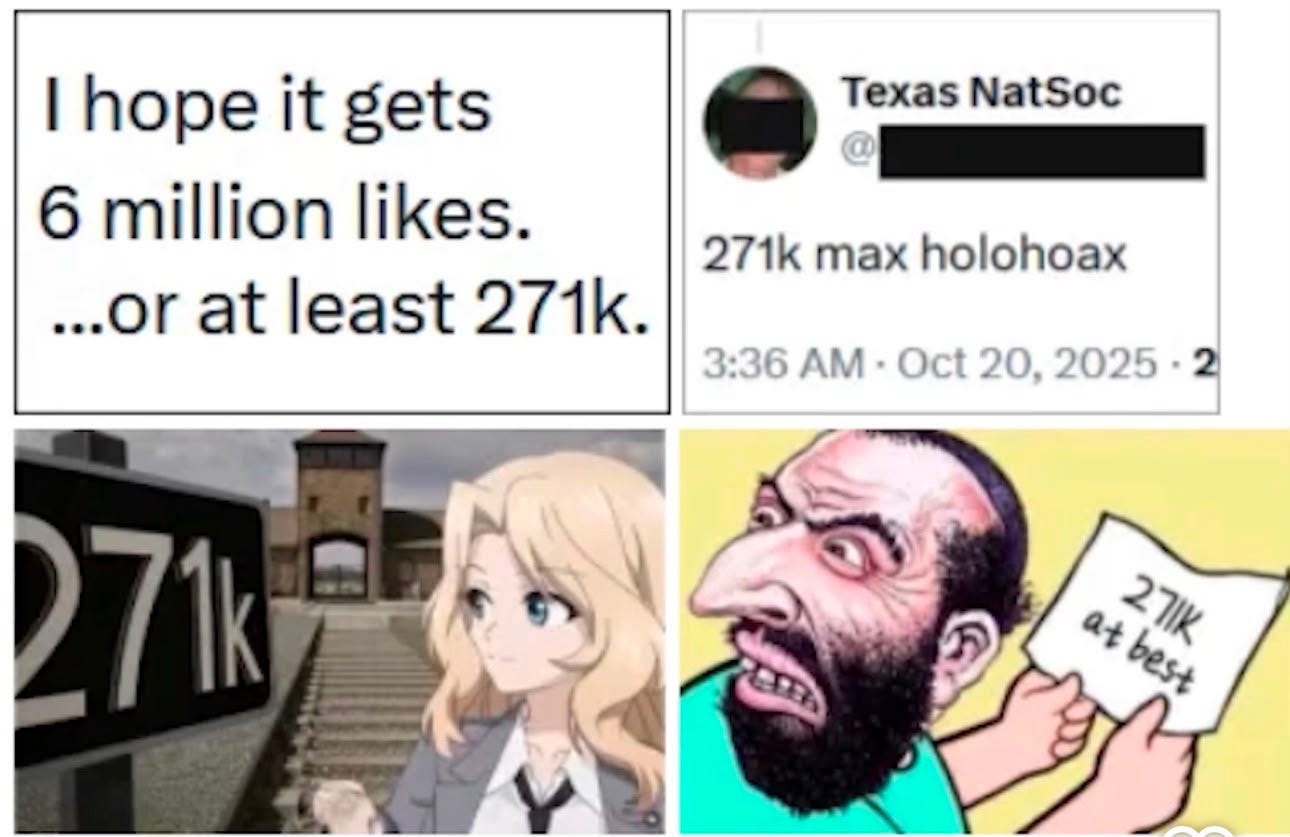
Sometimes it appears just as “271K.” Other times it is accompanied by a cookie emoji, an oven, a glass of juice, or a comment about wooden doors. To most people, these posts look meaningless. But not to those of us familiar with the language of online extremism.
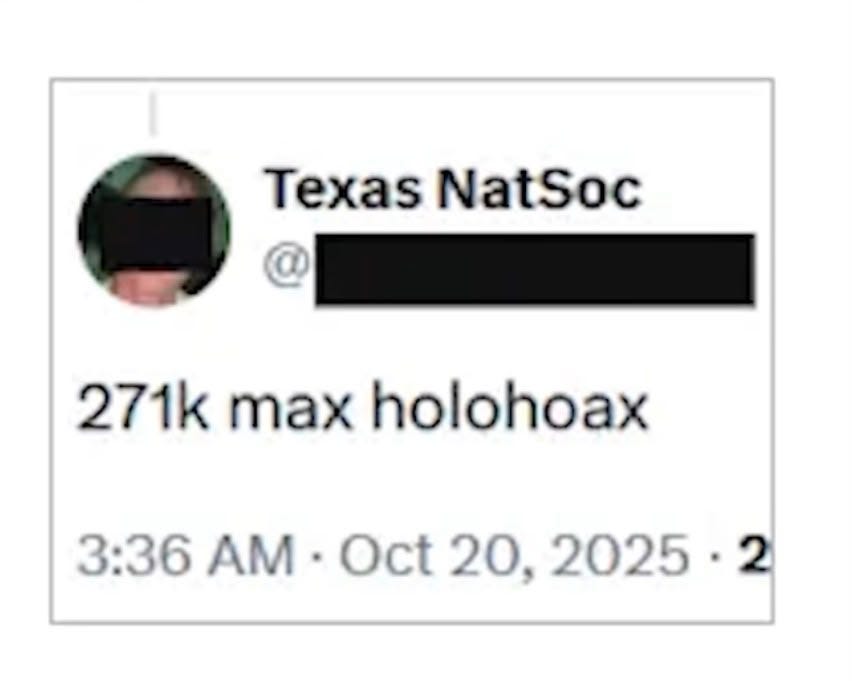
The number is used to claim that only 271,000 Jews were killed during the Holocaust rather than the factually accurate figure of approximately six million. It is not the product of newly discovered evidence or previously sealed archives, but rather an old falsehood repackaged for the age of algorithms, influencers, and short-form video.
Like many successful conspiracy theories, it begins with a real document before stripping away nearly all of its context.
The figure traces back to records held by the Special Registry Office in Bad Arolsen, Germany. Holocaust deniers circulated a document listing death certificates issued for prisoners held in a limited number of concentration camps. Those certificates were created only after relatives applied for them and officials found sufficient documentation to confirm an individual’s death. They were never intended to represent everyone killed during the Holocaust.
The records excluded millions of Jews murdered in extermination camps such as Auschwitz-Birkenau, Treblinka, Sobibor, and Belzec, as well as victims killed in ghettos, during mass shootings across Eastern Europe, and countless others whose deaths were never formally documented or whose records were destroyed.
The Arolsen Archives has repeatedly explained that the document records only a small fraction of those persecuted and murdered by the Nazis. Holocaust deniers nevertheless present it as though Germany—or even the Red Cross—admitted that the accepted death toll was false.
The estimate of approximately six million Jewish victims does not rest on a single document. It is the product of decades of research drawing on Nazi records, deportation lists, demographic studies, eyewitness testimony, physical evidence, and surviving archives. As the United States Holocaust Memorial Museum notes, the Holocaust is among the best-documented genocides in history.
The appeal of “271K” has never been its evidence, but that if you repeat that number enough times, some people will start believing it.
The underlying claim has circulated in extremist circles for decades. What changed around 2024 was its packaging. By reducing a complicated conspiracy theory to a single number, extremists created something that could be posted beneath thousands of videos, instantly recognized by supporters while appearing meaningless to everyone else.
Its rise has coincided with a broader resurgence of open Holocaust denial in parts of the West. Ideas once confined to neo-Nazi publications and obscure internet forums now reach millions through podcasts, livestreams, and short videos.
Dan Bilzerian, for example, told Piers Morgan in 2024 that he would bet his entire net worth that fewer than six million Jews were murdered during the Holocaust. He offered no serious historical evidence, relying instead on vague claims that the mathematics did not add up.
Nick Fuentes has taken a different approach. Rather than denying the Holocaust directly, he tells vague stories about cookies and ovens that invite audiences to draw the conclusion themselves. His followers understand the references and repeat them across memes, comment sections, and short videos.
Neither Bilzerian nor Fuentes invented Holocaust denial. What they provide is reach. They move ideas from the political fringe into ordinary online conversation.
A falsehood shared during a two-hour podcast can quickly become hundreds of short clips circulating across TikTok, Instagram, X, and Telegram, detached from any challenge or correction. By the time it reaches a teenager scrolling through videos, Holocaust denial looks like a joke, a provocative question, or forbidden knowledge that powerful people supposedly do not want discussed.
UNESCO estimates that denial or distortion appears in roughly 16 percent of Holocaust-related content on social media. On public Telegram channels, nearly half of discussions about the Holocaust contain the same forms of misinformation.
That raises another question: why rely on cookies, ovens, and coded numbers instead of simply saying what is meant?
Part of the answer is moderation.
Platforms can identify explicit phrases like “the Holocaust did not happen.” They struggle far more with a cookie emoji, a number, and an inside joke, especially when each symbol has an innocent meaning in other contexts. That ambiguity is precisely the point.
It allows users to communicate antisemitic messages while insisting they were “only joking.” It also draws in curious users. Someone unfamiliar with “271K” may search for it, only to find an online ecosystem filled with manipulated documents, edited videos, and conspiracy theories.
UNESCO-supported research has found that Holocaust deniers deliberately rely on humor, memes, and parody both to evade moderation and to make antisemitic ideas appear entertaining rather than extremist.
The cookie metaphor serves another purpose. It reduces murdered human beings to objects, stripping away their names, families, and lives until genocide becomes little more than a debate over production capacity. Dehumanization is the goal.
The trend emerged in English-speaking extremist communities, but numbers, emojis, and memes travel easily across languages. Podcast clips were subtitled into Arabic. Screenshots spread across X, TikTok, Instagram, and Telegram. Many accounts repeated the joke without ever explaining where it came from.
The war in Gaza created especially fertile ground for this kind of misinformation. Some users began touting Holocaust denial as an act of solidarity with Palestinians. Others repeated the claim because it appeared to challenge Israel or undermine the political use of Holocaust memory. Many almost certainly shared it without understanding its origins.
Research from George Washington University’s Program on Extremism documented a sharp increase in antisemitic Arabic-language content after October 7, 2023, identifying Holocaust denial as one of its recurring themes and warning that social media companies remain poorly equipped to detect coded antisemitism in Arabic.
None of this means criticism of the Israeli government is antisemitic. It is not. Nor does condemning the killing and displacement of Palestinian civilians amount to hatred of Jews.
But Holocaust denial is not criticism of Israel. Mocking Jewish victims does not advance Palestinian rights. Replacing six million murdered people with a fabricated number does nothing to save a single Palestinian life.
If anything, it weakens the Palestinian cause by allowing its critics to portray advocacy for Palestinian rights as a vehicle for antisemitism. It shifts attention away from Palestinians themselves and toward an indefensible historical falsehood.
Countering that misinformation requires more than simply labeling it false. Reliable information has to exist in the languages people actually use.
That is why Ideas Beyond Borders, through our translation program, translated Wikipedia’s article on Holocaust denial into Arabic, Persian, Dari, Kurdish, and Pashto. Those articles have since been viewed more than 100,000 times, giving readers access to reliable information where conspiracy theories often spread unchecked.
Our latest initiative, in partnership with the William Levine Family Institute for Holocaust Education at the United States Holocaust Memorial Museum, goes a step further. Together, we are producing videos for audiences across the Middle East and North Africa that explain not only why claims like “271K” are false, but how they are constructed and why coded language has become such an effective tool for spreading them.
Providing that information matters because a young person searching for “271K” should encounter evidence before they encounter propaganda.
Palestinians do not need the Holocaust to be false for their suffering to be real.
The killing of Palestinian civilians does not become more tragic if Jewish victims are erased from history, just as Palestinian rights are not strengthened by turning six million murdered Jews into cookies, emojis, or internet jokes.
We should be capable of recognizing both the Holocaust and the suffering of Palestinians without treating either as a threat to the other. We can oppose antisemitism, anti-Arab racism, Islamophobia, occupation, collective punishment, and the killing of civilians without abandoning historical truth or embracing antisemitism.
The moment we begin discarding evidence because it is politically inconvenient, we teach the next generation that facts matter only when they support our preferred narrative.
That is a lesson none of us should be willing to pass on.
Middle East Uncovered is powered by Ideas Beyond Borders. The views expressed in Middle East Uncovered are those of the authors and do not necessarily reflect the views of Ideas Beyond Borders.

Well said. Needed very much to be said. Distorting the truth is incredibly counterproductive when it comes to real solutions and better tomorrows. Thank you for this post and i appreciate these initiatives.