


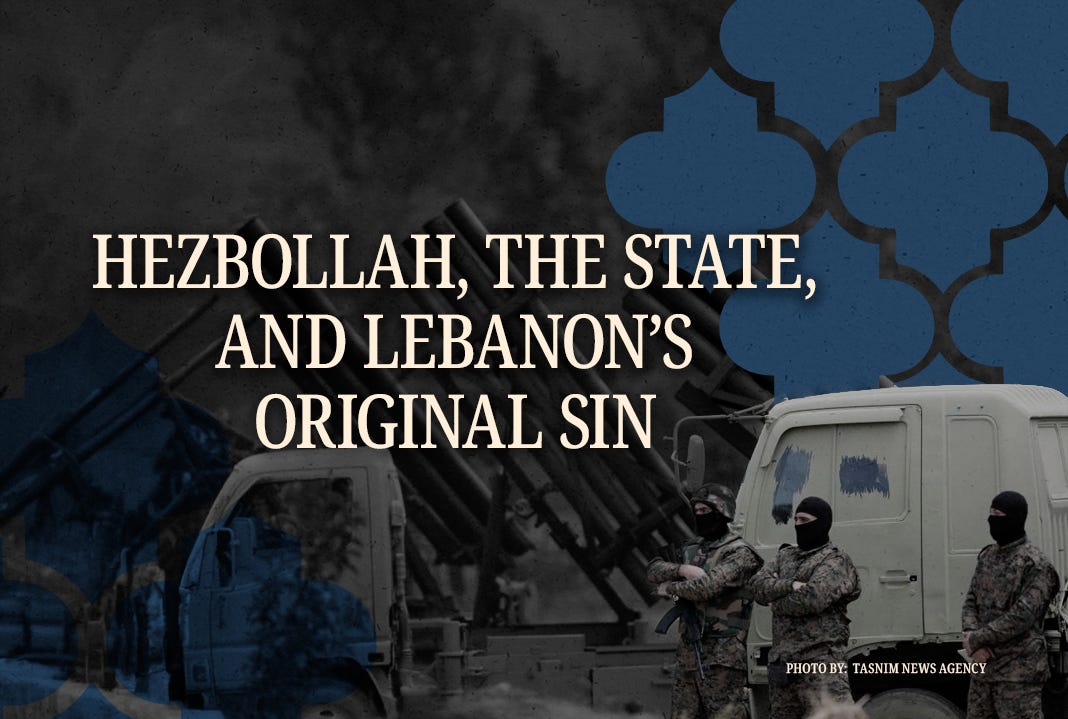
The war now unfolding in Lebanon, as Iran comes under direct attack, has forced a question the country spent decades postponing: what comes after Hezbollah? In recent days, the Lebanese government moved to ban the group’s independent military actions after it launched attacks tied to the Iran conflict—an extraordinary step in a country where the state has often behaved like a tenant living under an armed landlord.
Let’s call the project what it is. I am not neutral on Hezbollah. It is a terrorist organization—an armed apparatus built on violence, intimidation, and a command relationship with Iran’s Revolutionary Guard. It may cloak itself in the language of “resistance,” but its record, structure, and outcomes tell a different story: a militia that captured the state and used Lebanon’s people as its shield.
I like to call what is unfolding the “de-Hezbollahification” of Lebanon—a national hygiene project that dismantles a parallel sovereignty, removes the militia’s grip from institutions and streets, and restores the basic principle that only the state can declare or engage in acts of war. But one condition must be stated plainly before Lebanon repeats its mistakes: de-Hezbollafication cannot be driven by the desire for vengeance against the Shiʿa for supporting Hezbollah’s rise. It must rest on their equal citizenship—otherwise it will recreate the very vacuum that Hezbollah was born to fill.
Hezbollah rose from a long history of neglect. Before the civil war, Lebanon’s political system and economic priorities were structured around a hierarchy that left entire regions underdeveloped. Shiʿa communities in the south and the Beqaa faced some of the country’s worst poverty, the weakest public services, and the greatest exposure to border violence. They were Lebanese on paper but treated as peripheral in practice. Lebanon’s sectarian political system reinforced this pattern by dividing power along religious lines, making it harder for citizens to hold their leaders accountable.
Into that abandonment stepped Imam Musa al-Sadr, a progressive Shiʿite cleric with rare political instincts. He spoke about Shiʿa deprivation not as a sectarian grievance but as a national scandal—arguing that the neglect of Shiʿa communities was not just a problem for one religious group, but evidence that the Lebanese state itself was failing large parts of its population.
In 1974, he helped give marginalized Shiʿa communities a collective voice by co-founding what became the Amal Movement, linked to the “Movement of the Deprived.”
Al-Sadr mattered because he offered a different future to an already desperate community. His message was that the Shiʿa were citizens with rights, not a population meant to passively absorb the consequences of everyone else’s wars.
In 1978, he traveled to Libya with two companions at the invitation of Muammar Gaddafi—and then disappeared. They were last seen in Tripoli and never returned. Many Lebanese Shiʿa believe he was killed by the Gaddafi regime, though the full details are still unresolved.
His disappearance created a political and religious vacuum—the kind of vacuum external powers are quick to exploit.
Armed Palestinian organizations operated from southern Lebanon for years, launching attacks into Israel and drawing Israeli retaliation onto Lebanese villages. The “south” became a strike zone where civilians paid the price for decisions they had no hand in making.
Israel’s 1982 invasion unfolded amid that cycle, and the chaos of civil war created the conditions for a new actor to rise. In the early 1980s, with Iranian support, especially through the Revolutionary Guard, Hezbollah seized the opportunity.
The group built its legitimacy by exploiting the state’s failure and offering an alternative system of security, welfare, enforcement, and discipline. It fought and absorbed rivals, monopolized “resistance,” and turned the border into its exclusive political terrain. Over time, the South learned a terrible lesson: the state cannot protect you, but the militia might. Hezbollah institutionalized that belief and benefited from it.
Here is the part Lebanon likes to say with moral superiority and little self-awareness: “The people supported Hezbollah.”
Yes. Many did. And the support carried responsibility because Hezbollah is not a neutral social service provider. It is an armed organization with a transnational agenda aligned with Iran, and it has a long record of violence and extremism.
But Lebanon cannot pretend that support was chosen from a menu of equal options.
This is the moral root of the trap.
When a community is treated as an afterthought for generations, it begins to internalize that citizenship won’t protect you. So when Hezbollah presented itself as the only force able to defend their villages from the next invasion, many embraced it—even if that protection came with a cost.
That does not absolve the decision to empower a terrorist militia, but it explains why the decision was socially understandable, even though it was nationally catastrophic.
The most unforgivable part is this: The same actors—Lebanese, Arab, and international—who later demanded change tolerated the conditions that made Hezbollah inevitable when change was still possible. By the time they discovered their principles, the Shiʿa were already trapped inside a structure where leaving Hezbollah would be social suicide and put you and your family at risk.
Everyone is responsible. Hezbollah’s supporters are responsible for enabling its ascent. Lebanon’s ruling class is responsible for creating the vacuum. And the far-right political narrative that governs Lebanon’s imagination—treating Muslims, and particularly Shiʿa, as a demographic problem rather than citizens—helped poison the soil long before Hezbollah planted itself in it.
Israel’s withdrawal from southern Lebanon in May 2000 was Hezbollah’s coronation. Hezbollah claimed victory; much of the south idolized the “resistance” as proof that its model worked.
But the state still did not return. Neglect persisted. The south and the Beqaa remained underdeveloped. And Hezbollah—already armed, already organized—grew into a parallel sovereignty that increasingly dictated national decisions.
Over time, Hezbollah treated Shiʿa support as strategic cover. It embedded military infrastructure in civilian environments and wrapped its agenda in the bodies of its own people. It used the community as a human shield for a project that ultimately answered to Iran’s priorities, not Lebanon’s.
And now, in a war where Iran is directly targeted, Hezbollah has been pulled back to its core identity: defending Iran, even at the cost of Lebanon.
Lebanon already has a roadmap for change written into its postwar settlement, the Taif Agreement, which explicitly frames the abolition of political sectarianism as a fundamental national objective.
But Lebanon never implemented the spirit of that text. It implemented the mechanics that preserved the sectarian marketplace.
As long as Lebanon’s political system is based on sectarian quotas, citizens will continue to rely on their sect for protection rather than on the state. The constitution divides parliament equally between Christians and Muslims, and political power is still organized along sectarian lines.
The uncomfortable truth is that some of the biggest obstacles to change are the actors who benefit most from the existing privileges—particularly parties rooted in far-right Christian narratives that treat demographic equality as a threat to their existence.
The Lebanese Forces leadership (a civil war militia turned political party) has publicly questioned or cast doubt on calls to eliminate political sectarianism in the past, challenging the timing and motives. In broader electoral debates, major sectarian parties have repeatedly fought over reforms that could dilute sectarian leverage, including proposals linked to a single constituency and a senate, as discussed in Taif’s logic.
So yes, the same Lebanese Forces that loudly demand Hezbollah disarmament also benefit from the current system. Their anti-Hezbollah posture is often correct on the militia question. But the deeper national cure requires more than opposing an armed Hezbollah.
A truly equal civil state would reduce every sect—including historically privileged sectarian gatekeepers—to equal status. That is not an attack on Christians. It is the only way to build national unity without requiring armed patrons.
Complete De-Hezbollahification requires:
dismantling Hezbollah’s armed capacity and parallel security apparatus;
restoring state monopoly on war decisions and border policy;
integrating social services into accountable state institutions rather than militia patronage;
protecting Shiʿa communities during transition so they are not punished for being born in the wrong place at the wrong time;
abolishing political sectarianism in practice—not only in speeches—by building institutions where the citizen is not filtered through sect.
Without that, Lebanon risks repeating its original sin: creating a vacuum, then watching a new armed “protector” rise from it.
The war has forced the question. Lebanon must answer it.
The Shiʿa made a disastrous political bargain with Hezbollah. They are responsible for the consequences. They are also the product of a state that failed them, a region that exploited them, and a political class that left them with the impression that the only reliable roof was a militia.
Lebanon now faces a choice it has avoided for decades. It can dismantle Hezbollah’s military power while leaving the political system that created the vacuum in which it rose, or it can confront the deeper structures that turned entire communities toward armed protection in the first place.
Hezbollah filled a void created by state failure. If Lebanon removes the militia without finally filling that void with equal citizenship and accountable institutions, history will eventually produce its replacement.
Middle East Uncovered is powered by Ideas Beyond Borders. The views expressed in Middle East Uncovered are those of the authors and do not necessarily reflect the views of Ideas Beyond Borders.

The most important parameter in this war is endurance, please read my article about it inspired by the tale of the Simorgh, a very famous Persian poem by Attar: restack if you like it thanks ! https://mahnazhatami.substack.com/p/the-night-we-must-endure?r=6a6pnp&utm_medium=ios
Lebanon does not currently meet the definition of a fully functioning state since its armed forces do not control all the territory that is supposed to belong to the state and they do not have the capacity to properly defend the state.
So, if you want to get rid of Hezbollah - you have to create a state powerful enough to assert control over it first.
The problem, of course, is that Israel and its western allies will never allow Lebanon to build a military powerful to assert control over Hezbollah bc that would implicitly involve building one powerful enough to protect Lebanon from the IDF.
And therein lies the dilemma. Until you solve this conundrum, Hezbollah will remain a part of Lebanon. I would suggest the Lebanese army start with building air defenses and an Air Force capable of protecting its skies since, in theory, that should not threaten Hezbollah but, again, Israel will never allow that to happen. Which brings us back to square one.
If you want to solve the Hezbollah problem, you’ll need to solve the fanatical Zionists who keep attacking Lebanon problem first.