


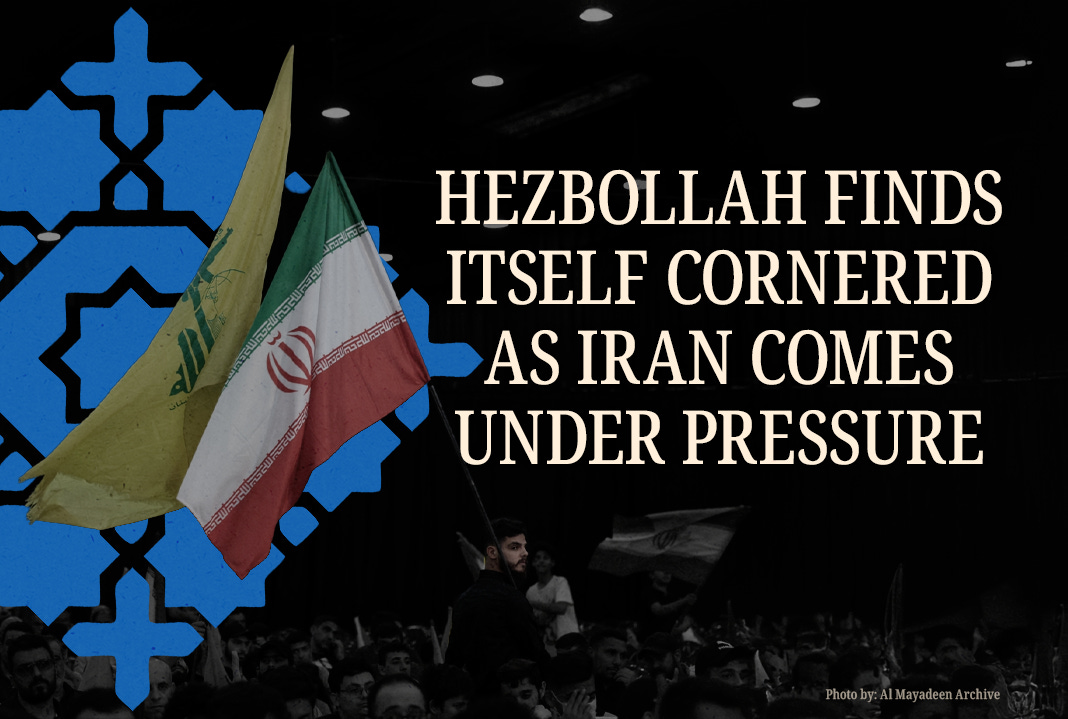
Hezbollah is confronting a deep strategic dilemma. For decades, its cohesion has been anchored in obedience to Tehran and to the broader ideological framework set by the Islamic Republic. But as Iran itself faces mounting geopolitical pressure and setbacks, that source of authority is being strained. The question for Hezbollah now isn’t just how many fighters it can field, but how a movement built on emulation of and loyalty to the Iranian regime adjusts when the patron it has long looked to as its model is grappling with internal and external challenges. The narratives that bind the two are under intense stress.
For decades, Hezbollah’s power rested on a tightly integrated model. Its doctrine provided the why (obedience and religious legitimacy), its weapons provided the how (deterrence and coercive leverage), and politics provided the cover (institutional influence in Lebanon). The arrangement held because it appeared internally consistent: loyalty to Tehran was cast as a source of strength rather than as evidence of its role as a strategic pawn in Tehran’s regional ambitions.
Coherence weakens when the center of gravity becomes unstable. As Iran becomes more directly exposed, Hezbollah’s operating model faces strain. The group is caught between preserving its alignment with Tehran and protecting its own position in Lebanon. This tension is not primarily about resources or battlefield capacity; it is rooted in doctrine—the framework that governs its strategic choices.
Several dynamics explain why Hezbollah now finds itself under structural strain:
1. The doctrine that once unified the movement now limits its flexibility.
Hezbollah’s ideological foundation is Wilayat al-Faqih—the guardianship of the Islamic jurist—operationalized as organizational obedience to Iran’s Supreme Leader. Academic analyses of Hezbollah’s conceptual framework describe this doctrine as a source of legitimacy and internal cohesion because it establishes a non-negotiable hierarchy of authority.
That hierarchy strengthens discipline, but it also constrains adaptation. A movement built on clerical authority cannot pivot as freely as one grounded in electoral accountability or national sovereignty.
Even if Hezbollah were disarmed tomorrow, the structural issue would remain. The doctrine asks Lebanese constituencies to accept a transnational chain of authority as superior to Lebanese political institutions. In a pluralistic society, the relocation of ultimate legitimacy outside the state is inherently destabilizing.
2. If Iran is directly attacked, Hezbollah faces a no-win scenario.
The doctrine creates a decision tree with limited exits.
Hezbollah’s leadership has publicly warned that if Iran is attacked, it would “ignite the region” and has stated the group is “not neutral.” Iranian officials have likewise signaled that an attack on the Supreme Leader would trigger escalation framed in religious terms.
If Hezbollah does not intervene in such a scenario, it undermines the obedience framework it has promoted for decades. A movement built on loyalty to a clerical center cannot remain passive if that center is threatened without damaging its core identity.
If Hezbollah does intervene, it reinforces the argument that it functions as an extension of Iranian power rather than as a Lebanese political actor with external alliances. Intervention would risk severe retaliation and further domestic isolation at a moment when its internal legitimacy is already contested.
Inaction weakens its identity. Action increases the risk of strategic overextension. The doctrine narrows the organization’s survivability options.
3. The Iranian model is harder to market in its current state.
Hezbollah has long presented itself as the Lebanese extension of a successful revolutionary model. Foundational texts frame Iran as the vanguard state that established authentic Islamic governance. That narrative carries weight when the center appears stable and ascendant, but becomes harder to sustain when the center appears pressured, reactive, or strategically exposed.
This creates a messaging dilemma. Downgrading the Iranian model weakens Hezbollah’s ideological coherence. Doubling down ties its legitimacy to a center whose durability is increasingly questioned.
In other words, Hezbollah can’t credibly tell its people, “our project is to replicate the model,” while simultaneously asking them to ignore the evidence that the model itself is under siege. The result is a familiar authoritarian reflex: they stop trying to persuade people and start demanding compliance. When the story loses its power, surveillance and coercion fill the gap.
4. Organizational restructuring suggests consolidation, not expansion.
Recent restructuring within Hezbollah has centralized administrative authority and elevated political and parliamentary figures into more prominent executive roles. The shift emphasizes managerial governance over symbolic revolutionary posture.
You can read this two ways, but both are bleak:
Scarcity management: Administrative consolidation is consistent with managing constraints—rationing resources, protecting patronage networks, and limiting fallout potential.
Contingency planning: If Iran’s ability to project power becomes more conditional, Hezbollah requires a Lebanese political infrastructure capable of absorbing pressure without publicly severing ideological ties.
In either case, the posture is defensive. It reflects perimeter management rather than strategic expansion.
5. Overseas safe havens are becoming less reliable.
Venezuela has not just been a source of funding for Hezbollah. It has also provided a relatively permissive environment where financial networks and logistical arrangements could operate with limited interference. Recent political upheaval there has increased scrutiny of those networks and drawn greater international attention to associated financial activity.
When countries that once offered this kind of operating space become unstable or less permissive, Hezbollah’s room to maneuver shrinks. Activities that could be managed remotely are pushed back to Lebanon, where oversight is tighter, and the political and security risks are higher.
6. The core problem is the ideology, not Hezbollah’s military strength.
Hezbollah’s danger is not only that it is armed or that it is widely designated as a terrorist organization. The greater danger is its doctrinal architecture: a framework that legitimizes external guardianship over national politics and sacralizes a chain of command that cannot be voted out.
This is why Hezbollah’s crisis is eerie. The model upon which it was built is now increasingly looking like the Achilles heel of the once almighty militia. If the obedience center in Tehran is to be militarily targeted in the foreseeable future, Hezbollah’s doctrine will ultimately become its death trap. And the theological rupture it will suffer may be fatal.
Middle East Uncovered is powered by Ideas Beyond Borders. The views expressed in Middle East Uncovered are those of the authors and do not necessarily reflect the views of Ideas Beyond Borders.

Always a breathtaking depth and scope of knowledge in your analysys and I always learn something new.