

He Escaped the War in Yemen. The Bombs Followed Him to Lebanon.
Anas Al Bakri left home hoping to outrun conflict, only to find another war waiting for him on the other side. Across the Middle East, many young people chasing a better future share the same story.

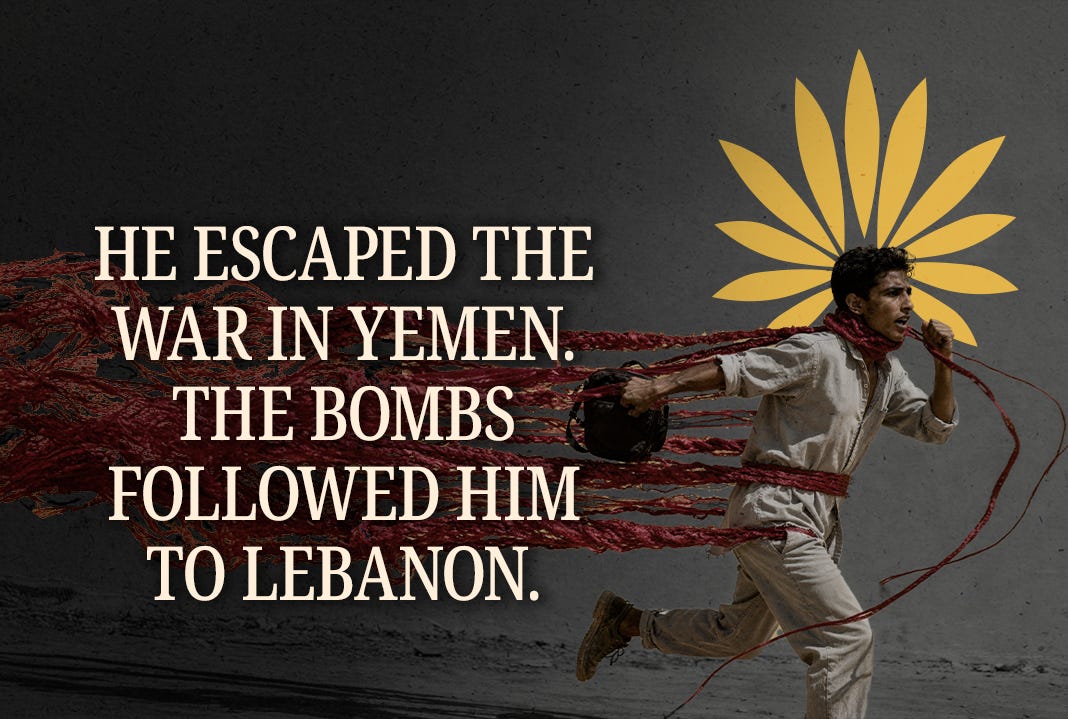
“The first time I was truly scared was in 2015,” recalled Anas Al Bakri, a Yemeni engineer now based in Lebanon. “One of the largest bombs of the war struck the famous Attan mountain in Sana’a. It was summer, and I was 14 years old. The blast was so powerful that it threw me out of bed, and every window in our house shattered.”
Growing up in Sana’a, Al Bakri’s childhood was deeply impacted by war and uncertainty. Normalcy was a foreign concept. For many Yemenis who came of age after the Arab Spring, instability was not an interruption to daily life but its defining condition.
The 2011 uprising that forced President Ali Abdullah Saleh from power after more than three decades in office initially raised hopes for political change. In 2012, his vice president, Abd Rabbuh Mansur Hadi, was elected to lead a two-year transitional period. But those expectations quickly faded. Economic hardship deepened, political reforms stalled, and public frustration mounted. Hadi’s decision to lift fuel subsidies in 2014 sparked widespread protests, accelerating a crisis that culminated in the Houthi takeover of Sana’a and the outbreak of Yemen’s civil war in 2015.
“For foreigners, it is difficult for them to comprehend growing up in Yemen,” Al Bakri said. “I’ve experienced a lot of trauma, and one of my saddest memories was when one of my best friends died as a result of an airstrike in 2019. A facility that was supposedly housing Houthis was bombed next to his home, and his house was completely flattened. He and his grandma both died, but his parents survived. He was like a brother to me.”
Yemen’s civil war resulted from the country’s failed political transition. In 2014, the Houthis, a Shiite militia later designated by the United States as a terrorist organization, capitalized on growing public frustration over economic downturn and stalled reforms. By September, they had seized Sana’a and gradually consolidated control over key state institutions. President Abd Rabbuh Mansur Hadi was placed under house arrest before resigning in January 2015. He later withdrew his resignation and fled to Aden, appealing for regional intervention against the Houthis.
In March 2015, a Saudi-led coalition that included the United Arab Emirates and Egypt launched a military campaign in support of Hadi’s government. Airstrikes became a daily occurrence across Yemen, and what began as a political crisis became one of the world’s most devastating humanitarian catastrophes.
“You’re 30,000 feet in the air, and you launch a missile toward a place where families have lived for generations,” said Al Bakri. “You press a button designed for ease of use, and an entire family disappears. It’s a very sad reality to accept.”
For Yemenis, the war wrought destruction on a staggering scale. According to the United Nations, more than 377,000 people had died as a result of the conflict by 2022. Roughly 60 percent of those deaths were linked to indirect causes such as hunger, disease, contaminated water, and the implosion of healthcare services, while the remainder were a result of armed violence. The humanitarian crisis continues today. As of 2026, the UN estimates that 4.5 million people are internally displaced. Out of more than 22 million people requiring aid, approximately 4.5 million children remain out of school, and nearly 11 million children urgently require humanitarian assistance to survive.
Al Bakri realized quickly that pursuing a future in Yemen was untenable, so he began searching for ways to spend his college years abroad. Luckily, he received two scholarship offers, one in Turkey and another in Lebanon.
“My sister was already in Lebanon, who was pursuing a similar program,” said Al Bakri. “So, I decided to go there because I didn’t know when I might be able to see my sister again if I decided to study in Turkey.”
Al Bakri arrived in Lebanon in April of 2021. His program was scheduled to begin in the fall of 2020, but the Beirut port blast, which devastated a large portion of Beirut’s infrastructure, delayed his travel plans until the following year. The blast was one of a few major events that tormented the state of Lebanon during that year. The Lebanese uprising that broke out in October of 2019 was followed by a gradual collapse of the Lebanese currency and the outbreak of COVID-19 in March 2020, severely straining Lebanon’s economy. Al Baqri became increasingly nervous about his choice, with a nagging feeling that he was about to trade one place of suffering for another.
“I remember that during the first night I landed in April 2021, the streets and buildings in Beirut were blacked out,” Al Bakri said. “There was no electricity, and I started to question whether I was in the right place, as I had just left Yemen where power outages were a norm.”
Nevertheless, Al Bakri began his studies at the Lebanese American University in Byblos, slowly adapting to Lebanese culture and making new friends. According to Al Bakri, he came to forget the sound of planes and fighter jets that had haunted him during his days in Yemen. However, those memories began to resurface when Israeli fighter jets started to roam the skies of Beirut in the wake of the horrific attacks on October 7th, 2023. The chaos and instability Al Bakri had fled from were beginning to catch up with him.
“I loved forgetting the feeling of supersonic sounds of fighter jets before a bomb drops,” Al Bakri said. “But it came back, and I regularly anticipate hearing it again. It will always come back, and you will always be reliving the PTSD. You can’t say that you’re used to it. It’s a painful topic to tackle, and I’d love to forget that feeling like it never existed. But it did exist, and I have to acknowledge that.”
The conflict between Hezbollah and Israel further intensified in early March following the death of Ali Khamenei in a US-Israeli airstrike. More than a million Lebanese were internally displaced as a result, with shelters beginning to overflow, and various schools across Lebanon transforming to meet the demands of displaced families. Many, however, have been forced to sleep in the streets.
Al Bakri ultimately decided he would leave in the coming year. However, he expressed deep love and sorrow for the country that hosted him for the past 5 years.
“My time [in Lebanon] made me fall in love with the country and the resilience of the people.” He said. “They are very similar to Yemenis, where they still love life despite losing their homes, their jobs, or even their loved ones.”
He hopes to start another degree program abroad and continue his work as an engineer, joining many of his friends from Lebanon who have left the country to pursue a better life. He hopes to return and visit when the situation becomes more stable, but it is unclear when either Lebanon or Yemen will offer the stability needed for people to build long-term futures there.
“Maybe we’ll unite Yemen once again,” Al Bakri said. “But for now, it is unfeasible for me to go back home or stay in Lebanon for the long term.”
Al Bakri’s story is far from unique. Across the Middle East, millions of young people have come of age amid war, economic crisis, and political upheaval, forcing them to make difficult decisions about where they can safely live, study, work, and build a future. Leaving is rarely a rejection of home. More often, it is an acknowledgment that opportunity and stability are simply out of reach. As conflicts continue to wreak havoc across the region, many young people like Al Bakri find themselves searching not for a permanent destination, but for a place where they can finally stop running long enough to start building their futures on their own terms.
Middle East Uncovered is powered by Ideas Beyond Borders. The views expressed in Middle East Uncovered are those of the authors and do not necessarily reflect the views of Ideas Beyond Borders.
 | A guest post by
|