


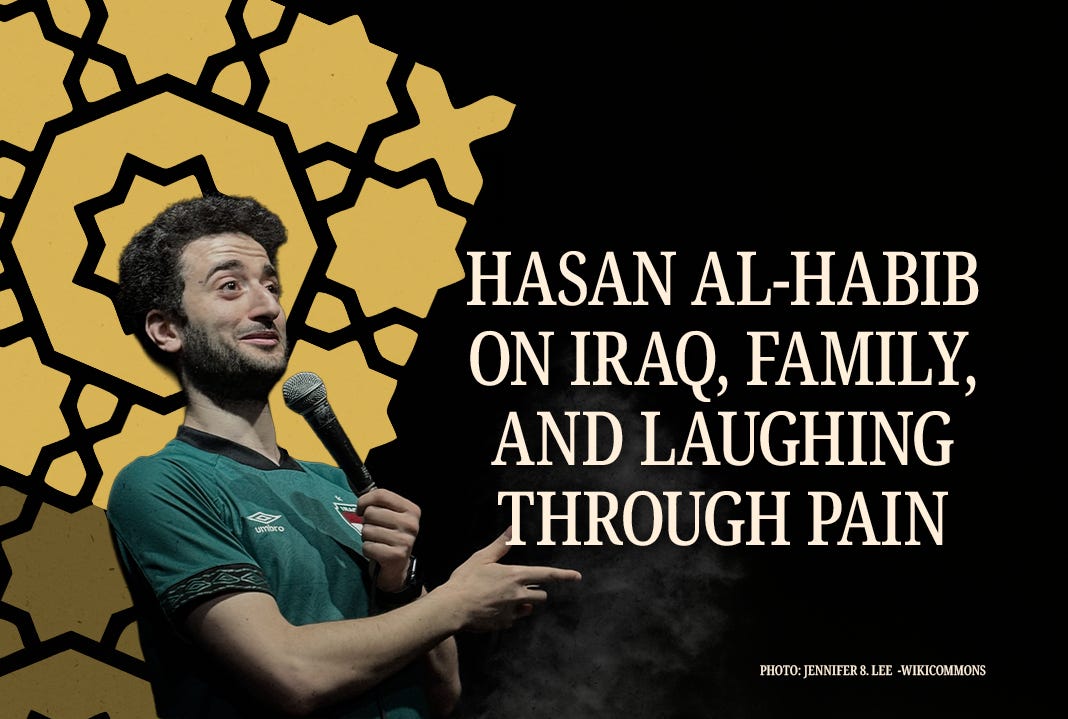
Hasan Al-Habib was supposed to be in Iraq in April. It would have been only his second visit to the country where much of his family history is rooted. But at that point the war was still raging between Iran, Israel, and the United States, drawing in the wider Middle East, including Iraq.
Al-Habib’s plans, naturally, were put on hold.
For the British comedian, the distance between his place of birth and Iraq has been a source of fascination, frustration and, at times, envy. As a child, he watched his South Asian classmates head off to weddings on weekends and wondered what it would be like to have that kind of family life nearby.
“I remember feeling jealous when they would complain, ‘I’ve got a big family, I’ve got to go to a wedding in such a place’, and I thought, ‘I can’t do that because they’re all in Iraq’,” he tells Middle East Uncovered.
Al-Habib is speaking from his hotel room in Edinburgh, where he will be performing his latest show “Stuck in the Middle (East) with You” at the Edinburgh Festival Fringe—the world’s largest performing arts festival—throughout August.
Even in Scotland, Iraq is difficult to escape. Al-Habib is wearing a bright green Iraqi football jersey, and we briefly discuss the national team’s performance at this year’s World Cup.
His connection to the country has always been mediated by family. When he was 16, his grandmother visited the UK. He credits her with the Arabic that he knows.
“My parents would speak to us in Arabic, and I would reply in English. My listening is decent, but my speaking isn’t as good,” he says. “My grandmother came over, and she didn’t speak any English. So all the Arabic I speak is thanks to her.”
Al-Habib was born in London and is the eldest of three children of Iraqi parents. His dad, who had a PhD in engineering, was from Baghdad and his mum, a medical doctor, was from Najaf.
The family moved near Birmingham, in the West Midlands, when he was two.
His first visit to Iraq was in 2016, to bury his uncle Amer in Wadi-us-Salaam, in the holy city of Najaf. For Al-Habib it was more than just a physical journey.
“It was amazing,” he says. “I felt like a part of my soul was unlocked, something I’d never felt while in the UK.”
However, while he enjoyed meeting extended family members, the trip for him also cemented just how British he truly was.
“I realized the UK is home. English is my first language,” he says.
That complicated relationship with family and sense of belonging runs through his comedy, including in his latest show. Al-Habib’s skits are normally self-deprecating, littered with anecdotes about everyday racism or anti-Muslim prejudice. He often jokes about once trying (unsuccessfully) to pass off as white British to fit in.
In his current show, however, he will tackle something considerably more painful—the abuse he says he suffered from his mother.
Their relationship, he says, has always been difficult. For a long time, he “didn’t tell anyone what was happening. One, because I was ashamed, and two, I thought, ‘What are you going to do about it?’” he says.
Living in that environment, “it’s easy to be gaslit,” he continues. “You’re told ‘this is not happening’, and ‘what you did was bad’. I’m a 32-year-old financially independent man. I’m not the kind of person you would think would be a victim.”
Having got out of the situation with his mother only months ago, it’s clearly still raw for Al-Habib. There are longer silences between his words, and fewer smiles and jokes.
Asked for more details about what he experienced, he starts and stops several times before saying, “It’s complicated.”
But in a strange way, discussing the emotional subject in front of countless strangers is cathartic in a way that therapy might not be.
“It feels like the audience is with you. Sometimes that’s enough,” he says.
Al-Habib’s life has been full of trials and tribulations. His parents got divorced when he was still in elementary school.
“I don’t remember them ever being happy,” he admits.
Being the “conduit” between two adults who would refuse to speak to each other also put a lot of pressure on him, even on his own relationships in later life.
“I couldn’t bear the thought of having children with someone and then splitting up. I didn’t want [the children] to go through what I did.”
For a while he lived with his dad. “I have nothing but huge admiration for him,” he says. “We grew up with a single dad. I have a better relationship with him now.”
His difficulties at home were compounded by the bullying he encountered at school. It was just after 9/11, and he was the only Arab in a class full of white children.
“I got into comedy because I realized if I was being funny, if I made people laugh, they couldn’t make fun of me—especially if I made fun of myself first,” he says.
Al-Habib began doing stand-up shows as a university student—he studied biochemistry at Imperial College London and completed a PhD in oncology at Cambridge University.
He laughs as he recalls his first live show in London. “I was terrible! But I got through it, because I was less terrible than everyone else and I was confident,” he says. “I delivered bad jokes terribly.”
He includes Sacha Baron Cohen, John Stewart, and Dave Chappelle among his comedy icons.
Al-Habib realized soon enough that his background could prove to be an advantage in comedy.
“Being Arab and Muslim growing up in Birmingham was rare, and it gave me a different perspective,” he explains. “An audience is more forgiving if you tell a bad joke, but if it’s something they’ve never heard before.”
Since then, Al-Habib’s career has been on an upward trajectory. His sketches have chalked up over 20 million views on social media, and he has appeared on multiple comedy shows on British television and radio.
His solo debut in 2025, “Death To The West (Midlands),” sold out its entire run and received nominations for Best Debut at the Leicester Comedy Festival Awards
It’s not just comedy that plays a huge role in his life. Al-Habib is also a practicing Muslim. Earlier this year he appeared on the new series of “Pilgrimage,” a popular factual show on the BBC, where seven celebrities of different faiths (or none) walk along a religious route.
“The show was fantastic; it was a unique experience. I wish more people could take part,” he says.
The program also gave him the opportunity to visit a synagogue for the first time, alongside fellow participant Ashley Blaker—also a comedian—who was previously an ultra-Orthodox Jew.
Al-Habib was also allowed to pray inside, something he described as a “privilege.”
“I’ve never been to a synagogue before; I’ve always wanted to go,” he says. “It was a unique introduction into Jewish belief. Ashley had different views to the people inside; you get that in every faith. There are big splits in Islam as well, which have caused so many deaths and fights.”
The show also caused him to reflect on his faith while he was a student. Al-Habib recalls the Muslim students who would regularly go out drinking, but a conversation with one of them made him realize that he had judged him without knowing about his inner turmoil.
“You can’t judge people, especially if they’re having deep psychological issues,” he says. “They might drink alcohol, but they might be dedicated in other aspects of their faith.”
Like many successful comedians before him, Hasan Al–Habib has spent much of his career turning difficult experiences into jokes, often making himself the punchline before anyone else can. His latest show at the Edinburgh Fringe takes that instinct into more uncomfortable territory, but the aim remains the same—finding humor in pain.
Middle East Uncovered is powered by Ideas Beyond Borders. The views expressed in Middle East Uncovered are those of the authors and do not necessarily reflect the views of Ideas Beyond Borders.