


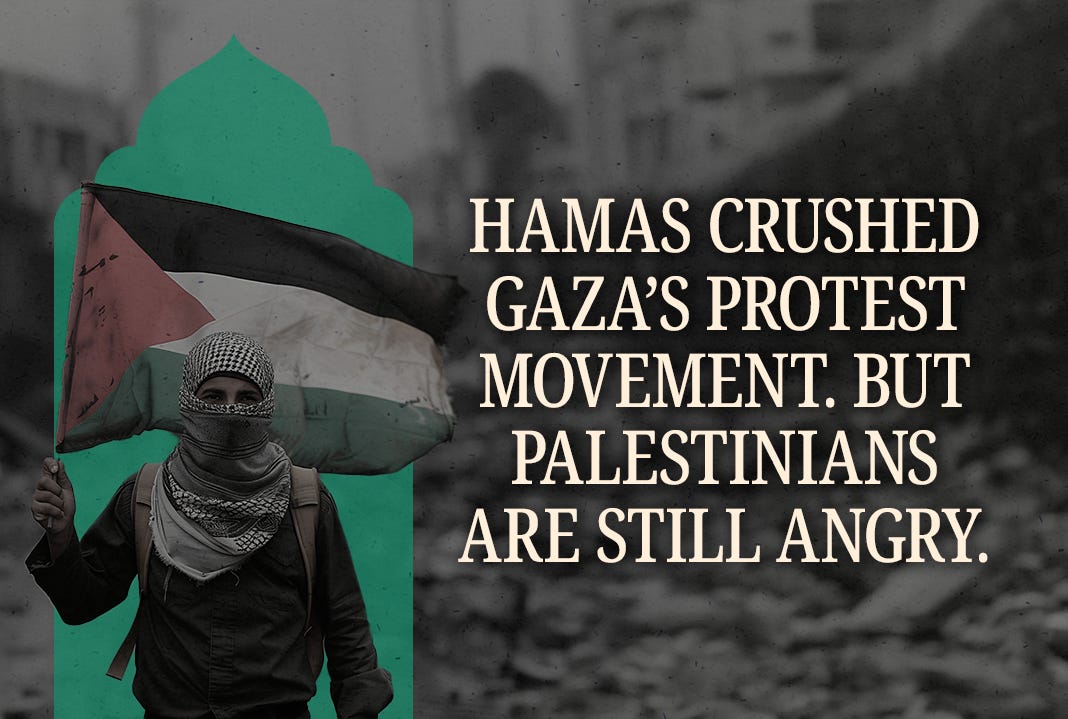
On June 26, Gazans were supposed to take to the streets. The call had circulated for weeks under the banner of the “June 26 Revolution” and was intended to be a day of protest against Hamas’s rule, government corruption, and the devastation of war.
The message was simple: the people of Gaza wanted the right to decide their own future, free from the leadership that had once again dragged them into a devastating war with Israel.
In the end, however, the uprising failed to generate the mass mobilization its organizers had hoped for. Small demonstrations broke out in parts of Gaza, with protesters chanting slogans such as “God willing, Hamas out,” “We are not pawns,” and “We want to live.” But across much of the Strip, there was little or no visible protest.
According to Gazans and outside activists who supported the demonstrations, that silence was the result of fear.
Reports from inside Gaza described masked Hamas operatives deployed near possible gathering points, restrictions on movement around displacement camps, and phones confiscated from many residents. A resident of central Gaza told The Times of Israel that Hamas-affiliated masked men were present in Deir al-Balah to prevent people from assembling. Ynetnews quoted a local source who described the atmosphere as one of “clear pressure,” saying that every attempt at public organization was met immediately by security forces.
Hamas supporters presented the crackdown as a necessary effort to maintain public order and prevent chaos. But effectively, this amounts to crushing dissent.
Kareem Jouda, a Palestinian peace advocate from Gaza whom I interviewed earlier this year for The Dispatch, told me that Hamas’s suppression of the June 26 protests was a coordinated effort to stop the movement before it could gather momentum.
“The intimidation campaign was a two-pronged strategy,” Jouda told me. “It was executed both online and on the ground.”
On the ground, he said, Hamas relied on direct threats and pressure on the families of activists. Online, the movement was smeared as suspicious, foreign-backed, or part of an Israeli effort to weaken Gaza from within.
This accusation is one of Hamas’s most effective tools. Hamas does not need to prove that a dissident is a “collaborator.” It only needs to be frightening enough that others think twice before joining him.
In Gaza, to be accused of collaboration is a way of painting political dissenters as treasonous. This creates an immediate risk of violence.
Jouda argues that Hamas has long weaponized the fear of “external exploitation” and “civil war” to discredit any grassroots movement that challenges its rule.
“This fear is largely a manufactured narrative pushed by Hamas itself,” he said. “They consistently weaponize the threat of external exploitation or civil war to delegitimize any popular movement and cast doubt on the loyalty of the protesters.”
The June 26 movement was especially vulnerable to these tactics because some of its most visible supporters were outside Gaza. Several organizers and amplifiers had left the strip during the war or in previous years. This included activists who had previously clashed with Hamas or participated in anti-Hamas movements. Hamas-linked voices argued that those abroad had no right to speak for people who had suffered bombardment, displacement, and hunger inside Gaza.
But that argument also obscures the fact that not everyone inside Gaza can safely say what they think.
Jouda says the information environment itself is part of the repression. “There is no real, independent journalism inside Gaza,” he said. Journalists operate under severe pressure, he argued, and cannot freely report the reality on the ground without risking consequences.
That claim was echoed in reporting around the June 26 protests. Gaza-based journalists were reportedly warned not to cover the planned demonstrations. Major outlets did not prominently feature the scattered anti-Hamas protests; some instead highlighted empty intersections and declared the “failure” of the June 26 Revolution.
But the grievances driving the June 26 movement have not disappeared. Gazans are exhausted by war, Israeli military devastation, living in tents, corruption, the collapse of basic services, and Hamas’s determination to hold onto power regardless of the cost to ordinary people.
“The people are desperate to protest and make their voices heard,” Jouda said. Their outrage, he argued, is driven by all of it at once: the catastrophic reality of the war, Hamas’s insistence on holding onto power, the gambling with civilian lives, and rampant corruption inside the strip.
Even small protests are a significant step forward. Inside Gaza, to step into the street is to risk being filmed, identified, accused, beaten, detained, or having one’s family pressured afterward.
Jouda believes the intimidation might be working, but he also believes there has been a shift.
“There is naturally a degree of fear that creates a gap between private and public speech,” he said. “But the reality today is that the threshold of fear has shifted.”
The anger, he said, has grown too overwhelming to remain fully private. People are expressing fury and resentment toward Hamas more openly than before—in conversations, online, and sometimes in the streets.
The June 26 protests may have been quashed this time. They may have been smaller than organizers hoped. Hamas may have succeeded, for now, in preventing a broader eruption. But a crushed protest does not mean the end of the struggle against Hamas is forever defeated.
The more interesting question is whether this anger can become a sustained political movement.
Gaza has seen protest waves before. In 2019, the “We Want to Live” movement challenged Hamas over economic misery and repression. In March 2025, rare public demonstrations again broke out, with some Gazans chanting against Hamas and demanding an end to war.
Jouda believes the next movement will have to be broader and more coordinated if it is to survive.
“For a future movement to succeed and endure, it requires absolute, unified coordination among all segments and structures of Gazan society simultaneously,” he said.
The message, in his view, must be firm: “Hamas—or whatever remains of it—must leave.”
This asserts a basic principle Hamas has spent years denying: that the people of Gaza are not the property of the armed faction that rules them.
The June 26 movement showed that beneath the surface of fear there is a genuine, growing hunger for another future. Hamas still has enough force to intimidate people, but not enough legitimacy to force them to love their rulers. The current silence should not be mistaken for consent.
Middle East Uncovered is powered by Ideas Beyond Borders. The views expressed in Middle East Uncovered are those of the authors and do not necessarily reflect the views of Ideas Beyond Borders.

I’m glad my fellow Palestinians are waking up!
The Palestinian Impasse
—WHAT IS TO BE DONE?
https://substack.com/@aaronruby/note/p-201924781?r=7jhui4
The Palestinian people and their struggle stand before the abyss.
Only a complete political reorientation can restore the initiative needed to break the impasse and avert catastrophe.
……
No one can presume to dictate a course to the Palestinians; only they can determine the objective, strategy and tactics of their own struggle.
But Marxists are neither spectators nor commentators regarding Palestinian struggles. The working class is international and its struggle is one. Socialists take responsibility for seeking to liberate all our class from capitalism and stand in solidarity with all the oppressed. We are not bystanders.
Today, it would be difficult to imagine a greater betrayal of the Palestinians than to remain silent as they are destroyed by Israel and by the bankruptcy of their own leaderships, or to exhort further futile and counterproductive sacrifices.
The catastrophic October 7, 2023 attack and the horrific genocide since have reduced millions of Palestinians to helpless victims on an unprecedented scale, inexorably ground down by the overwhelming military might of the Zionist state, coupled with political disorientation.
Two million are trapped in the absolute hell of daily military attacks by Israel and the ever-worsening inhuman conditions in the Gaza concentration camp, reduced to disorganized individuals and families struggling simply to survive.
In the West Bank, over three million Palestinians live under a brutal military dictatorship and are being progressively dispossessed and driven from their lands at a rate unseen in decades.
It is clear that Israel intends to make life unlivable for the more than five million Palestinians in the occupied territories in order to drive them into exile.
A Second Nakba is underway.
Yet not a single Palestinian organization offers a viable perspective, program, or strategy capable of confronting this historic disaster. All they offer is the repetition of perspectives and strategies that have already failed. They are politically bankrupt.
The most alarming fact is not merely the scale of the catastrophe, but the near-total absence of Palestinian political initiative.
Following the First Intifada—initially propelled by the Palestinian masses themselves rather than any established leadership—and especially since October 7, the Palestinian masses have increasingly ceased to act as an independent political force capable of shaping events. Instead they have been reduced to reacting to the initiatives of others: the Israeli state, the settler movement, the Arab regimes, imperialist powers, international institutions, and their own bankrupt leaderships.
Some might call October 7 an initiative. If so, it has served Israel beyond measure and been a catastrophe for the Palestinians.
In both politics and war, the side that permanently loses the initiative is ultimately defeated. A people cannot liberate themselves if they are unable to influence the course of events and compel their adversaries to respond to their initiatives and actions rather than merely reacting to those of their opponents.
It is not merely a question of what they are against, what they resist, but what they are for, what they seek to achieve. That must begin with the present reality.
If the annihilation of the Palestinians is to be avoided, a complete reorientation is required.
Mere denunciations of the endless cruel crimes of the Israeli regime offer no way forward and have become a futile diversion from developing the necessary new perspective. To continue repeating failed strategies while expecting different results is a recipe for further defeats and catastrophe.
The heroism and valor of the Palestinian people are undeniable. For generations they have sacrificed beyond measure, enduring horrific brutality and slaughter at the hands of the Israeli state, and held their heads high against impossible odds. They have carried the hopes of hundreds of millions for a more just world. If their sacrifices are not to be in vain then a strategy must be developed towards realizing their desire for freedom.