

From an Ally to the Great Satan
Long before chants of “Death to America,” Iranians saw the United States as a trusted outsider—until the relationship gave way to suspicion and, eventually, open hostility.

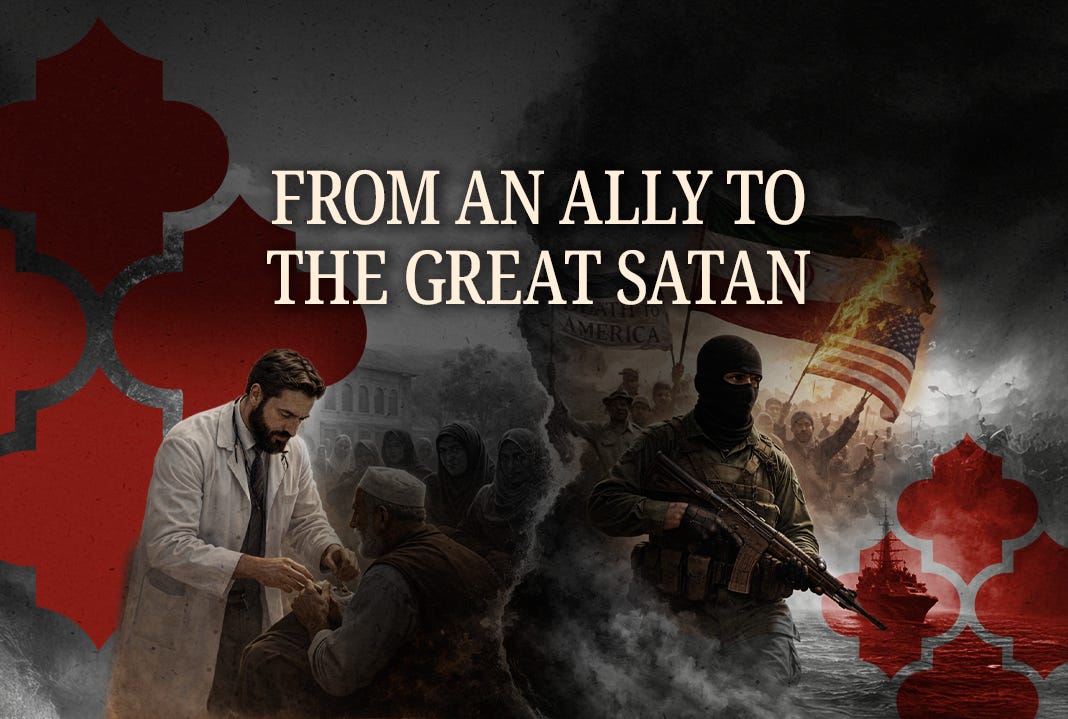
Today, the United States is known in Iran by one of the most famous and colorful political insults in modern history: the “Great Satan.” It is easy to assume that this hostility reflects something ancient or inevitable, that Americans and Iranians were always destined to view each other with suspicion. But history tells a far stranger story.
For much of the nineteenth and early twentieth centuries, Iran did not see America as an imperial threat at all. Many Iranians saw the United States as the opposite.
Historian John Ghazvinian notes that when Americans first appeared in Iran in the nineteenth century, they did not arrive as soldiers or colonial administrators. They came as missionaries, doctors, and teachers. They built schools and hospitals, not military bases. In the city of Urmia, American missionaries opened some of the first modern schools in the region and introduced Western medical training. One physician, Dr. Joseph Cochran, helped establish what became one of the first modern medical schools in Iran. Patients traveled from distant villages to seek treatment. At a time when foreign powers were often seen as domineering outsiders, many Iranians instead encountered Americans as surgeons, nurses, and teachers.
These early encounters mattered.
For villagers arriving after days of travel to reach an American clinic, the United States was simply the place where the doctors came from.
Some Americans became deeply woven into Iranian political life. The Presbyterian missionary Howard Baskerville became something of a legend during Iran’s Persian Constitutional Revolution in 1909. Baskerville was teaching at an American mission school in Tabriz when fighting broke out between constitutionalists and royalist forces. Against his superiors’ wishes, he left the safety of the mission and joined the constitutionalist fighters. He was killed by a sniper at the age of twenty-four.
Thousands attended his funeral. One Iranian mourner reportedly said, “He gave his life for us though he was not one of us.” More than a century later, Baskerville’s grave in Tabriz is still visited by Iranians who remember him as someone who died defending their parliament.
Baskerville was just one of many cases showcasing America as the friendly outsider. In 1911, Iran hired an American financial administrator, Morgan Shuster, to reform the country’s chaotic finances. Shuster attempted to build a modern tax system and challenge the privileges of powerful elites and foreign interests.
His efforts angered Russia, which issued an ultimatum: remove Shuster from his position, agree to seek Russian and British approval before hiring foreign nationals in the future, and pay an indemnity for the costs of deploying Russian troops from the Caucasus.
The Iranian parliament cracked under pressure, and crowds gathered in Tehran shouting in support of the American adviser who had done his best to defend Iran’s sovereignty.
These stories explain why many Iranian reformers once viewed the United States differently from other foreign powers. As Ghazvinian writes, America appeared to them as “a disinterested outsider,” a country that seemed free from the imperial ambitions that defined European involvement in the region.
Iranian intellectuals followed American politics with fascination. Newspapers wrote admiringly about the American constitutional system. Some reformers believed the United States was proof that a powerful modern state need not become an empire.
Iranian students soon began traveling to American universities. Some returned home describing New York and Chicago with amazement, writing letters about electric lights, modern industry, and universities filled with students from across the world.
For a brief moment in history, America was not the Great Satan. It was the foreign country that many Iranians trusted the most.
But that perception did not last long.
Over the course of the twentieth century, the relationship gradually changed, with admiration slowly giving way to suspicion. Strategic interests, regional politics, revolutions, and ideological battles reshaped how the two countries viewed each other.
By the time of the Islamic Revolution in 1979, the image of the United States in Iran had transformed dramatically. Anti-American rhetoric became one of the defining slogans of the new Islamic Republic. The chant “Death to America” echoed through the streets and soon became an integral part of the political language of the state.
In the United States, the embassy hostage crisis seared the image of Iran as an enemy deep into the American political imagination. For many Americans, the future story of U.S.–Iran relations effectively began at that moment.
Over time, both societies forgot the earlier chapters. Americans came to see Iran through the lens of revolutionary slogans, hostage crises, and regional confrontation. Iranians were taught a narrative of foreign interference and humiliation.
By the late twentieth century, the relationship had shifted from curiosity to direct confrontation.
Historian David Crist describes the modern phase of this relationship very differently from Ghazvinian’s early story. In The Twilight War, Crist writes that the United States and Iran fought a long “shadow war” across the Persian Gulf.
American sailors stationed in the Gulf during the 1980s lived with the constant possibility of confrontation with Iranian Revolutionary Guard boats. Small speedboats packed with rockets and machine guns could suddenly appear on the horizon. Encounters at sea were tense and unpredictable. Sailors knew that any confrontation could escalate within minutes.
The same Iran that chants against America once mourned an American who died defending its freedom. The same United States that now treats Iran as a permanent adversary was once admired by Iranian reformers who studied its institutions and imagined a similar future for their own country.
Two histories sit side by side. In one, America is a distant country associated with schools, hospitals, and a young teacher buried far from home. In the other, it is a rival power, representing warships, sanctions, and regional conflict.
Both are real. Both are part of the same relationship.
Each side remembers its own grievances more clearly than the other’s intentions.
And yet the earlier history does not disappear. It sits in the background, largely forgotten, but still there.
A century ago, Iranians gathered to honor an American who died for their parliament. Decades later, Americans watched images of their fellow citizens held hostage in Tehran. Each moment shaped how the other side would be understood for generations.
Neither tells the whole story on its own.
The relationship between the United States and Iran was not always defined by confrontation. It does not have to remain that way forever.
Middle East Uncovered is powered by Ideas Beyond Borders. The views expressed in Middle East Uncovered are those of the authors and do not necessarily reflect the views of Ideas Beyond Borders.
Excellent and deep story, thank you. I may add my private perspective. During my trip to Iran in 2019, I spoke a lot to people about pretty much everything - history, religion, politics. I was very surprised how open, thoughtful and educated they were. What also surprised me was how little hatred I felt towards America and Israel. Compared to other Middle East states I went (mostly Muslim), the Iranian society felt far more advanced and less radicalized. I felt pretty much like in Europe, where you can talk to people about pretty much anything. I personally feel that the Iran-Israel-US hostility is a bit of an artificial, politically-steered thing. I did not feel it at all among people. Here's more.
https://substack.com/home/post/p-191117219
This is an amazing article. It reminds me of how as an American visiting Vietnam in 2018, I was embraced (literally) by an elderly former North Vietnamese decorated soldier, who had survived napalm attacks. He and his wife now lived in a narrow room in Red Cross retirement housing. His pressed army jacket with its decorations was hung proudly on one wall of the room. But there was also a small table with a glass cover and under the glass was a photo of an American doctor, who had treated him and befriended him and his family after the war. The doctor was one of the many American private individuals and and organizations who came to Vietnam after the war ended to provide medical and other services, help individuals and help rebuild the country.