


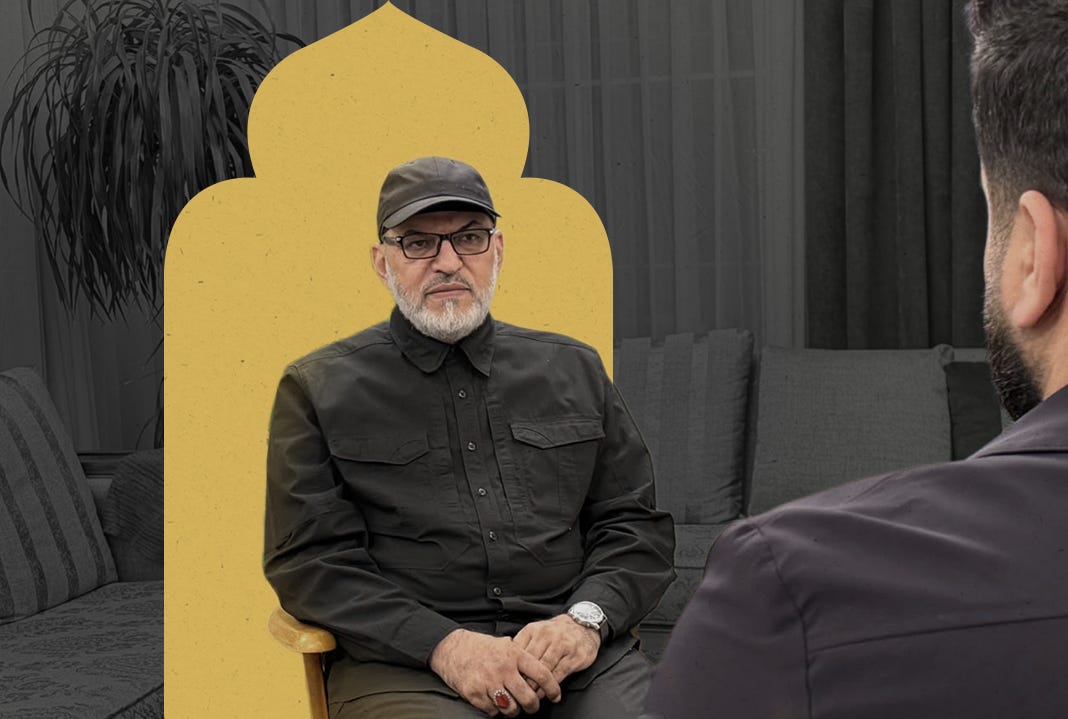
This interview was conducted by Iraqi journalist Muhi al-Ansari and is published by Middle East Uncovered as independent journalism in the public interest. Its publication does not constitute endorsement of Abu Alaa al-Walai, Kata’ib Sayyid al-Shuhada, or their views or actions.
Middle East Uncovered: What role does Kata’ib Sayyid al-Shuhada perform that the Iraqi state cannot fulfill?
Abu Alaa al-Walai: Our current role is one of jihad, aimed at doing all possible good for Iraq and making sacrifices for its sake. We regard the American and Turkish presence as an occupation, in contrast to the position adopted by the government. This approach extends from our struggle against the former regime, when we went to the gallows in defense of our religion, sect, and homeland, to the present stage, in which occupation is not limited to the military sphere but also encompasses political occupation, control over Iraqi decision-making, and interference in domestic affairs, investment, and the economy.
Middle East Uncovered: Do you believe you have the support of the Iraqi public? What evidence would you point to?
Abu Alaa al-Walai: Yes, we enjoy substantial support and backing among the Iraqi public, with a broad support base among certain segments of society and within the political and social spheres.
Middle East Uncovered: Who better represents the Iraqi public: your movement or the Sadrist movement?
Abu Alaa al-Walai: All parts of the political landscape deserve respect. The Sadrist movement is a large popular movement whose role, influence, and supporters cannot be denied or overlooked. The factions have a prominent role in protecting the political system and fighting terrorism, just as the Sadrist movement played a crucial, pivotal role in the events of 2006.
Middle East Uncovered: Hadi al-Amiri described the October 2019 protest movement—known as Tishreen—as “fitna,” or strife. How would you describe it?
Abu Alaa al-Walai: As for the Tishreen Revolution, Hajj al-Amiri’s remarks were misunderstood. He may have expressed himself poorly, or his speech may have been drafted imprecisely. He believed that some individuals had behaved improperly within the revolution, which changed much of the Iraqi reality and corrected its course. In our view, Tishreen comprises poor people in need of services, degree holders, and members of the Popular Mobilization Forces, alongside political forces that have withdrawn and ideologically driven individuals. There is genuine fear within the Coordination Framework that it could recur, despite the lack of political success of its representatives. We also affirm our pride in belonging to this revolution.
Middle East Uncovered: How do you assess the Iraqi government’s performance?
Abu Alaa al-Walai: As for assessing the current government, judging its performance in both service delivery and institutional affairs seems difficult and unfair, given that it is operating with only half a cabinet, in addition to the circumstances of the war, the Strait of Hormuz crisis, the unsettled regional situation, and the economic crisis. Nevertheless, it deserves credit for successfully averting intra-Shia fighting, protecting Iraq from international isolation.
We consider the judiciary an important pillar of the state and of Shiite governance. It has also contributed significantly to preserving the current political system. Nor do we forget its major role in combating terrorism and corruption.
Middle East Uncovered: In your view, has the experience of Shia-led governing coalitions—from the United Iraqi Alliance to the Coordination Framework—been successful? If not, what needs to change?
Abu Alaa al-Walai: The political forces and parties have evolved in stages, from the Shiite Alliance to the Coordination Framework, which has demonstrated success over six years in forming governments quickly and navigating pivotal periods. Its future survival is nevertheless in doubt because representation within the Framework is determined by the number of parliamentary seats held.
Middle East Uncovered: The Iraqi prime minister has repeatedly said that your weapons must be handed over to the state and that those who refuse are operating outside the law. How do you respond? By that definition, would you consider yourselves outside the law? Are you prepared to disarm, and what conditions would you set for handing over your weapons to the Iraqi state?
Abu Alaa al-Walai: We have complied with the decisions of the Quadripartite Committee and the provisions of the Sovereignty Document, conditional on the other party’s compliance.
Editor’s Note: The Coordination Framework formed the Quadripartite Committee by decision after signing the “Sovereignty Document.” It includes representatives of the Iraqi government, the Popular Mobilization Commission, the Coordination Framework, and the armed factions that signed the document. It follows up on implementing the document’s provisions and acts as an arbitration body that the four parties turn to over any breach of the agreed rules of engagement.
The Sovereignty Document is an internal Iraqi agreement between the government, four armed factions, and the Coordination Framework. It aims to regulate faction weapons and restrict them to the state, affirm the state’s exclusive authority over decisions of war and peace, and commit to de-escalation and institutional procedures. It includes commitments tied to specific timelines and arbitration mechanisms through a quadripartite committee to examine any violations.
Middle East Uncovered: Do you believe in Iraqi patriotism? In your view, is an Iraqi official’s allegiance to Iran’s leadership on religious grounds compatible with loyalty to Iraq?
Abu Alaa al-Walai: We believe in patriotism and in a relationship grounded in religious legitimacy that does not conflict with it, as well as in supporting the supreme religious authority in holy Najaf. One example is the defense of the shrine of Sayyida Zaynab. We see no contradiction between patriotism and religious legitimacy, and our belief in borders is a secondary matter.
Middle East Uncovered: How would you describe your relationship with Iran? Is it one of complete subordination, religious allegiance, financial support, or something else?
Abu Alaa al-Walai: Our relationship with Iran is historical, religious, and sectarian. We see Iran as a neighbor and a friend. It provided support in every form during the war against ISIS, from logistical support, training, and weapons to the participation of Iranian personnel. This is a deeply rooted relationship based on religion and neighborly ties that cannot be severed. Our blood has mingled on the same battlefields and in the same trench in the fight against the enemies of our homeland, religion, and sect. Our most recent martyr was also alongside Sayyid Hassan Nasrallah’s escort; they were assassinated by Israeli aircraft immediately after leaving Iraq for Iran.
Middle East Uncovered: If Iran came under attack, would you consider yourselves obliged to intervene militarily?
Abu Alaa al-Walai: Our approach to regional conflicts is to participate in defense of the Shiite community’s existence as a whole. If Iran faces a genuine threat to its existence, we will certainly participate in that battle. If the threat is not existential, however, we will not participate, as we demonstrated during the recent war against Iran.
Middle East Uncovered: How would you describe the role of the American embassy in Iraq?
Abu Alaa al-Walai: With regard to the United States, we consider the American embassy a source of evil that blatantly interferes in Iraqi political decision-making and exerts pressure on political forces. It lacks popular acceptance, despite the welcome it received when the Americans entered at the outset of regime change. American forces have been defeated militarily in Iraq as a result of major operations and are no longer able to protect themselves.
Middle East Uncovered: Do you believe that armed factions aligned with Iran, such as yours, could ever have a normal relationship with the United States? What would it take?
Abu Alaa al-Walai: Relations with the United States will never be normal as long as it is regarded as the “Great Satan” and continues policies that harm Iraq. There is also a clear message to Kurdish and Sunni parties: America will abandon them, just as it abandoned the SDF, Afghanistan, and others.
Middle East Uncovered: What is your view of the American withdrawal from Iraq? Do you see it as a goodwill gesture toward your factions?
Abu Alaa al-Walai: We believe the American withdrawal is intended to create a vacuum, destabilize Iraq’s security, and drag us into infighting and instability. We believe that the Americans did not withdraw but were defeated in Iraq. As evidence, during the forty-day war they acknowledged that resistance factions had carried out 600 military operations against them and their bases. We say the number is much higher, perhaps twice as high. We point to Masoud Barzani’s statement that the Kurdistan Region had been subjected to more than 1,000 operations. Nor should we forget our operations against American bases in neighboring countries: Syria, Jordan, and Kuwait. Our operations pursued them even beyond their bases, following them to hotels and homes after they left those bases.
Middle East Uncovered: Do you see Syria as a potential adversary? In assessing Ahmed al-Sharaa, do you give more weight to his past or to his conduct today? Do you believe his transformation is genuine?
Abu Alaa al-Walai: It is important to point out that Syrians are not adversaries of Iraqis or of Iraq. We hope Syria remains a unified state and is not subjected to territorial or sectarian partition, because dealing with a stable state with clearly defined institutions remains better for Iraq than dealing with multiple groups, whatever their orientations or ideological foundations.
We also reject any renewed Shiite–Sunni fighting because of the tragedies it caused in the past, and we emphasize our refusal to become involved in Syria again. Syrian Islamist groups must also be approached with caution, and their ability to make a rapid democratic transition overnight must be questioned in light of their past conduct. We prefer to deal with a unified Syrian state as a better guarantee for Iraq.
As Islamists, we believe in judging by outward conduct, and we believe that a person can change and move from one condition to another. With regard to Ahmed al-Sharaa, moving from a long experience in armed Islamist movements to running a state and its institutions is a process that, by its very nature, requires time and accumulated experience in political and institutional practice.
The Iraqi experience is one example. Even after more than twenty years, it still faces challenges in consolidating democratic practice and building institutions. Such transformations do not happen quickly; they require time and gradual changes in approach, ideas, and practice.
From this perspective, we believe it is still too early to judge al-Sharaa’s experience. The next few years, including how issues involving the Alawites, the Druze, and the Syrian Democratic Forces (SDF) are handled, as well as the building of state institutions, will provide an important indication of the nature of this transformation.
Middle East Uncovered: Are you concerned that Iraq is gradually alienating the Arab world, particularly following repeated attacks attributed to armed factions against Arab countries? Given that Iraq is a majority-Arab country, what could it possibly gain from losing the trust of its Arab neighbors?
Abu Alaa al-Walai: In regional and international relations, building trust with neighbors takes a long time, particularly with those who were involved in sending suicide bombers or allowing bases to be used to bomb Iraq. The government must use its official relations to build solid, strong partnerships.
Middle East Uncovered: What concrete steps would you be willing to take to build a genuine relationship of trust with Arab countries?
Abu Alaa al-Walai: Building trust takes time, whereas destroying it happens quickly. We urge the government to continue building trust with Iraq’s neighbors and establishing solid, clearly defined relations based on mutual interests, reciprocal support for one another’s positions, and respect. We support the government’s efforts in this direction. As a faction, we have no intention of building relations outside the framework of the state.
On the U.S. Reward
Al-Walai also addressed the U.S. reward offered for information about him:
“As for my being wanted by the Americans, with a large reward offered for me, this has not curtailed my activities or movements. Nor has it diminished my role in bringing opposing views closer together, defusing crises at times, and preventing conflicts and disputes from escalating, particularly between the government and certain factions.
“Recently, we have worked hard to bridge differences and reach a final agreement acceptable to all parties, putting the interests of the homeland and the people above all other interests.”
On Factions Holding Government Positions
Al-Walai also criticized U.S. efforts to prevent certain Iraqi factions from holding executive positions:
“The Americans are playing a negative role by preventing certain factions with parliamentary representation from taking executive positions in the government. The members of parliament belonging to those factions entered parliament through their voters’ ballots and the ballot box, not by using weapons.
“We reject this interference, which infringes on Iraq’s sovereignty and the independence of its decision-making.”
Who is Abu Alaa al-Walai?
Hashim Finyan Rahim al-Sarraji, known as Abu Alaa al-Walai, is the secretary-general of Kata’ib Sayyid al-Shuhada, an Iraqi armed group founded in 2013 and active in Iraq and Syria. The group’s affiliated brigade operates within Iraq’s Popular Mobilization Forces.
Al-Walai was born in Baghdad and began his political and religious activities before 2003. Accounts of his life indicate that he was arrested during the 1990s by security services under Ba’ath Party rule and released in 2002.
After 2003, he became involved with Shiite armed factions and was associated at an early stage with Kata’ib Hezbollah. American forces later arrested him in connection with his armed activities. He spent several years in detention before being released in 2010.
He subsequently became associated with the establishment and development of Kata’ib Sayyid al-Shuhada, which became particularly active during the Syrian war before expanding its military and political presence in Iraq. Al-Walai assumed leadership of the group after its founder, Abu Mustafa al-Sheibani.
Politically, al-Walai appears at meetings and events associated with Iraq’s Coordination Framework alongside his role leading the armed faction.
The United States accuses al-Walai and Kata’ib Sayyid al-Shuhada of close ties to Iran and the Islamic Revolutionary Guard Corps’ Quds Force and of participating in attacks against American forces and facilities in Iraq and Syria. Washington placed al-Walai and the group under terrorism-related designations in November 2023 and designated Kata’ib Sayyid al-Shuhada a Foreign Terrorist Organization in September 2025.
In 2026, the U.S. Rewards for Justice program announced a reward of up to $10 million for information about al-Walai.
Editorial Notes
No payment was made to the interviewee, his organization, their representatives, or the interviewer in connection with this interview. Middle East Uncovered retains full editorial control and sole authority over publication. Neither the interviewee nor his organization has any right to approve or veto the published material. The interviewer’s review is limited to checking accuracy and the faithful representation of the interviewee’s statements.
This English-language Q&A has been prepared from the interviewer’s Arabic account, translated, edited for clarity, and organized by topic. It is not a verbatim transcript.
The interviewee’s statements are presented as his account, not as independently established facts unless expressly indicated. Editorial decisions, including the selection and presentation of the material, remain the responsibility of Middle East Uncovered.
Middle East Uncovered is powered by Ideas Beyond Borders. The views expressed in Middle East Uncovered are those of the authors and do not necessarily reflect the views of Ideas Beyond Borders.
