


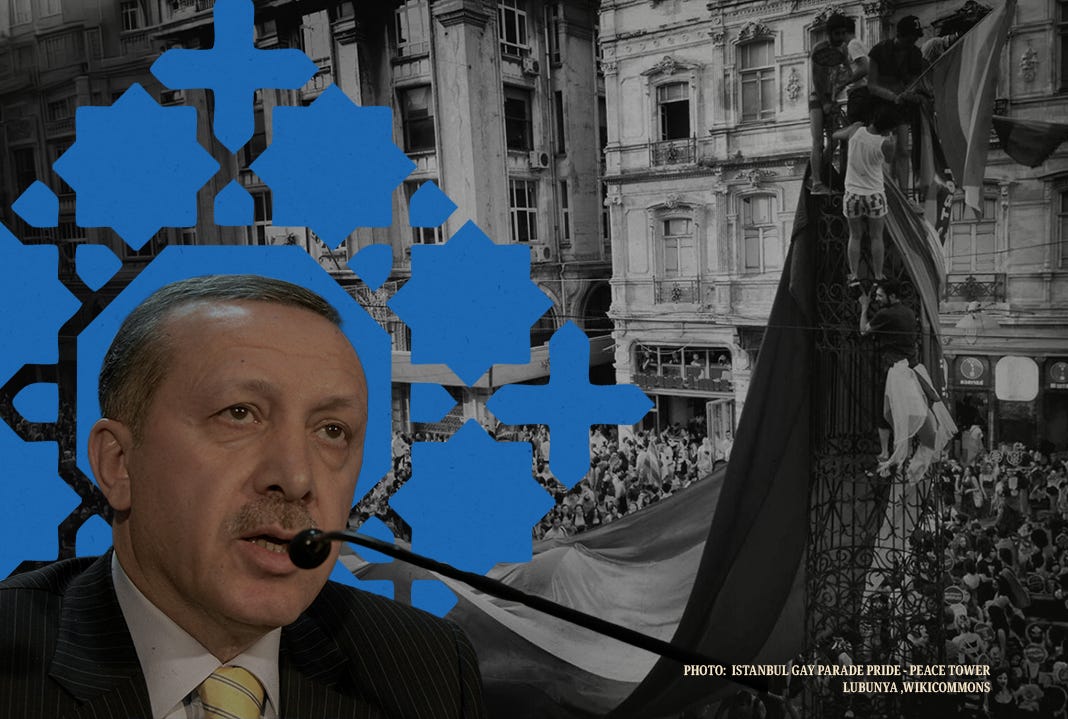
On September 12, Turkish authorities launched a nationwide operation called “My Family Is Safe,” part of a government campaign presented as an effort to protect traditional family values. Within days, authorities had blocked more than 180 social media accounts. The crackdown began with LGBTQ organizations and university groups, but quickly expanded to include journalists and Amnesty International Turkey. Women’s rights organizations that had publicly expressed solidarity with those targeted were soon caught up in it as well.
If the goal were simply to silence LGBTQ organizations, there was no need for a nationwide operation. They have had almost zero public visibility for years, and Istanbul Pride has been banned for over a decade. So why now?
The timing was no coincidence. Within days, Erdoğan’s inner circle was making the government’s intentions clear.
On September 17, chief presidential adviser Mehmet Uçum announced that Erdoğan would run “one last time” and floated April 16, 2028, as the election date. There is, however, the rather inconvenient matter of Turkey’s constitution: presidents are limited to two terms, and Erdoğan is already serving his second.
The next day, Justice Minister Akın Gürlek told party members that the next election would be held “to re-elect our president,” rather neatly settling the question of its intended outcome.
The raids came first; the statement five days later. In Turkish politics, that sequence is rarely an accident.
Read together, it feels as if the next election season has just kicked off. But why start it this way? To understand that, we need to look more closely at Erdoğan’s peculiar position.
The next election will decide whether Erdoğan’s era continues into a fourth decade. He enters it at his strongest in terms of control over the institutions, and at his weakest in terms of popular support. Things did not look great for him, even before the last election. In 2023, despite near-total control of the state and the media, a questionable rival, and a pre-election spending spree so large that the country is still paying for it, he barely made it, falling short of 50 percent in the first round and winning only in a runoff.
Now, three years later, he finds himself in even more dire straits, with the latest poll averages putting his governing bloc at around 41 percent of parliamentary support. Even after three years of (semi-)austerity, inflation still sits above 30 percent, so he can no longer afford the same playbook, at least not at the same scale. And the cracks within his own ranks, driven by the failing economy, are widening.
The most dramatic change since 2023 has come from Erdoğan’s main opposition. After losing the presidential election that year, the Republican People’s Party (CHP) made a striking comeback under its new leader, Özgür Özel. In the March 2024 local elections, it won eight of Turkey’s 10 largest cities and dealt Erdoğan’s ruling party its worst electoral defeat in more than two decades.
Then the courts intervened. On May 21 of this year, an appeals court annulled the party congress that had elected Özel and reinstated Kemal Kılıçdaroğlu, his predecessor and the man Erdoğan defeated in 2023. Three days later, riot police raided the CHP’s headquarters. The fight eventually split the opposition, with Özel and 90 lawmakers leaving to form the New Party. Prosecutors are now seeking to strip Özel of his parliamentary immunity.
The 2024 local elections gave the opposition control of Turkey’s largest municipalities and their budgets. Today, more than 40 opposition mayors have been arrested, removed from office, or replaced by government-appointed trustees, and at least 17 elected on the CHP ticket have defected to Erdoğan’s ruling Justice and Development Party (AKP), often after investigations were opened against them. As we head into the next election, many of the cities voters handed to the opposition in 2024 will be run by people they did not elect.
And the defections are still coming. Just last night, nine more opposition mayors joined the AKP, including five from the CHP. Erdoğan personally welcomed them into the party and pinned AKP badges to their jackets.
Then there is the constitutional question. Erdoğan can run again only if parliament calls an early election, which requires 360 votes. His alliance is roughly 30 short.
Uçum’s plan relies on a technicality. Parliament would call an early election in February 2028, with the vote on April 16, only weeks before the regularly scheduled date. Because the constitution sets no minimum on how early an early election must be, as long as parliament acts before the regular election calendar begins, that is enough to give Erdoğan another run. Technically, parliament would be cutting his second term short after four years and eleven months, and the constitution would compensate him for this “injustice” with another run. It would also allow the government to go to the polls with a fresh 2028 budget, as Uçum openly admitted.
The missing votes are not hard to find. The opposition has demanded early elections for months; it can hardly vote against one now. The trap is built into the rules: every opposition “yes” hands Erdoğan his eligibility, and every “no” looks like fear of the ballot box. Calling the election is the easy part. Winning it is the problem.
Taken one by one, each of these cases has its own legal file and official explanation. Taken together, they show the machinery of the state being used to cripple Erdoğan’s opponents before voters ever reach the ballot box.
This is where the LGBTQ crackdown fits in. It does two jobs at once. First, it gives Erdoğan a rallying cry for his conservative base. Pro-government newspapers have already framed the issue as a fight to defend the Turkish family against decadence imported from Europe. The message is designed to bring back conservative voters who have drifted away from Erdoğan, largely because of the economy.
Second, it exploits a country already in survival mode. Two years of arrests, trustees, and court cases have pushed nearly every independent actor in Turkey into triage. The New Party is vying for survival, and its leader is fighting to stay out of court. Mayors are wondering who is next on the chopping block. Civil society groups are navigating investigations and frozen accounts, and while journalists increasingly have to weigh every word before they publish.
Everyone is busy saving themselves. In this environment, who has the strength to defend a group with little electoral weight? That is precisely why LGBTQ organizations were chosen. Defending them is costly, and the political payoff is small. The card was played at exactly the right moment.
The women’s movement is a different case. It is one of the most organized forces in Turkey’s independent civil society. When more than 120 women’s organizations signed a declaration opposing the raids, authorities blocked their accounts too. The crackdown had expanded from the original targets to organizations that objected to their treatment.
Ankara also knows that the outside world is no longer paying attention. In July, Europe’s leaders came to Ankara for the NATO summit, shook Erdoğan’s hand, and left. None of them publicly mentioned Ekrem İmamoğlu, the Istanbul mayor and the opposition’s presidential candidate, who has been in prison since March 2025. With a war next door in Iran and another still raging in Ukraine, Turkey has become too useful to criticize. If an imprisoned presidential candidate did not merit a mention, Ankara has little reason to expect one over a few blocked accounts. It has rarely operated in a more comfortable international environment.
But the real prize is what disappears from the conversation. Annual inflation stood at 31.5 percent in August, more than three years into an austerity program meant to bring it down. Rent, wages, and pensions should be the country’s focus. This is the issue that could cost Erdoğan the election, and it is the one no one has the energy to talk about.
The next steps are easy to predict. Around the New Year, the government will likely announce generous raises for minimum wage earners and pensioners, perhaps with a gift for those caught in the retirement calendar. The sequence is simple, yet it has worked historically in Turkey: exhaust, silence, sweeten, then vote.
The opposition carries its share of the blame for how well this is working. After İmamoğlu’s arrest last year, I wrote that the balance of courage in Turkey had shifted, and it had. Crowds filled the square outside Istanbul City Hall night after night, and some 15 million people cast ballots in the CHP’s symbolic primary to say İmamoğlu was their candidate. That was an extraordinary reservoir of energy, much of it from citizens who belong to no party but care deeply about democracy.
The opposition failed to turn it into anything lasting.
That energy has since largely depleted, and many of those who once filled the squares have tuned out. By the time riot police fired tear gas inside the headquarters of the party that founded the Republic, only a fraction of those crowds came out.
The government’s latest move lands on that fatigue. Its answer to last year’s courage is not more intimidation, but instead relies on the people’s exhaustion. A society too busy surviving to argue, or to hold on to each other. And a ready-made campaign line: look at them, they can barely manage their own affairs; how could they run a country?
Last year, Turks proved they could still find their courage. The question for 2028 is whether they will still have the energy to use it.
You might also like:
Turkey Jails İmamoğlu in Authoritarian Turn

On March 19, 2025, Istanbul’s mayor and presidential candidate Ekrem İmamoğlu was taken into custody. By jailing an elected representative, the state signaled how far Turkey’s democratic institutions had eroded. For many inside the country, it was the day authoritarianism shed its last restraints. He
Middle East Uncovered is powered by Ideas Beyond Borders. The views expressed in Middle East Uncovered are those of the authors and do not necessarily reflect the views of Ideas Beyond Borders.