


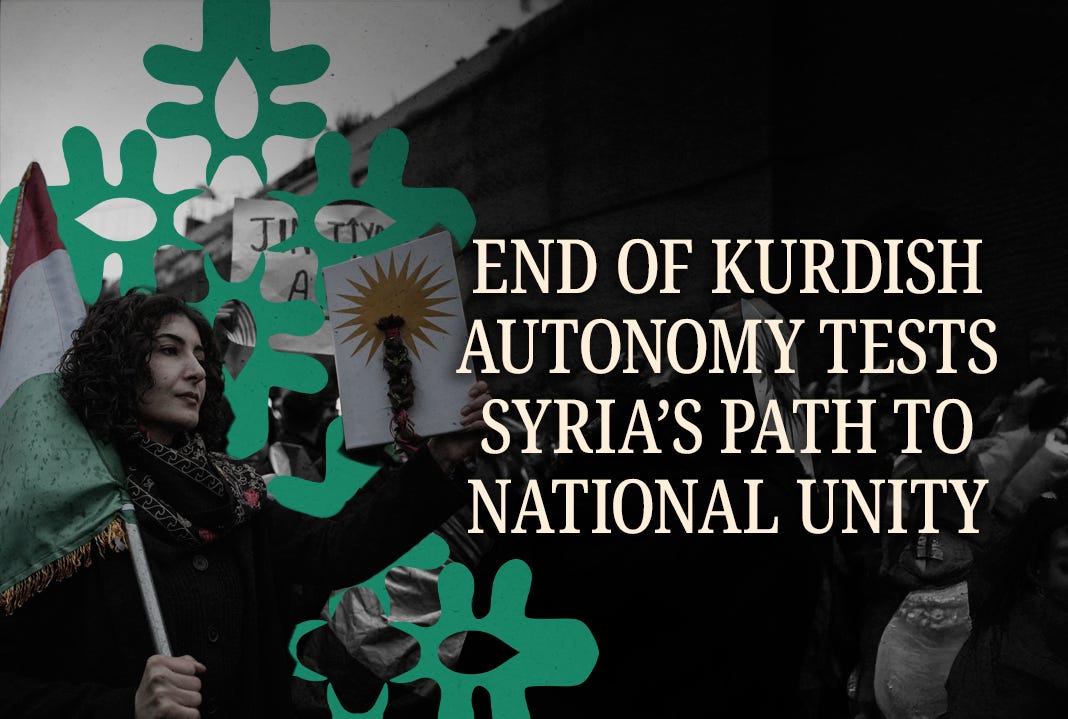
Standing on the front line in the Kurdish-majority town of Kobane, Nesrin Abdullah can see a new Syria taking shape—and it’s not the vision that her female fighters gave their lives for in the battle to defeat the Islamic State (ISIS). For those who fought an existential war for self-determination, that future now feels stripped away.
“The pursuit of democracy, freedom, and nation-building—where people could live with dignity—has been dismantled,” the Women's Protection Units (YPJ) commander said. “Syria, as we knew it, is dying.”
After weeks of bitter fighting, government-linked troops and the Kurdish-led Syrian Democratic Forces (SDF) reached an agreement on Friday that spells the end of Kurdish autonomy in northeast Syria. The deal will fold Kurdish forces and civilian structures into the central state, forcing Kurds to relinquish hard-won rights and watch a decade of self-rule evaporate.
In January, Syria’s interim President Ahmed al-Sharaa answered longstanding Kurdish grievances with a landmark decree recognizing Kurdish civil rights. Citizenship was restored to all Kurdish Syrians, ending decades of statelessness for tens of thousands stripped of their nationality under the Assad regime.
Cautious optimism greeted the move, which made Kurdish a national language and marked the first official recognition of Kurdish rights in Syrian legal history. But after decades of repression, minority communities are wary. Kurds are familiar with broken promises and question the government’s commitment to the decree.
“The Kurds in north-east Syria are right to fear what [government] control would look like,” said Natasha Walter, citing the recent massacres of other minorities in the country. “Al-Sharaa, with his background in al-Qaida and desire for a centralized national government, represents the polar opposite of the secular, decentralized ideals of the autonomous administration,” she told The Guardian.
Al-Sharaa is now following through on his vow to unify Syria and dissolve the system of self-governance that Kurds have operated for over a decade in the de facto autonomous state of Rojava.
On Tuesday, Syrian government forces entered the northeastern city of Qamishli to dismantle one of the last remaining SDF strongholds under the terms of the ceasefire deal.
Talks between the two groups began soon after the fall of the Assad regime, as al-Sharaa looked to consolidate his control over the fractured country. But negotiations over the integration of Kurdish institutions into the state stalled at the end of last year. Frustrated, al-Sharaa ordered government troops to launch a lightning offensive and seize swathes of SDF-held territory in northeast Syria.
In Kobane, the streets are heaving with people displaced by the fighting. Kurdish forces accused government troops of imposing a siege on the town, which is seen as a symbol of the victory against ISIS and the birthplace of the Rojava Revolution.
Observers warned of a humanitarian disaster unfolding with food, water, and electricity in short supply, with reports of several babies dying from cold exposure in freezing temperatures.
A UN humanitarian convoy was allowed to enter Kobane following the extension of a ceasefire.
Reports that Damascus-affiliated factions desecrated the bodies of Kurdish female fighters fueled further outrage. Videos circulating on social media showed the body of SDF fighter Deniz Çiya being thrown from a building, while others showed female fighters being harassed and taunted by Syrian Arab Army soldiers.
“Today, there is a massive assault on our people and on the region as a whole. This attack does not target only the Kurds; it affects many communities. What is unfolding in Syria is a grave and far-reaching crisis,” said Abdullah.
Under Friday’s deal, the SDF, which previously controlled around a third of Syrian territory, will withdraw from the frontlines. Government forces will enter the Kurdish-controlled cities of Hassakeh and Qamishli, and three brigades will be created to begin the phased integration of the SDF into the Syrian army.
A previous integration deal, signed last March, fell apart.
In a statement on X, US Special Envoy for Syria Tom Barrack hailed the new agreement as a “profound and historic milestone in Syria’s journey toward national reconciliation, unity, and enduring stability.”
However, concerns that a centralized Syria will leave Kurdish communities exposed are reinforced by the loss of their former Western partners, who have shifted their support to the transitional government.
A short-term deal based on rapid integration at the expense of a more complicated and inclusive transition process is “doomed to failure,” said Thomas Schmidinger, Associate Professor for Political Science and IR at University of Kurdistan Hewlêr (UKH) and author of several books on Rojava.
“In the long-term, it does not bring stability and could ultimately tear the country apart.”
Kurds make up around 10 percent of the population in Syria. Forcing the SDF to relinquish self-rule risks reinforcing deep divisions in the country, where massacres of other minorities have stoked fears of further sectarian violence.
“It destroys what little trust minorities have left in the new state and jeopardizes Syria’s unity. Druze and Alawites will now rely even more on protection from outside, for example, from Israel,” Schmidinger added.
The Democratic Autonomous Administration in North and East Syria (DAANES), more commonly known as Rojava, first emerged in 2012, when Kurdish forces established a system of self-governance based on democratic confederalism, grassroots democracy, women’s liberation, and ethnic inclusivity.
Feted for its unique commitment to gender equality and power sharing, the Rojava model proved that a viable alternative could exist in a region where patriarchal control and authoritarianism prevail.
This proved uncomfortable for neighboring Turkey, which, like Syria, has long sought to oppress its Kurdish population by force. But for a time, the SDF was untouchable as a vital US partner in the war against ISIS.
As Kurdish forces recaptured areas seized by the militants in 2014, western media celebrated the brave fighters of the Kurdish Women’s Protection Units (YPJ) with glossy photoshoots of young women on the frontlines.
Now, the US has shifted strategies in Syria, throwing its support behind al-Sharaa, whose rebel offensive overthrew Bashar al-Assad in December 2024.
Confirmation came via X when Barrack announced the end of US support for the SDF, stating that the original purpose of the partnership had “largely expired.”
“Today, the situation has fundamentally changed. Syria now has an acknowledged central government that has joined the Global Coalition to Defeat ISIS (as its 90th member in late 2025), signaling a westward pivot and cooperation with the U.S on counterterrorism.”
“Damascus is now both willing and positioned to take over security responsibilities, including control of ISIS detention facilities and camps,” he added.
Other US politicians voiced concern over the dangers posed by another Western betrayal of the Kurds.
“I support a fair chance for the new Syrian government, however if there’s an escalation of attacks against the Kurds by Syrian forces supported by Turkey, this will create a whole new dynamic,” Senator Lindsay Graham wrote on X.
Former Secretary of State Mike Pompeo echoed these sentiments, stating that “turning our backs on our Kurdish allies would be a moral and strategic disaster.”
He also warned of the wider risk posed by the escape of ISIS members from SDF-held prisons in Syria. “If unchecked, we could soon see mass displacement, ethnic cleansing, and the possible reemergence of ISIS as a powerful player inside Syria and a global terrorist threat,” he said in an opinion piece for The Washington Post.
Until fighting erupted, the SDF held around 8,000 suspected ISIS fighters and over 30,000 people linked to the group in prisons across north-eastern Syria. Among them are women and children detained at al-Hol, including foreign nationals from countries that refuse to repatriate them.
As clashes escalated, dozens of ISIS detainees escaped from al-Shaddadi prison in northeast Syria, some of whom were later rounded up. The US is in the process of transferring around 7,000 prisoners to a “secure location” in Iraq, reflecting Washington’s underlying doubts over the security capabilities of al-Sharaa’s administration.
Publicly, US President Donald Trump has embraced Syria’s interim President, describing him as a “young, attractive guy—tough guy” when they met last year.
Al-Sharaa, a former jihadist who until 2024 had a $10 million bounty on his head for past links to al-Qaida and ISIS, has “a real shot at pulling it all together,” President Trump said at the time.
In the aftermath of a tentative truce, prospects for a peaceful resolution remain to be seen. The agreement lays out a path to national unity, but for Syria’s Kurds, who made huge sacrifices in the war against ISIS, forcible inclusion comes at the cost of hard-won achievements over the past decade.
“What is threatened is the right to political and cultural existence within a unified Syria, not as a marginal component or a victim, but as a real partner in shaping the future,” said Eminê Osê, deputy co-chair of the DAANES Executive Council.
In Kobane, where self-rule offered an alternative to authoritarianism and extremism, the government offensive reinforces a familiar cycle, where repression fuels resistance and violence ensues.
For many Kurds, the dismantling of Rojava relinquishes more than territory. “Targeting this model means closing one of the few remaining paths toward real peace built on justice, recognition, women’s participation, and the protection of diversity,” Osê said.
“What is at stake is not a piece of geography, but the possibility of a different Syria.”
Middle East Uncovered is powered by Ideas Beyond Borders. The views expressed in Middle East Uncovered are those of the authors and do not necessarily reflect the views of Ideas Beyond Borders.
