

Eid in a Time of War
As war stretches across the Middle East, those of us with roots in the region carry its weight from afar—balancing professional detachment with deeply personal stakes.

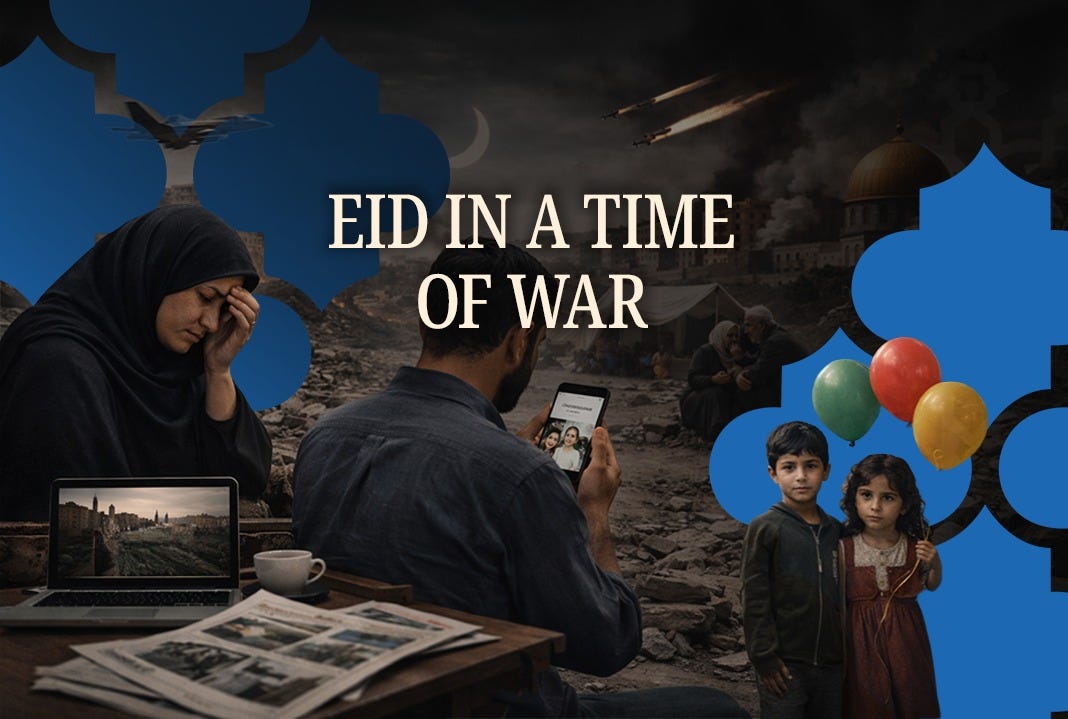
On the first day of Eid, the festival marking the end of the holy month of Ramadan, a quiet dread settled within me as I sent my usual “Eid Mubarak” greetings to family and friends across the region. The responses were heart-wrenching, matching this heaviness I’ve been feeling of late. “It is Eid, but it’s neither happy nor is it mubarak [blessed],” responded one friend. My Iranian friends in the U.S. and across the region are also marking Nowruz, the Persian New Year, either mourning for the losses they’ve witnessed in their country or with so much unease and mixed emotions as the U.S.-Israel-led war in their homeland marks its third week. To date, more than 1,200 Iranian civilians have been killed, tens of thousands injured, and more than 3 million Iranians forcefully displaced. The Iranian people are cut off from the rest of the world as the regime continues its near-total internet blackout, unable to reach families and friends in the diaspora who are desperately waiting for proof of life.
In Lebanon, where Israel is determined to eliminate Hezbollah, around 1,000 people have been killed, and a million Lebanese citizens are now internally displaced. The Lebanese diaspora, which outnumbers the country’s population, is glued to the news. For some, it’s déjà vu as Lebanon has tragically lived through so many wars and crises, but that certainly doesn’t take away the anxiety of worrying about loved ones. Across the region where this war has extended, including the countries of the Gulf Cooperation Council, Jordan, Northern Iraq, and Israel, the Islamic Republic’s attacks have crossed all red lines, damaging infrastructure, killing civilians (primarily in Israel, UAE, Bahrain, and Iraq), and destabilizing their daily lives and sense of security and peace. And all of this is unfolding after more than two years of war in Gaza that has devastated the strip and killed over 70,000 people, following the Hamas attacks on Israel that left 1,200 dead and more than 250 taken hostage.
For many of us with roots in the Middle East working in foreign policy and national security, the fog of war—seemingly without end—extends far beyond the battlefield. It weighs heavily on me as an Arab American with family in Jordan and friends and colleagues across the region, from Dubai to Doha. Showing up to work each day and maintaining dispassionate analysis carries a weight of its own. In conversations with counterparts and friends—Arab American, Iranian American, and Jewish American alike—that weight is both emotional and mental.
We wake with unease, compelled to check the headlines before anything else, and then to reach out to loved ones in the region. Social media fills with images of families sleeping in the streets in Lebanon, the sound of sirens echoing across cities from Manama to Erbil, and the visible grief of those mourning and those simply trying to survive.
These are images and sounds that stay with you, regardless of where you stand on the war. As psychologist Dalia Halabi wrote, “Distance changes how the brain experiences war,” noting that “the brain processes direct reality and distant uncertainty in different ways.” This does not diminish the devastation people are living through, but it helps explain why those on the ground can sometimes appear steadier, more accustomed to the rhythm of conflict. For many, this is not the first war they have lived through.
At the same time, social media offers glimpses of life continuing as it can—from Kuwait City to Doha to my hometown of Amman. Today, images of Palestinian children celebrating Eid with balloons felt bittersweet: bright colors set against grey rubble. As a friend in Dubai wrote to me, “We’re all carrying more than we show…different lives, different roles, but it’s there, and most of it goes unseen.”
It’s a privilege to receive such a message and fully understand it. It just clicks. And that’s why being from the region has its perks. It broadens our perspectives and enriches our analysis, given our connections to the textures of society, the culture, and the sociopolitical dynamics at play. As a native Arabic speaker, I access news coverage of the conflict across the varying Arab news outlets across the region, allowing me to better understand the geopolitics, the socio-politics, and the pulse of the people. It makes me a better analyst as it does others with roots in the region.
For my Iranian American friends and colleagues, their Farsi tongue enables them to see and understand the day-to-day in Iran, whether on social media or newscasts. It gives them the power to relay and translate the sentiments of the people, providing context for how perceptions form and why they matter in policy analysis. Our roots in the region empower us not only to understand complexity and nuance, but also to unpack it in the face of binary narratives that dominate the airwaves and the digital space, often steering audiences towards maximalist positions.
As my Iranian American journalist friend reported in Sky News a few days ago, many things can be true at the same time: “Iranians can oppose this brutal regime and celebrate the killing of its leaders, but also be wary and anxious of the war and what ‘day after’ scenario these bombings will bring.”
One truth we in the policymaking community and foreign policy sector should be aware of is that, while we are far removed from the battlefield, we’re all very much operating in an environment far from immune to the political divisions, tensions, and polarization unfolding in the region. To say it is tense is an understatement. More of a reason to not just hold steady, but to stay true to the mandate of non-partisan analysis, while also elevating diverse voices across the region and valuable expertise that brings in the necessary historical, sociopolitical, and cultural context.
Today, I am grateful to friends and colleagues who check in as I do with so many whose families have been affected. What proves challenging at times is operating outside of the working environment, in my interactions with those in our midst who either do not understand the nature of this work or, frankly, those who do not understand the implications beyond how it is reflected at the gas stations in America. I am sometimes shut down when I try to share what is going on—or met with aching silence.
I have come to understand, however, that people have their own capacities, and I let it be. Holding steady has proven to be a journey of self-rediscovery. When I feel the pressure, the sadness, and the frustration of uncertainty, as many of my colleagues working in this space do, I reach out to my community. It’s how the people of the region are coping, with solidarity and togetherness.
After a long day’s work following developments in the region, I get to come home to my sweet children and my loving husband. I am even more grateful and more energized to do the work—in an endless search for the hope for a better future that the people of the region so deserve.
Middle East Uncovered is powered by Ideas Beyond Borders. The views expressed in Middle East Uncovered are those of the authors and do not necessarily reflect the views of Ideas Beyond Borders.
 | A guest post by
|
Thank you, Merissa, for sharing the perception, feelings and thoughts of your community.
My heart goes out to all the people in and from the Middle East, wishing for Peace to come soon.