


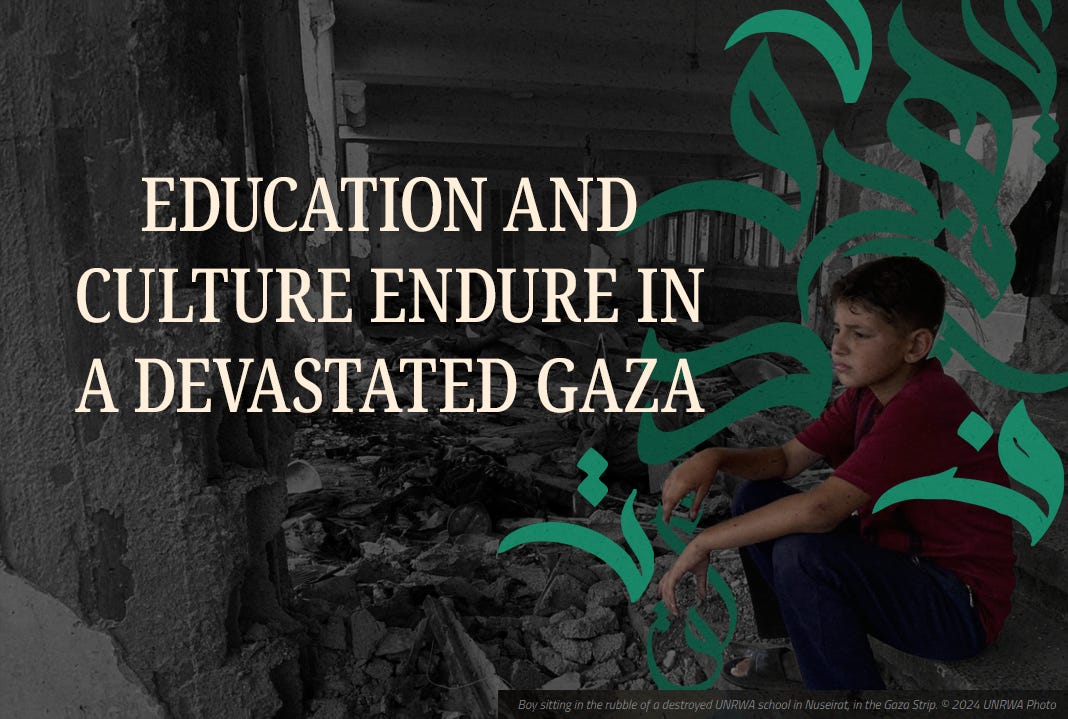
One might assume that in a city that has been relentlessly bombed for two years—where more than 1.9 million people have been displaced, over 90% of civilian infrastructure has been destroyed, and large-scale starvation persists—cultural and educational life would simply collapse. Daily survival, securing food and water, and finding a safe place to sleep have superseded nearly everything else. By any conventional standard, cultural institutions should not exist in conditions like these.
Yet on the ground, something different is unfolding. Instead of disappearing, cultural and educational life is reassembling itself in scattered, improvised, and often unrecognized forms. Long before the war in Gaza, Palestinian society had achieved one of the lowest illiteracy rates in the region. According to the Palestinian Central Bureau of Statistics, only around 2–3% of Palestinians aged 15 and above were illiterate by 2022–2024. Higher education was also widespread: in 2022–2023, 44% of Gaza’s youth aged 18–24 were enrolled in universities and colleges, and 22.8% of Palestinians aged 25+ held bachelor’s degrees or higher.
Given that many countries in the region average around 75–80% adult literacy, the Palestinian adult literacy rate (~97–98%) stands out as markedly high.
When schools and universities were destroyed or repurposed as shelters, Gazans refused to let education go. In the Al Mawasi area of southern Gaza, the makeshift “Mazoon Knowledge” school opened its doors in November 2024 to serve nearly 1,500 displaced students from first to fourth grade who had been deprived of schooling for two years. It is just one of many local initiatives that emerged to keep learning alive despite war, displacement, and hunger. In the Deir El Balah governorate, the Education Cluster mapped 84 Temporary Learning Spaces (TLSs). Classes were held in tents, damaged school buildings, and shelters that housed displaced families at night.
For university students, remote learning became an emergency lifeline. Several institutions, including Al-Azhar University and Al-Aqsa University, adopted distance education soon after the war began. UNESCO launched a “Virtual Campus” project to support up to 20,000 higher-education students from Gaza and to provide digital access points in temporary learning spaces. These initiatives relied on hybrid models, but online learning depended on conditions that barely existed. Internet and electricity repeatedly collapsed as fibre-optic lines were destroyed and power supplies failed. Students relied on weak 2G and 3G signals from temporary towers, often walking long distances—sometimes to coastal areas or near UN compounds—just to download lecture files or submit short assignments. That thousands still attempted to follow university courses under such circumstances speaks more to Gaza’s determination to preserve education than any institutional plan could.
The preservation of cultural life followed a similar pattern. The Edward Said National Conservatory of Music (ESNCM) was heavily damaged, yet teachers salvaged instruments from the rubble and created improvised studios in displacement camps. Music classes continued through WhatsApp, with oud and violin students sending practice recordings from tents. ESNCM teachers said music became “a structure of the day” for children who had lost any sense of routine.
The Qattan Foundation—long a pillar of Gaza’s cultural life, running libraries, children’s literature workshops, heritage programs, and artist residencies—also saw its offices destroyed. But former trainees and partner artists revived parts of its mission informally: children’s storytelling circles led by graduates of the “Reading for Pleasure” program; makeshift creative workshops using salvaged materials like charcoal, cement dust, and scraps of wood; and archival rescue efforts where volunteers retrieved burned or damaged manuscripts from the Cultural Centre library and digitized surviving fragments with mobile phones. Many individual artists continued working despite losing their studios.
For Palestinians, education and culture are not tied to buildings or institutions—they continue through people. Even under displacement, starvation, and bombardment, Gazans ensure their children learn, that music continues, that heritage is carried forward, and that creativity endures.
This drive to learn and to create is not new. In the wake of the 1948 Nakba, when hundreds of thousands of Palestinians were expelled and forced into refugee camps, Palestinians themselves organized tent schools and continued teaching even without books or formal infrastructure. Today, they are doing much the same—confronted with similar conditions, and responding with the same determination.
The improvised classrooms and studios cannot restore universities or libraries overnight, nor can they shield students from the long-term impacts of war and years of studying lost. But they prevent the total erasure of a generation. They preserve the chain of knowledge and identity that has endured decades of hardship. And perhaps most importantly, they demonstrate that creativity and the drive to learn persist, even in the ruins of war.
Middle East Uncovered is powered by Ideas Beyond Borders. The views expressed in Middle East Uncovered are those of the authors and do not necessarily reflect the views of Ideas Beyond Borders.
