


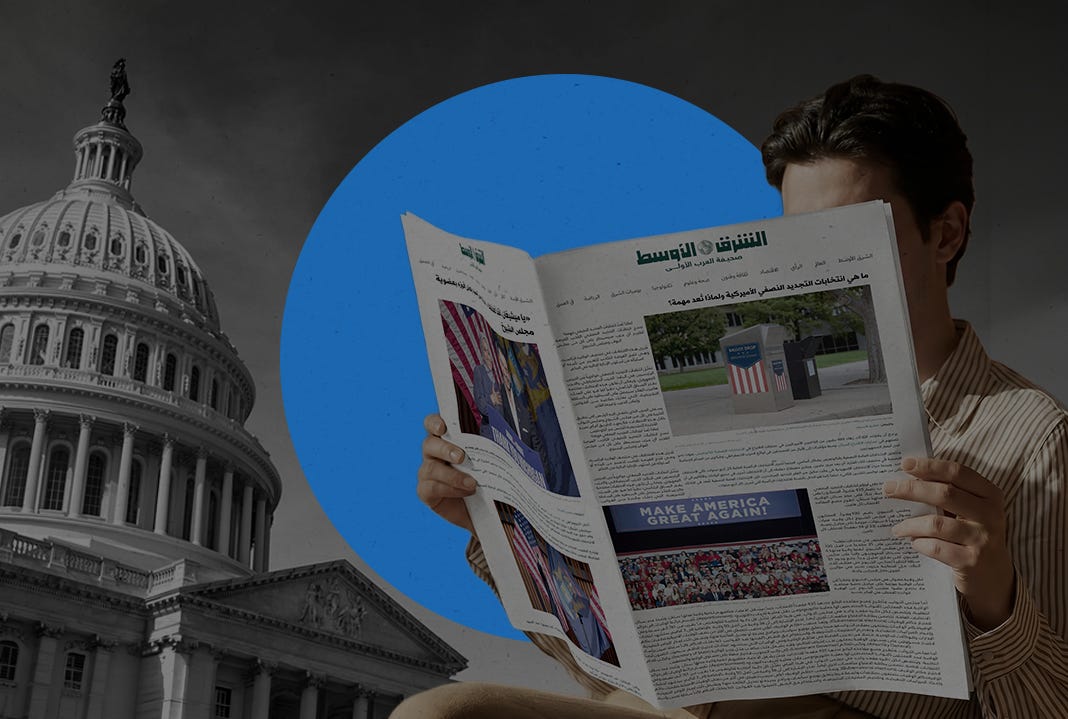
If you have been watching Qatari, Emirati, or Saudi television over the past 24 hours, you might think the American midterm elections had just decided the future of the war with Iran.
Democrats have delivered a massive defeat to President Trump and the Republican Party, taking control of both the House and Senate. And much of the discussion in Middle Eastern media has focused on one question: Does Trump’s defeat mean Iran has won?
I think the question itself misses something fundamental about American politics.
I have lived in the United States for more than twelve years and have been eligible to vote since 2019. One thing I’ve noticed is how differently American elections are understood in the Middle East, where they are often interpreted almost entirely through their potential consequences for our region.
On Al Jazeera, analysts debated whether Americans had rejected the war and whether Democrats could force Trump to change course. On Sky News Arabia, the discussion included whether the results represented a strategic victory for Tehran. Al Arabiya focused on the scale of the Democratic victory, Trump’s threatened vetoes, and reactions from Iran.
To be fair, these channels featured competing perspectives, including analysts who challenged the idea that Iran had somehow “won.”
But a defeat for Trump is not automatically a victory for the Islamic Republic. And an American election, however consequential, does not necessarily determine the outcome of an American led war.
The first thing to understand is that American midterm elections are primarily about American domestic politics. And the party controlling the White House usually loses seats in Congress.
When Obama was president, Republicans gained 63 House seats in 2010. During Trump’s first term, Democrats gained 41 seats in 2018. Under Biden, Republicans took control of the House in 2022.
Americans often use midterm elections to express frustration with whoever is in power. Sometimes that frustration involves foreign policy, but it also includes the economy, the cost of living, healthcare, immigration, and many other domestic issues.
This election was no exception. According to the ABC News Voter Poll, 34 percent of House voters considered the Iran war crucial to their vote. But 49 percent said the same about the cost of living, and 54 percent about government corruption.
That doesn’t mean the war was unimportant, but the American electorate is much more complicated than the picture often presented on Middle Eastern television.
In 2006, the United States was fighting a bloody and increasingly unpopular war in Iraq—and frustration with President George W. Bush was growing.
Democrats won a massive victory that year, taking control of both the House and Senate. Opposition to the Iraq War was one of the central issues driving that result.
Now, if we applied some of the logic being used in today’s Middle Eastern media coverage, we would assume that Bush’s defeat meant the Iraq War was about to end.
But what actually happened?
Just two months after the elections, in January 2007, Bush announced that he was sending more than 20,000 additional American troops to Iraq in what became known as “the surge.”
Instead of ending the war, he escalated it.
And when the new Democratic Congress passed legislation linking war funding to withdrawal deadlines, Bush vetoed it. Democrats did not have enough votes to override his veto.
Think about that for a moment. The president’s party had just suffered a major electoral defeat, much of it related to an unpopular war, and the president responded by sending more troops.
That is possible because the United States has a presidential system. Congress controls funding and can challenge military policy, but the president remains commander in chief and retains substantial authority over military operations. Overriding a presidential veto requires a two-thirds majority in both chambers.
I am not suggesting Trump will necessarily do the same thing with Iran. Iraq in 2007 and Iran today are very different situations. But the example should make us cautious about assuming an electoral defeat automatically changes military strategy.
Much of the current conversation assumes that what happens next depends primarily on Trump’s willingness to use military force. But I don’t think America’s biggest problem with Iran is military capability.
There is very little doubt that the United States possesses overwhelming conventional military superiority over Iran. The more difficult question is what America is actually trying to achieve and what happens after the military operations conclude.
If the objective is to destroy specific military capabilities, that is one thing. If the objective is to prevent Iran from acquiring nuclear weapons, that is another. And if the objective is regime change, we are talking about something else entirely.
Suppose the Islamic Republic collapses tomorrow. Then what?
Are we assuming that Iran, a country of more than 90 million people with significant ethnic, religious, and political divisions, will automatically transition into a stable liberal democracy?
I certainly hope Iranians eventually get the opportunity to build a freer and more prosperous country. But hoping for something and having a realistic plan for achieving it are not the same thing.
A sudden collapse would more likely lead to internal conflict, instability, and waves of refugees.
Where would those refugees go? Turkey, which has already absorbed millions of refugees from previous regional conflicts, would face another enormous challenge. Gulf countries, including the UAE, which has longstanding economic and social connections with Iran, would also have to deal with the consequences.
This is why some governments in the region can strongly oppose the Islamic Republic and its regional influence while simultaneously fearing the consequences of its collapse.
Two things can be true at once. You can want the regime gone without wanting the country itself to come apart, and Washington has to think about that no matter which party controls Congress.
Then there’s the question of what all of this means for Americans at home, especially when it comes to energy prices.
Some American oil companies may benefit from higher energy prices. That does not mean the average American does.
Most Americans don’t experience the economy through GDP numbers or oil company profits. They feel it at the gas pump, at the grocery store, in transportation costs, and in how much money is left in their account at the end of the month.
War often benefits certain sectors of an economy while making ordinary people’s lives more expensive. And the economic relationship between the United States and Iran is extremely asymmetrical.
America has a massive, diversified economy that can absorb costs that would be devastating to Iran. The Iranian economy was already suffering from years of sanctions, currency depreciation, and serious structural problems before the current conflict.
But here is where things get interesting.
The Iranian regime can lose military assets, suffer enormous economic damage, and see the living standards of its citizens deteriorate… and still declare victory simply because it survived.
For the Islamic Republic, simply staying in power can count as a win.
Ordinary Americans want to know what a war will cost them in their day-to-day lives.
Americans can reasonably ask what the war accomplished, whether it made their country safer, and whether the results justified the costs.
This is why the Iranian leadership can look at the American elections and declare victory even when the actual strategic situation is far more complicated. And frankly, it is not surprising that Tehran would present the results this way. Governments routinely interpret events in ways that serve their domestic political narratives.
A Democratic win is not automatically a win for Iran. Disliking Trump is not the same as supporting the Islamic Republic, and opposing the war does not mean Americans agree on what should happen next.
Some Americans believe military intervention was a mistake from the beginning. Others may believe the administration has failed to define achievable objectives. Some may support a tougher policy toward Iran but oppose how Trump has conducted it. Others may simply be frustrated by higher prices and the economic uncertainty that accompanies war.
These are very different positions, even when they produce the same electoral outcome.
None of this is to minimize the Democratic victory. It is a major political development, and it will substantially complicate Trump’s remaining two years in office.
But American politics is more complicated than that. A Republican win does not automatically mean war, a Democratic win does not automatically mean peace, and a loss for Trump does not automatically mean a win for Iran.
The historical record should make us more careful about drawing those conclusions.
For me, the most important question is whether the United States has a realistic definition of success in Iran, a credible plan for what happens after the fighting, and an understanding of the consequences for the people who actually live in the region.
Because winning a military confrontation is one thing. Creating a more stable Middle East afterward is something entirely different.
And that is a question no American midterm election can answer on its own.
Middle East Uncovered is powered by Ideas Beyond Borders. The views expressed in Middle East Uncovered are those of the authors and do not necessarily reflect the views of Ideas Beyond Borders.
A thoughtful discussion