


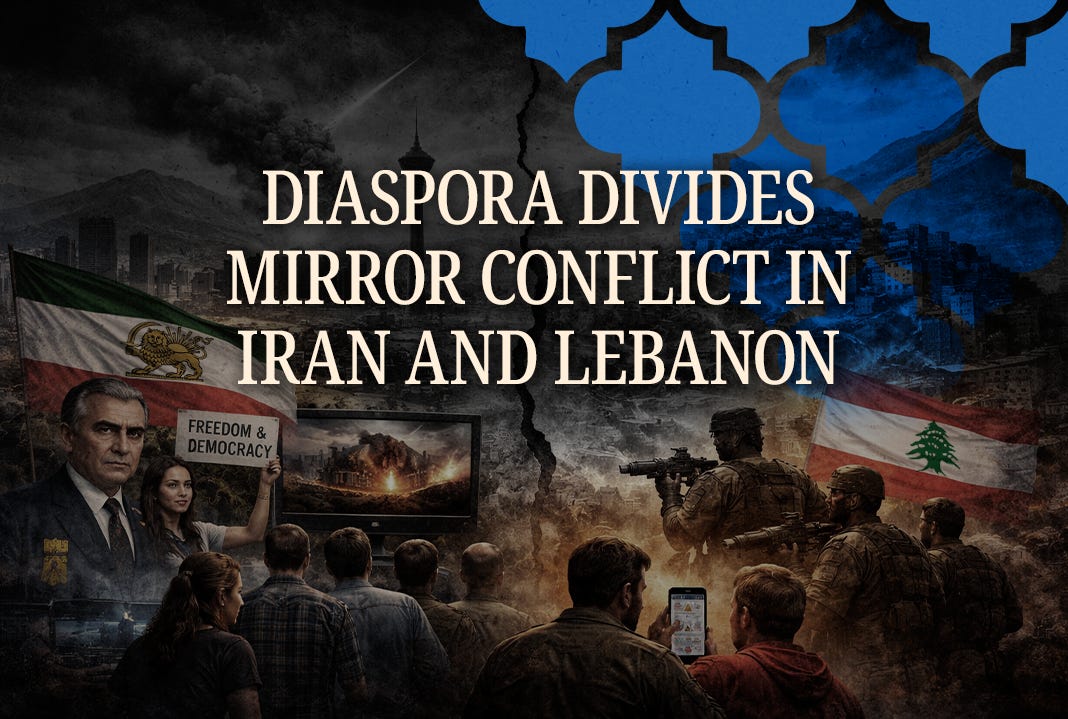
A missile strike lands near Tehran. Within minutes, the footage is translated and shared across diaspora networks from London to Los Angeles. At the same time, families tied to Beirut refresh their phones as evacuation warnings spread and neighborhoods are reduced to rubble.
This is no longer a distant war. For millions of Iranians and Lebanese abroad, it is a daily reality, experienced in real time, shaped from afar, and argued over across borders.
But proximity has not engendered unity. It has exposed deeper disagreements about what the future should look like and who gets to define it.
As war and economic recession continue in Lebanon, the diaspora has become indispensable. Remittances are sustaining families, funding evacuations, and replacing basic state functions.
Alongside this economic role, a more controversial idea has resurfaced among segments of the Lebanese Christian diaspora: the possibility of an autonomous, or even independent, Christian-majority entity centered in Mount Lebanon.
This reflects a growing sense that the Lebanese state, in its current form, is no longer viable. Hezbollah’s military dominance, repeated cycles of conflict, and prolonged institutional breakdown have led some to revisit older visions of decentralization or partition.
Support for such proposals is limited and difficult to quantify. Among a smaller but increasingly organized current within the Lebanese Christian diaspora, the Christian Lebanon Initiative has articulated a structured proposal for the creation of a sovereign Christian state in Mount Lebanon. The movement presents its project as a lawful, phased strategy grounded in constitutional and international frameworks, outlining steps that include building transnational community structures, developing coordinated civic and economic networks, and preparing legal arguments for potential self-determination.
While these ideas remain contested and do not represent the majority of Lebanese Christians, their growing visibility reinforces how diaspora spaces can become arenas where competing, and at times controversial, visions of national futures are articulated and debated.
Within some segments of the diaspora, particularly among communities historically aligned with Hezbollah’s political base, there are voices that continue to view Hezbollah as a legitimate actor within Lebanon’s political system and as part of the broader Axis of Resistance. Supporters argue that its role functions as a deterrent in a volatile regional environment and represents a constituency that cannot be excluded from Lebanon’s power-sharing structure. From this perspective, calls for external pressure, disarmament, or structural exclusion risk destabilizing the country further.
At the same time, other voices within the Lebanese diaspora argue that Hezbollah should be disarmed fully and without delay, framing their position as consistent with Lebanon’s official commitment to place all weapons under state authority. They point to the government’s approval in September of the Lebanese army’s plan, presented by General Rodolphe Haykal, to bring all arms, particularly Hezbollah’s, under state control. For supporters of immediate disarmament, this decision represents an institutional mandate to strengthen the state’s monopoly over force and implement existing security commitments.
Their argument is shaped not only by frustration with prolonged conflict, but also by concerns about continued Iranian involvement in Lebanese affairs, which reinforces parallel military structures and complicates full sovereignty. From this perspective, completing the army’s plan is a necessary step toward restoring state authority, stabilizing the country, and creating conditions for long-term peace.
These positions, partition, reform-within-unity, and continued resistance alignment, reflect not a single diaspora narrative, but a divided political landscape that mirrors Lebanon’s internal divisions.
The Iranian diaspora is similarly divided about who should govern Iran.
One of the most visible tensions is between those who support a return to monarchy, often associated with the legacy of Mohammad Reza Pahlavi, and those calling for a democratic system that rejects both the current regime and Iran’s monarchical past. Among monarchist-leaning segments of the diaspora, his son, Reza Pahlavi, is increasingly seen as a legitimate successor or, at minimum, a unifying transitional figure. This support is visible in diaspora protests and echoed inside Iran, where slogans such as “Javid Shah” (“Long live the Shah”) have re-emerged, alongside chants calling for the return of the Pahlavi dynasty . These expressions reflect not only nostalgia for the monarchy, but also a search for recognizable leadership in the absence of a clear alternative.
At the same time, this vision is heavily contested. Some Iranians, continue to associate the monarchy with authoritarian rule, arguing that calls to restore it overlook the repression and inequalities that contributed to the Iranian Revolution. Critics within the diaspora often emphasize that replacing one centralized authority with another risks repeating patterns of exclusion and political repression. Instead, they advocate for pluralistic and democratic frameworks that prioritize institutional accountability over individual leadership. This divide is not only ideological but generational, reflecting different lived experiences of Iran’s past and different expectations for its future.
These divisions shape how diaspora communities engage with the outside world, what kind of change they advocate for, and how they frame Iran’s future to international audiences.
In both cases, distance does not remove people from political life, but reshapes how they participate in it. Calls for partition in Lebanon or restoration in Iran may gain traction abroad partly because the immediate consequences are less visible. The risks—renewed conflict, instability, unintended outcomes—fall primarily on those on the ground.
This does not make diaspora voices irrelevant. But it does mean they operate under different conditions, with different constraints. Despite their divisions, both diasporas play a real role in current events.
Lebanese abroad are sustaining an economy in free fall. Iranians abroad are shaping how protests, repression, and war are seen globally, through media, advocacy, and political lobbying.
They influence narratives, fund survival, and keep attention on crises that might otherwise fade from the news cycle. But they do so without consensus, and often in competition with one another.
Many in the diaspora live between two realities: physically in one country, but emotionally and politically tied to another. War, protest, and collapse don’t seem so far away—they show up daily, on screens, in conversations, and in the impossible choices people have to make.
This creates a form of engagement that is immediate but uneven. Close enough to care deeply, far enough to be removed from the full consequences of every decision.
The role of the diaspora in Iran and Lebanon is complicated. It is neither detached nor decisive, neither purely constructive nor inherently harmful.
The question is how to understand their influence without overstating it, or dismissing it. Because in both Iran and Lebanon, the future is no longer being imagined only within national borders. It is being debated, contested, and partially shaped far beyond them.
And that reality is becoming harder to ignore.
Middle East Uncovered is powered by Ideas Beyond Borders. The views expressed in Middle East Uncovered are those of the authors and do not necessarily reflect the views of Ideas Beyond Borders.
