


Large numbers of Arab-American voters in Dearborn, Michigan, were celebrating on Tuesday night. Abdul El-Sayed, an Egyptian-American Democrat, defeated Republican Mike Rogers, becoming the first Muslim ever elected to the United States Senate.
El-Sayed’s election came as part of a “Blue Wave” that swept America. Democratic candidates won in places that they haven’t come close to winning in for decades, picking up Senate seats and governorships in long-time Republican strongholds like Texas, South Carolina, Kansas, and Ohio.
In Dearborn—one of only a few Arab-American majority cities in North America—82% of voters chose El-Sayed. Two years earlier, a majority of Dearborn voters had voted for Donald Trump as president, in what was seen by some commentators at the time as a way to punish Democrats over the Biden administration’s support for the war in Gaza.
This time, the mood was celebratory. Arab-Americans in Dearborn hailed El-Sayed’s victory as a historic breakthrough, with residents describing the result as deeply personal and local leaders celebrating the election of the country’s first Muslim senator.
In Gaza itself, however, the response to El-Sayed’s victory was more divided.
One Palestinian political commentator known for his pro-Hamas views—Fayez Abu Shamala, a former mayor of Khan Yunus—was so delighted with El-Sayed’s victory that he was out in the streets distributing sweets.
He told The New Arab: “Our enemy is the same as Abdulrahman al-Sayed’s enemy.”
Another Palestinian interviewed by The New Arab, Halima Baraka, had a different perspective. She was not particularly interested in political celebrations thousands of miles away.
“We want the war to stop, people to return home,” she said, telling them that what she really wanted was for reconstruction to begin.
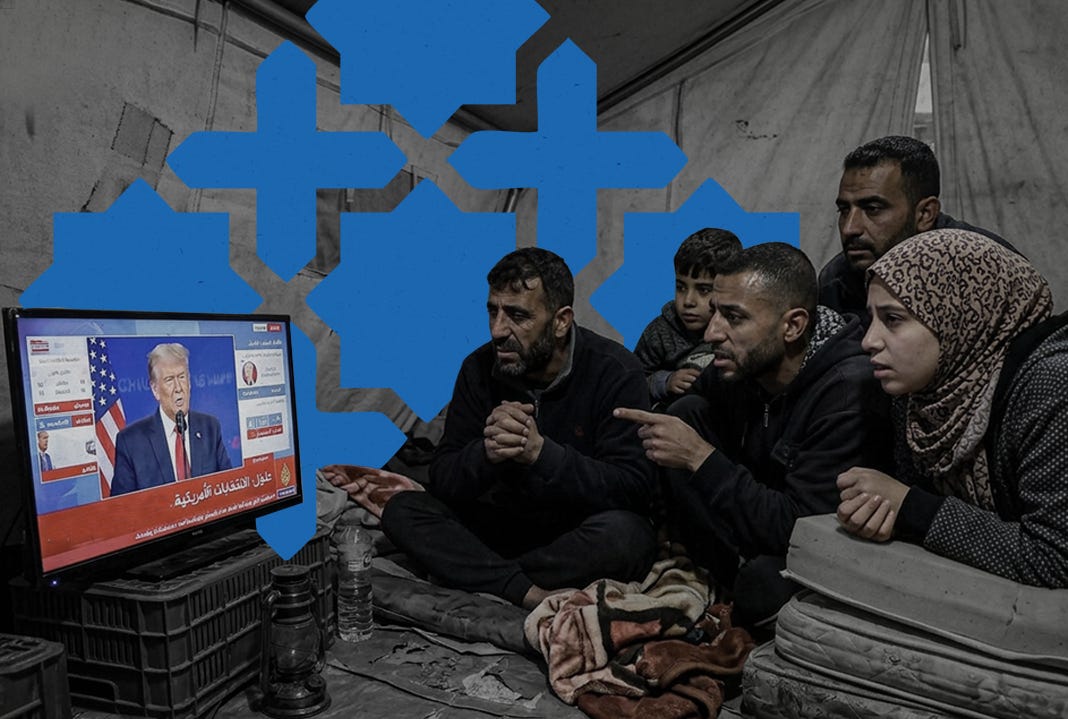
For Palestinians who have suffered through three years of war, the election result may seem completely irrelevant to their day-to-day lives and struggles. Winter is setting in in Gaza, and 54% of Palestinians are still living in tents.
In those conditions, election outcomes in America may feel extraordinarily distant or even completely irrelevant. Abdul El-Sayed may say he wants to help Palestinians, but that doesn’t guarantee any Palestinians will be helped, or that living conditions on the ground will improve.
Individual members of Congress have limited power to reshape U.S. foreign policy on their own, particularly while the presidency remains in the hands of the opposing party.
Elections have consequences, yes, but it’s difficult to assess what the long-term consequences of this election will actually be for Palestinians—or for Americans.
Reconstruction in Gaza cannot begin until several political and security questions are resolved, starting with the ceasefire agreement brokered by the Trump administration last October.
Under that deal, Hamas and other Palestinian armed groups are expected to disarm, Israeli forces are supposed to withdraw from Gaza, and a new Palestinian administration is meant to take over governance of the territory.
Now, more than a year after the ceasefire went into effect, we are still deadlocked.
Israel still controls two-thirds of Gaza. Hamas continues to operate in the remainder.
Israel is insisting that Hamas must disarm before any military withdrawal takes place. Hamas insists that Israel must withdraw before giving up its weapons.
And despite months of efforts by the Trump administration to broker a deal, the two sides have yet to reach one.
Democrats (who are more nominally pro-Palestinian) have control of both houses of Congress now.
They may use tougher language toward Israel, be less willing to defend it diplomatically, cut funding, or accuse it of genocide against Palestinians.
But like the Trump administration, which still controls the presidency, they cannot force Israel or Hamas to accept the deal needed to begin reconstruction in Gaza. And they cannot make peace take hold.
For me, the fact that many of Hamas’ supporters are jubilant is not a good sign at all.
Hamas does not actually have the interests of the Palestinian people at heart. For them, a Palestinian “victory” often means anything that creates a setback or difficulty for Israel. They celebrate any development that (in their eyes) weakens Israel politically, diplomatically, or militarily. Regardless of whether it actually improves Palestinians’ lives.
Hamas and their supporters have long celebrated attacks against Israel as being great victories for the Palestinian cause, even when the long-term consequences for Palestinians have been utterly ruinous.
October 7 was the most extreme example. Hamas portrayed the attack as a historic achievement. And three years later, Gaza is in ruins. The population is displaced. 75,000 Palestinians have died in the war.
What kind of achievement is this, really?
As a Palestinian, I do not see much value in pressuring or criticizing Israel if it does not move us any closer to peace.
That is what we need: peace, reconciliation, and a serious path toward rebuilding.
Empty virtue signaling may make Arab Americans, white leftists, and American liberals feel good about themselves. But it does nothing for the Palestinian in Gaza who lost his home and now lives in a tent. It does nothing for the child who lost a limb in the war. It does nothing for the orphan growing up without parents.
Palestinians do not need more politicians borrowing their suffering for applause, campaign slogans, or votes. Their cause should not become a political prop that gets picked up when it is useful and discarded when the election is over.
We will see whether Democrats can offer Palestinians something more than that.
Right now, I am not optimistic.
You might also be interested in:
The Resistance That Devours Its Own

When Hamas launched its attack on Israel on October 7, 2023, much of the Arab world did not respond with mourning or even caution. Instead, there were scenes of jubilation. Civilian deaths were minimized, reframed, or ignored entirely. The vulnerability of Gaza’s population, who would inevitably face the brunt of retaliation, was a footnote. What matter…
Middle East Uncovered is powered by Ideas Beyond Borders. The views expressed in Middle East Uncovered are those of the authors and do not necessarily reflect the views of Ideas Beyond Borders.

Whether it's extremists celebrating Trump, or extremists celebrating El-Sayed, the elected person is not in control (or necessarily to blame for) the views of supporters.