


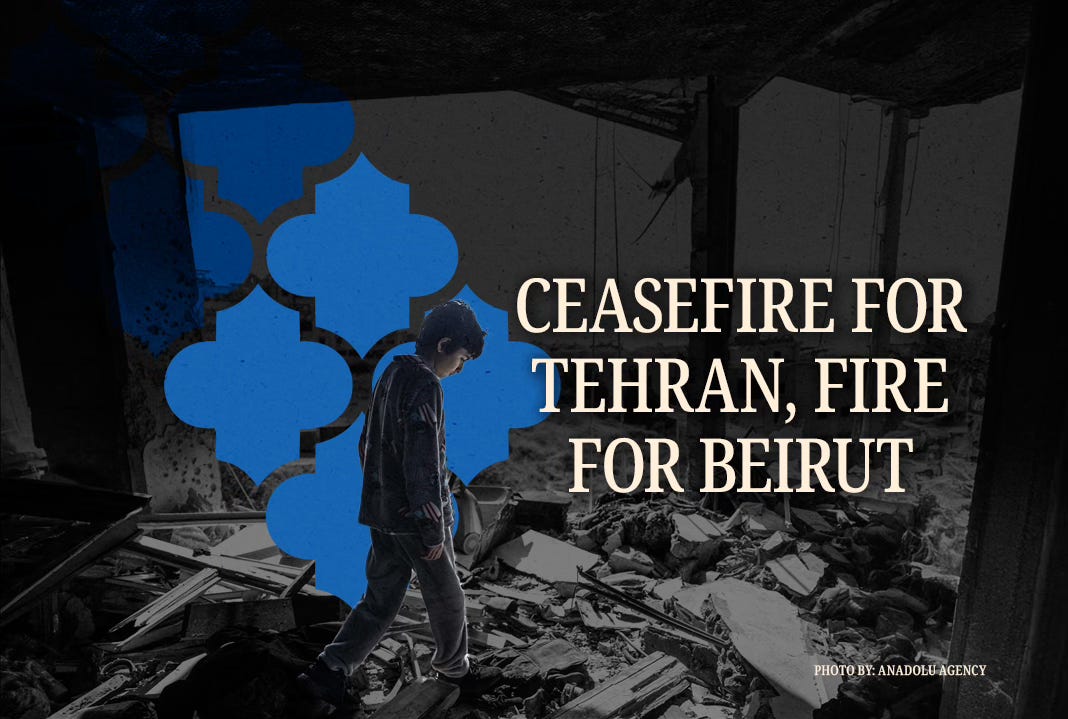
On April 8, just hours after Washington and Tehran announced a two-week pause in hostilities to allow for direct negotiations, Hezbollah declared victory, as it has done previously, regardless of the facts. Minutes later, the truth exploded all over Lebanon. Israel unleashed the heaviest wave of strikes since its war with Israel began, killing at least 254 people and injuring around 1,200.
The latest wave of violence threatened the fragile ceasefire and prompted Iran to pull back on its promise to reopen the Strait of Hormuz. The US and Israel have responded with claims that Lebanon was not included in the ceasefire agreement. Iran and mediator Pakistan say it is. Efforts to spin this as a “legitimate misunderstanding” fool no one. Lebanon’s exclusion from the deal was deliberate.
This is the moment the Hezbollah myth breaks in public: the organization that dragged Lebanon into the fire “for Iran” has discovered that Iran can protect its interests while Lebanon burns.
It is possible that Hezbollah was never included in the deal in the first place. In this case, the group was used as an auxiliary front, activated when Iran needed leverage, then sidelined once it secured a pause. Or, Hezbollah was included in theory, only to be carved out of the agreement in practice.
The second option explains the public contradiction. If Lebanon was discussed, it was discussed as an external file—a separate arena that Israel could continue to “sanitize” while Iran enjoys the benefits of a truce. That is what a carve-out looks like: the ceasefire protects the signatories, and the non-signatory becomes fair game.
Either way, Hezbollah’s strategic problem is exposed: once you choose to be a proxy, you are never guaranteed proxy protection.
The foundations of Hezbollah’s predicament were laid long ago, when the group’s founding doctrine pledged obedience to the Iranian jurist-leader and cemented its status as a mercenary group. In today’s politics, the relationship is described even more bluntly. A recent analysis cited Lebanon’s prime minister as saying that the IRGC commands Hezbollah, while commentators have claimed that the group cannot disarm without Iran’s authorization.
Hezbollah’s role in the conflict that erupted following US-Israeli strikes on Iran reflects this dynamic. Its entry into the war was not a Lebanese sovereign decision. It did it because it was ordered to do so, after the assassination of Iran’s supreme leader on February 28. That is the definition of a mercenary dynamic: a Lebanese organization initiating a Lebanese front in response to an Iranian trigger.
With that comes the consequences—the moment you learn your employer can stop the war and still watch your people bleed.
The strikes that followed the ceasefire on April 8 unleashed a wave of destruction across Lebanon, with central Beirut neighborhoods hit, hundreds killed nationwide, hospitals damaged, ambulances struck, and whole families erased in minutes. The UN described casualty reports as “appalling,” with the human rights chief calling the destruction “horrific.”
They are all to blame. Israel, for using civilian pain to squeeze political outcomes in what can only be described as a criminal act. Hezbollah for embedding within civilian communities and forcing ordinary people to become the canvas on which military messages are written. And the Lebanese authorities, for presiding over prolonged political paralysis. A state that cannot prevent war, cannot contain escalation, and cannot even establish a unified negotiating posture is less like a sovereign state and more like an emergency NGO issuing appeals over rubble.
The Lebanese government announced a ban on Hezbollah’s military activities last month after the group opened fire on Israel, but it was never backed by any action. The ban was another theatrical performance, nothing more.
The army, too, is caught in a crisis, reluctant to enforce the state’s monopoly over arms and confront Hezbollah. This undermines efforts to pull Lebanon out of war and separate the state from Hezbollah.
As officials scrambled to clarify whether Lebanon was included in the truce, Prime Minister Nawaf Salam insisted that no one negotiates for Lebanon except the state. This is the contradiction that kills countries like Lebanon, where everyone declares sovereignty but nobody wields it.
Clearly, the ceasefire has not ended the war in Lebanon, but it has clarified the status of a key political player. From now on, Hezbollah can no longer claim to be Lebanon’s shield; it is Iran’s instrument—manipulated by Iranian priorities and abandoned when they shift. The fatal weakness of mercenary politics has been exposed: the proxy is excluded from political processes and then left to count the dead. Beirut learned that lesson yesterday, and it will live with the consequences for years to come.
Middle East Uncovered is powered by Ideas Beyond Borders. The views expressed in Middle East Uncovered are those of the authors and do not necessarily reflect the views of Ideas Beyond Borders.
