


The recent clashes between Hezbollah and Israel, following the death of Iran’s Ali Khamenei, have rendered much of southern Lebanon uninhabitable. The fighting between the two parties continues today unabated, and Hezbollah’s latest incorporation of low-tech drones is posing a new challenge to Israel’s campaign. For the Christian minority in the south, the situation is becoming more dire by the day. But despite the uncertainty, many families are committed to staying, unwilling to relinquish their ancestral land.
“It felt like a more intense continuation of the 2024 war,” said Judith Sleiman, a Christian Lebanese Pharmacist who lives in Southern Lebanon’s Burj Al Molook, a village in the district of Marjayoun. “The moment Lebanon became involved again, memories and flashbacks from those days immediately came rushing back.” Sleiman told Middle East Uncovered.
Southern Lebanon’s Christian villages are concentrated mainly in the districts of Marjayoun, Bint Jbeil, and Hasbaiyya. Some, including Rumaysh and Ain Ebel, have grown increasingly isolated by the fighting. Others, such as Burj Al Molook, face regular bombardment.
“The constant loud sounds of daily bombings returned once again,” Sleiman said. “You would wake up to them and fall asleep hearing them, too. Even sleep no longer gave your body the rest it desperately needed.”
Sleiman’s family home in the south dates back many generations. Despite the difficulty of their current living situation, her family continues to cling to it. According to Sleiman, they rarely leave home due to safety concerns, and rely on humanitarian aid delivered to churches and distributed to local families.
“Many people urged us to leave and find safety elsewhere, but that never felt like the right choice,” Sleiman told Middle East Uncovered. “Even while living with fear and danger, leaving would have meant losing something even deeper—our villages, our olive trees, and our sacred land, the land that Jesus Christ walked on.”
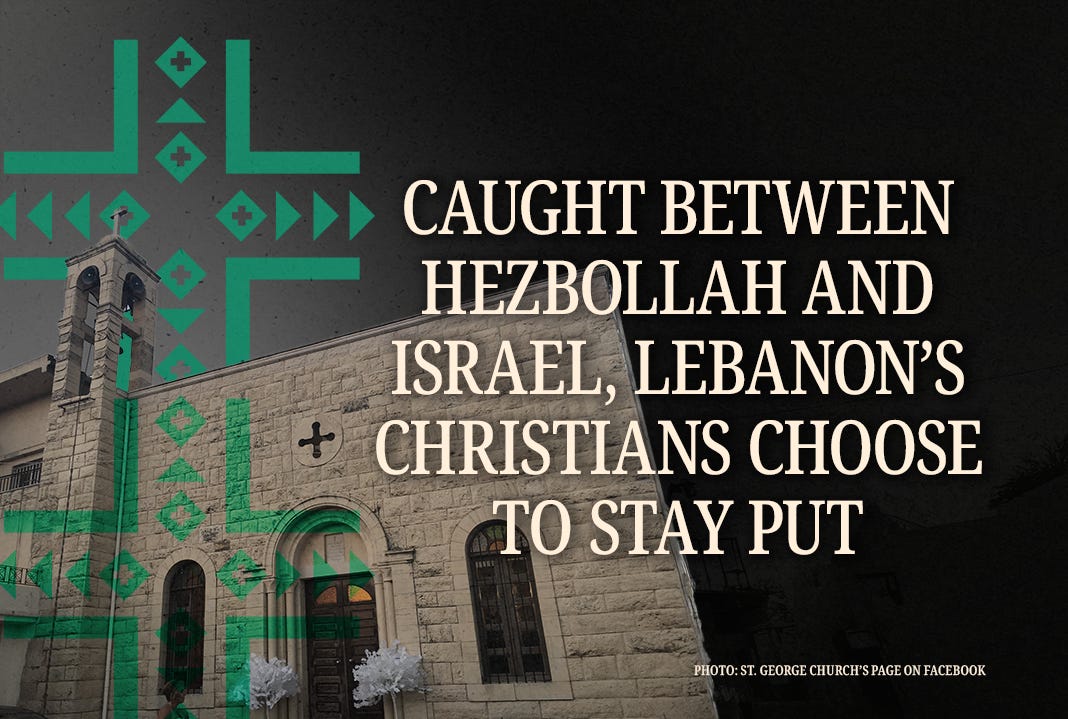
Further south in the village of Rumaysh, Tony Elias, a priest at St. George church, is another member of the Christian community committed to staying. According to Elias, there are a total of 6,200 Christians in Rumaysh in addition to the 75 families from the villages of Yaroun and Quozah.
“How could I not stay in a land that has been blessed with the footsteps of Jesus?” Said Elias. “This land has been inherited to us by our forefathers, and it is our duty to preserve it for the generations to come.”
Elias says it has been particularly difficult for farmers in the south, who face difficulty accessing their land used for tobacco farming. Only some have managed to access it. Since Elias and his community live within the Israeli “yellow line”—a military buffer zone that extends 10 kilometers into southern Lebanon from the border—their movement is heavily restricted.
Outside of the neighboring villages of Ebel and Debl, Elias needs prior authorization to visit other zones. “Despite the hardship, we are still trying to live a normal life that is motivated by faith and the desire to further cement our presence in the land,” Elias said.
Since the outbreak of the conflict in early March, More than a million Lebanese have been displaced. Some southern villages have either been destroyed or occupied by the Israeli Defense Forces (IDF). Many of those who have been displaced are currently housed in public schools, which have been transformed into shelters by the state of Lebanon. The shelters, however, are overflowing, leaving many without housing.
Mahdi Hallal is one of the thousands who have left the south. Prior to leaving, Hallal lived in the Shia-majority city of Nabatieh. He left with his family on March 2nd of this year, a couple of hours after the IDF started targeting towns in the south. This was the second time they were displaced, having previously fled in September 2024.
“The most horrendous sight that my eyes ever witnessed was on the road when we were leaving,” Hallal told Middle East Uncovered. “A building that was no more than 10 feet on our left got obliterated into rubble and dust. All you could see was fire and ash, and my first thought was ‘hell’…hell was the perfect description of the whole experience.”
As the sound of warplanes and bombardment grew closer, Halal and his family said it was psychologically unbearable. Expecting their town to be targeted next, he and his family fled shortly before it was struck, roughly 30 minutes after they left. They now live in Mount Lebanon, though he says he often thinks about those who had no way to leave.
“There are thousands of people who stay in their homes under daily and continuous danger because they can’t afford to rent somewhere else.” Hallal told Middle East Uncovered. “It is less about pride in the face of the enemy, and more about not wanting to go through humiliation and the possibility of having to sleep in tents and on the streets. They prefer death over the suffering of uncertainty.”
As the war drags on, many displaced Lebanese face an uncertain future. Entire towns in the south have been damaged, emptied, or isolated by the fighting. For the Christian minority in southern Lebanon, however, leaving is about more than safety. Many see it as abandoning a generations-old connection to the land, rooted in family history and religious faith.
For them, preserving their presence in the south is nothing short of a religious calling—a deeply held belief that they belong there—and not even bombardment will uproot them from the land where Jesus once walked.
Middle East Uncovered is powered by Ideas Beyond Borders. The views expressed in Middle East Uncovered are those of the authors and do not necessarily reflect the views of Ideas Beyond Borders.