


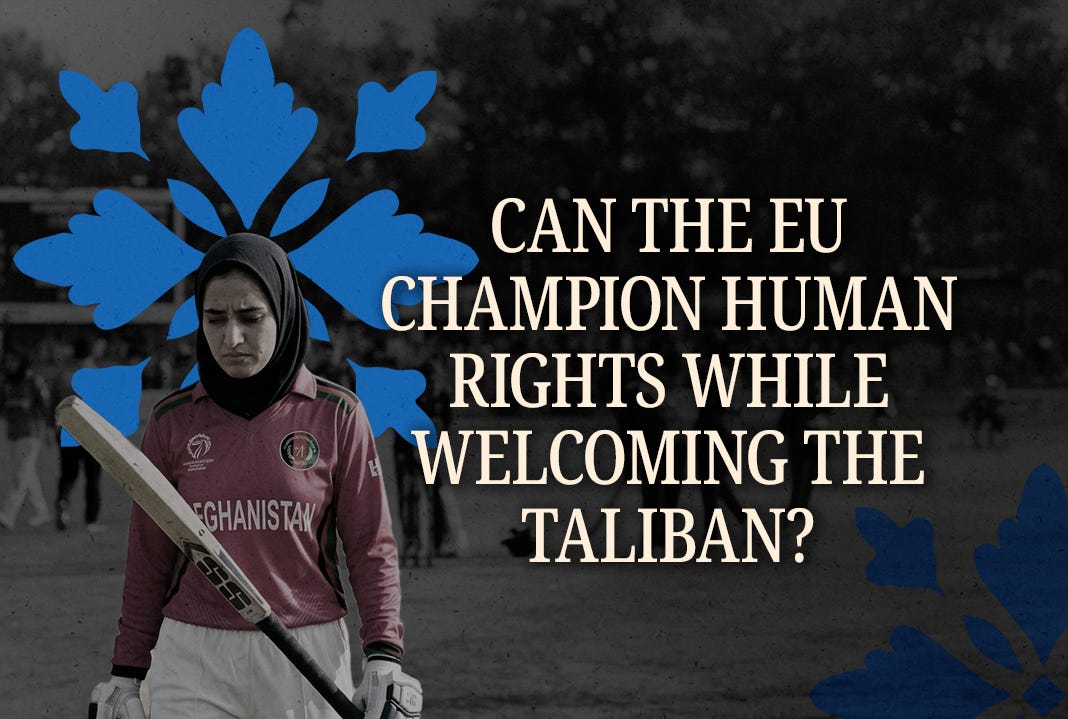
Greeting each of the Afghanistan women’s national cricket team players in Clarence House, King Charles inquired about their journeys, training routines, families, and marveled at their command of English.
“You’re amazing, you speak such good English!” he told the women as they beamed in their bright pink sports shirts.
Later, they presented the king with a signed shirt, a bat covered in Afghan-style decorations, and a lapel pin featuring the team’s badge.
This visit to Clarence House, on The Mall in London, was a warm, symbolic encounter in which the king honored a group of extraordinary women who have refused to surrender to one of the world’s most oppressive regimes.
Yet, just days earlier and only a few hundred miles away, European officials welcomed representatives of that same regime to Brussels.
The two moments could not have sent more different messages.
The Afghan women’s cricket team is celebrated by Britain because they represent everything the Taliban seeks to erase. Forced into exile after the Taliban seized power in August 2021, they now live in Australia and compete as the Afghan Refugee Women’s Team because they are barred from representing their home country. The International Cricket Council shamefully refuses to recognize them as their country’s official women’s team, even while the Afghan men’s team continues to compete freely internationally.
Their presence on the cricket field is a rebuke to the regime that outlawed their dreams.
For Marzia Babakarkhail—a former Afghan judge who survived two Taliban assassination attempts—Europe’s decision to engage directly with Taliban officials sends an alarming message.
“I believe the EU has made the wrong decision in this case,” she told Middle East Uncovered. “Any approach that leads to deportations or strengthens cooperation with the Taliban raises serious human rights concerns.
“Afghanistan is still facing a severe crisis, particularly for women and girls. Our schools are closed, women are forced to stay at home with no jobs, no system and no protection under the law.
Returning people to such conditions cannot be justified. The EU must remain consistent with its own values and commitments. Human rights, dignity, and the protection of life and safety must always come first.”
She has lived the consequences of the regime Europe is now engaging.
Babakarkhail spent years serving as a family court judge in Afghanistan while campaigning for women’s rights and establishing schools to educate girls. Those efforts made her a target. Taliban militants first stormed her home armed with guns. When that failed, they deliberately ran her down with a car and left her for dead. After six months in hospital, she fled to Britain without speaking a word of English. Today she is a proud British citizen and works for a member of parliament in Greater Manchester.
Her story mirrors the choices now confronting thousands of Afghans.
Firooza Afghan was only months into her professional cricket career when the Taliban swept back into Kabul. She and her teammates immediately went into hiding, fearing they would be identified as athletes in a country where women would soon be banned from almost every aspect of public life. An extraordinary rescue effort led by Australian cricket figures Mel Jones, Dr Catherine Ordway, and Emma Staples eventually secured humanitarian visas for the players, coaches and their families.
Firooza was among the last to escape. Together with her mother, siblings and aunt, she crossed illegally into Pakistan, passing through eleven Taliban checkpoints before finally reaching safety. Now 21, she says every match is played for those left behind.
“We are not playing for ourselves but for all Afghan women in our country where the situation is getting worse and worse day by day,” she said in an interview with a British newspaper.
“They, too, deserve to be free and choose their own path in life, and we want to remind a world that seems to have forgotten.”
This week, officials from the European Commission and representatives of 15 member states met a Taliban delegation in Brussels in an effort to accelerate the return of Afghan migrants, particularly those convicted of serious crimes or considered security threats.
It was the first time Taliban representatives had been invited to Brussels.
The meeting reflects a growing dilemma for European governments. Afghanistan has long refused to cooperate over deportations, while domestic political pressure to increase migrant returns continues to mount across much of Europe.
According to the latest figures, more than 14,000 Afghan nationals were ordered to leave EU countries during the first nine months of last year. Yet only around 340—or two percent—were actually returned.
European officials insist practical engagement with the Taliban does not amount to formal recognition.
Johan Forssell, Sweden’s migration minister, a country that hosts one of Europe’s largest Afghan populations, defended the meeting in the local press, arguing that his government must negotiate to “protect Swedish interests.”
For a regime that has spent years seeking international legitimacy, invitations to Brussels carry enormous symbolic value.
Since returning to power, the Taliban have issued more than 160 decrees systematically dismantling the rights of women and girls. Girls are banned from secondary schools and universities. Women have been pushed out of most professions, forced to comply with increasingly oppressive dress codes, subjected to severe restrictions on movement, and excluded from public life. In many cases they are effectively denied the ability to participate in society without male permission.
Against that backdrop, many human rights advocates fear that migration policy is beginning to eclipse the very values Europe claims to defend.
Volker Türk, UN High Commissioner for Human Rights, has warned against any forced returns, arguing that people can’t legally be sent back to places where they risk torture or persecution.
Amnesty International has likewise condemned any cooperation on deportations, describing Afghanistan as fundamentally unsafe and warning that engagement with the Taliban over returns ignores Europe’s legal and moral obligations.
Babakarkhail shares those concerns.
“I am deeply concerned about any engagement with the Taliban that could be seen as normalizing their authority,” she says. “Afghanistan is still facing a severe human rights crisis, especially for women and girls, who continue to be denied their basic rights, including education, work and freedom.
“Any discussion with the Taliban must be approached with extreme caution and must not come at the cost of human rights or the dignity of the Afghan people.
“The international community, including the EU, should ensure that human rights remain at the center of any engagement and that the voices of Afghan women are not ignored.”
That is precisely the question now facing Europe.
Raquel García Hermida-van der Walle, a member of the European Parliament and Chair of the Delegation for Relations with Afghanistan, said the visit was a “betrayal of our values.” She added, “The Taliban receive the privilege of dealmaking with the entire European Union, and some seem fine with it. Yes, getting migration under control is important, but so is maintaining a minimum of decency and standards.
“Europeans died to give women and girls their rights. So no, don’t legitimize the Taliban—ever. No one disputes that governments must manage migration or negotiate difficult international realities. But there is a profound difference between pragmatic engagement and conferring legitimacy on one of the world’s most repressive regimes.”
Europe cannot applaud the courage of Afghanistan’s exiled women cricketers on the one hand while, on the other, offering the regime that drove them into exile a seat at the diplomatic table in Brussels.
If the European Union truly believes in human rights, equality, and the protection of women, those principles should not be up for negotiation whenever issues around migration become inconvenient.
For Afghan women, it is yet another example of how world leaders, once again, are choosing to look the other way while they continue to suffer.
Middle East Uncovered is powered by Ideas Beyond Borders. The views expressed in Middle East Uncovered are those of the authors and do not necessarily reflect the views of Ideas Beyond Borders.