


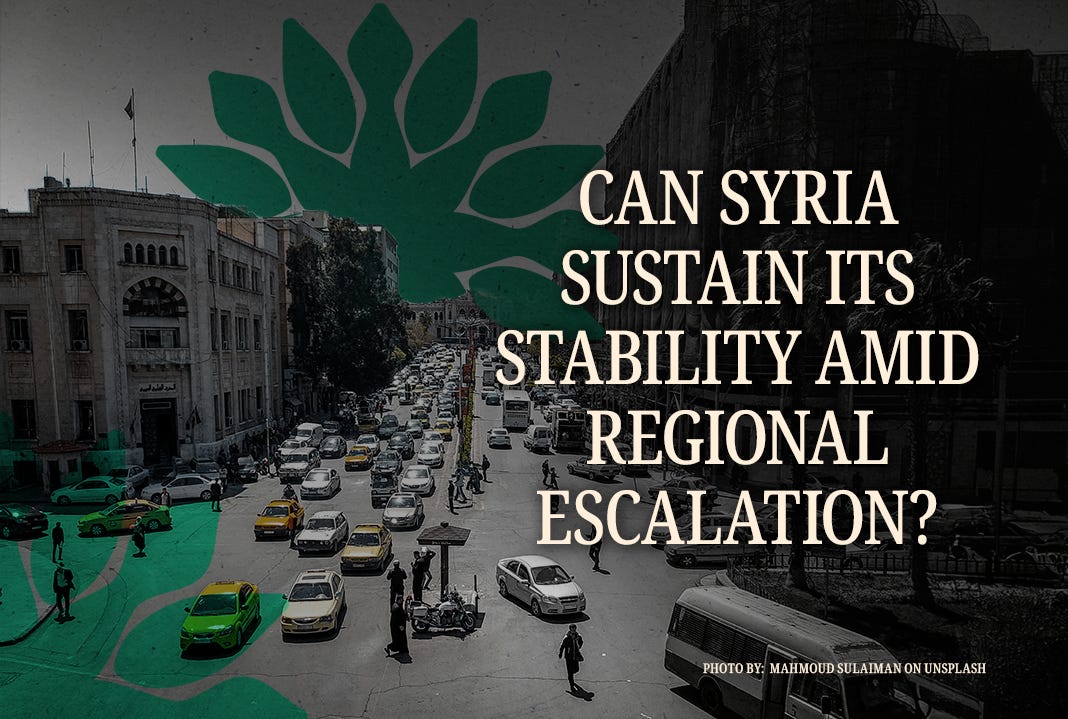
DAMASCUS, Syria — People on the streets barely look up at the sound of missile interceptions overhead, even as Israel and the United States escalate their conflict with Iran.
For the first time in well over a decade, Syria seems to have become one of the safest countries in the region.
Regional violence has killed over a thousand people in Lebanon and Iran and dozens elsewhere in recent weeks, as the ongoing war widens; nevertheless, many Syrians continue to return and rebuild. After more than a decade of barrel bombs, snipers, foreign militias, and fragmentation, this period of being largely left alone—for the time being, at least—has restored a sense of hope in much of the population.
Citing the latest figures from the EU border agency Frontex, Benjamin Feve, senior research analyst at Karam Shaar Advisory, posted on X on March 20 that “only 30 Syrian nationals were detected crossing into the EU irregularly in January 2026,” marking a sharp drop from previous years.
Conversations in Damascus’s upscale cafés often focus on business opportunities and complications tied to international travel amid airport shutdowns; in less well-off households on the outskirts, discussions center on rising prices for basic goods and a persistent lack of electricity.
One Lebanese-Syrian woman in Damascus told me that “war has become normal for us,” adding that she plans to bring as much of her family still in Lebanon to Syria as soon as possible.
As Western embassies in Iraq and Lebanon—Syria’s neighbors to the east and west—issued shelter-in-place orders requiring staff to remain at home and prepare for emergencies, diplomatic personnel in Damascus attended lavish iftars during Ramadan and moved freely around the city.
This relative safety has not come effortlessly. Over the past year, a wide range of actors have worked to ensure that Syria’s neighbors and major powers do not view the country or its current leadership as a threat.
Syria’s transitional government has made no secret of the fact that it considers good relations with the United States key to the country’s future. In November, Syrian and US officials announced that Syria had joined the US-led international coalition against the Islamic State, after Syrian President Ahmed al-Sharaa visited Washington and met his US counterpart at the White House.
As part of efforts to ensure that the Jewish community knows it is welcome, the US-based Syrian Emergency Task Force—including its executive director, an American citizen of Palestinian-Syrian origins, Mouaz Moustafa—took several figures from the community to Syria to meet with key government officials and visit the Damascus synagogue as well as other places in the city last year.
The Syrian government has also worked to ensure at least cordial relations with Russia as well, despite Russia’s massive involvement in the war and its ongoing harboring of the Assad family. Russian President Vladimir Putin met with Syria’s foreign and defense ministers in December to discuss political, economic, and military issues of “mutual interest.”
“During the meeting, both sides reviewed ways to advance military and technical partnership in a manner that strengthens the defensive capabilities of the Syrian Arab Army and keeps pace with modern developments in military industries,” Syrian official state news agency SANA reported at that time.
Syrian Foreign Minister Asaad al-Shaibani said, during a meeting with his Russian counterpart, Sergey Lavrov, on the same trip, that Russian-Syrian relations were entering “a new stage.”
Many Syrians, meanwhile, still view Israel warily—or worse. However, many have come to acknowledge that it is a neighboring country with significant military and geopolitical power, and ensuring it does not see Syria as a threat is essential for their future and that of their children. As a result, Syria has not reacted militarily to the numerous Israeli attacks on its territory since the former regime fell on December 8, 2024.
Iraq and Syria have also been working to maintain good neighborly relations since Assad’s ouster, despite the fact that Iran-backed Iraqi armed factions had previously fought against the core of Syria’s current government and were responsible for the deaths of many Syrian civilians.
Iraq’s intelligence chief made the first of multiple visits to Damascus only a few weeks after former Syrian president Bashar al-Assad fled. Cooperation with Iraq has made it possible to avert several alleged plans to assassinate Syria’s new president.
Iran, however, is no longer welcome here. Many Syrians say that while Russian-Syrian relations at times brought some benefits before the war, most see Iran’s influence in the country as having been largely detrimental to both the state and its population.
Since the conflict in Syria began in 2011, following brutal crackdowns on anti-government protests, Iran-backed militias held de facto control over large parts of the country, including areas near the Iraqi border. Since their departure, along with Assad’s, gains in personal freedom and societal trust have been made. A Freedom House report released on March 19 found that Syria made the largest gains in political rights and civil liberties worldwide in 2025, amid a global decline in such rights.
Syria still faces significant challenges, however, and the ongoing conflict may aggravate them. Even seemingly mundane issues that continue to affect the country and its population may have serious consequences if not addressed quickly. Several foreign diplomats and NGO staff, for example, have repeatedly criticized, in private, the stifling and counterproductive nature of existing bureaucratic procedures; some who worked in the country prior to Assad’s ouster say that cumbersome regulations and time-consuming processes have become even more burdensome.
This, some in Syria say, may largely stem from a deeply ingrained cultural mindset that will take time and effort to change; neither Syria nor the wider region has the luxury of time, unfortunately, if they want to avoid serious repercussions on their economies and society as a whole. For now, the relative calm is holding. But it rests on a narrow set of calculations: restraint at home, careful signaling abroad, and a regional environment that could shift quickly. In a region where escalation has become the norm, Syria’s stability remains contingent, not assured.
Middle East Uncovered is powered by Ideas Beyond Borders. The views expressed in Middle East Uncovered are those of the authors and do not necessarily reflect the views of Ideas Beyond Borders.

Thank you for this excellent analysis. I have linked to it from my Syria Specific beat: https://michaelalandover.substack.com/p/syria-one-valuable-essay. I have held out hope that this could happen, and it is almost hard to believe.
I am distressed to read about the March 30 kidnapping of Shelly Kittleson. I would hope that our country would participate in finding you as quickly as possible. Instead, we’re getting an unhelpful “I told you so” from a regime who holds journalists in high contempt. Please come back safe and in good health. Our thoughts are with you.