


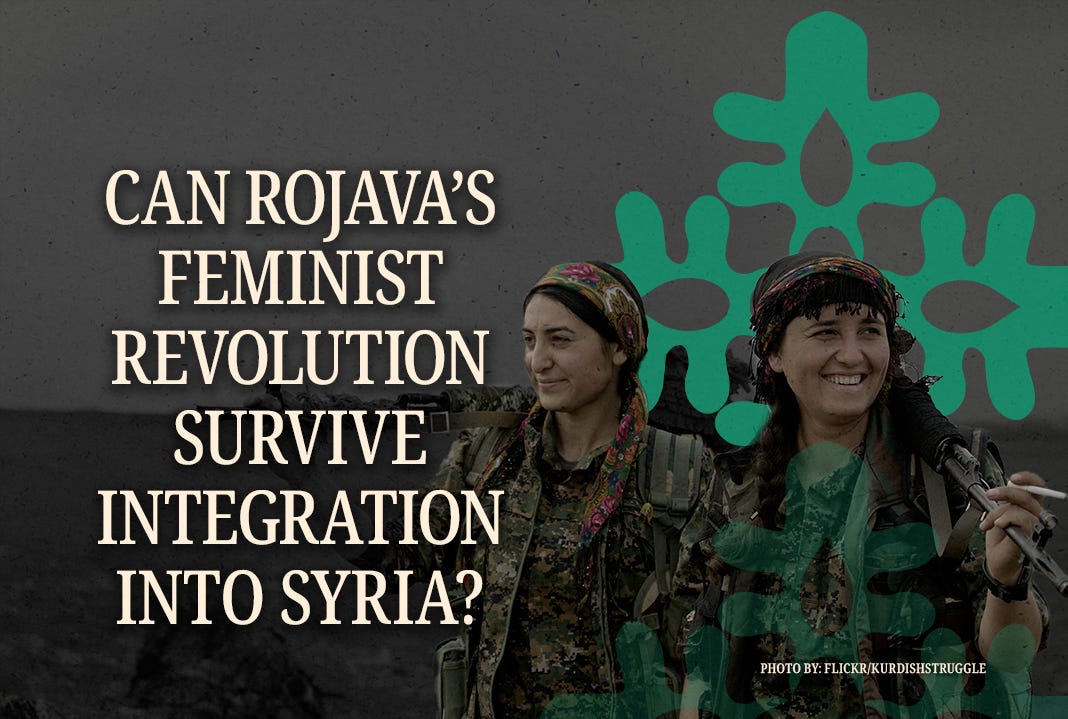
The weeks leading up to the truce were terrifying. Fighting drew closer to Janeh Layle’s home near Qamishli as government forces advanced across Kurdish-held areas in northeast Syria. A lightning offensive by the Damascus army in January had forced the Kurdish-led Syrian Democratic Forces (SDF) to relinquish large swathes of territory, prompting waves of displacement. “They were less than an hour away. We were really afraid,” she said.
Days later, crowds gathered in the streets to celebrate an end to weeks of violence. Layle was among them, grateful that war had been averted. But as the immediate danger subsided, deeper anxieties surfaced. After more than a decade of self-rule, how would Kurds preserve their way of life under Syria’s new leadership, in particular, the freedoms that allowed women to live and work as equals?
“Women were given a real chance to develop here. It was an opportunity for us to create a community and shape our environment as it should be,” Layle said.
The January 30 ceasefire deal between interim President Ahmed al-Sharaa and SDF commander Mazloum Abdi ended the Kurdish-run autonomous administration in northeast Syria and set out a path towards integration. It marks a significant step in Damascus’ push to reassert nationwide authority—a process welcomed by Washington as a step towards reconciliation and unity.
Critics, however, warn that compelling the Kurds to surrender hard-won rights could deepen tensions in a country still plagued by division. The SDF previously held about a quarter of the country, managing prisons containing ISIS fighters and major oilfields, which have now been transferred to Damascus.
“The population in the predominantly Kurdish regions is sceptical of the agreement, and rightly so,” said Lea Schneider, a member of the Women Defend Rojava Campaign. Vague wording and lack of detail have fueled concerns that concessions on paper could be pared back in practice. “It does not yet include provisions regarding women’s rights, which is a major worry,” she added.
For more than a decade, the Democratic Autonomous Administration of North and East Syria (DAANES), widely known as Rojava, built a system grounded in gender equality and grassroots governance. Supporters have described it as the world’s “first feminist revolution,” and the birthplace of the Jin, Jiyan, Azadi (Women, Life, Freedom) slogan chanted during 2022 protests in Iran.
However, human rights organizations have at times accused the ruling Democratic Union Party (PYD) of restricting political pluralism, detaining rivals, and suppressing dissent. “It is important not to romanticize Rojava and to recognize that gaps exist between rhetoric and reality. But where its ideas worked out, they were transformative,” wrote Natasha Walter in The Guardian.
Under the administration’s co-chair system, institutions at every level of government are headed by both a man and a woman. Universities offer classes in jineology, the “science of women,” premised on the idea that society cannot be free without female liberation, while female-only cooperatives promote financial independence.
While visiting the autonomous administration last year, Walter was struck by the everyday feminism she encountered throughout society. Women in all roles—soldiers, university professors, factory workers, farmers, and politicians—were well-versed in feminist literature and eager to debate. “They were talking about how they were building on western feminism and how they had new ideas…they have their own inspirations, but they were very engaged in terms of my traditions as well,” she told Middle East Uncovered.
The Women’s Protection Units (YPJ), an all-female militia affiliated with Kurdish forces, became a symbol of women’s role in the fight against ISIS and the feminist principles underpinning the Rojava revolution. “We believe that women’s liberty is society’s liberty,” said YPJ commander Nesrin Abdullah.
Speaking before the ceasefire, she warned of a fundamental misalignment between Kurdish communities in Syria and the country’s new government. “This attack on the region is an attack on women. What we have gained in the past 14 years through the revolution, particularly for women, they want to demolish it,” she said.
There is currently one woman in Al-Sharaa’s transitional government. Hind Kabawat, who has served as the minister of social affairs and labour since March 2025, has expressed a commitment to driving change and said she is not in the position for “window dressing.”
Al-Sharaa has insisted that minority and women’s rights will be protected, but analysts question whether the policies practiced under the autonomous administration can endure in a region where women are often marginalized from political life.
“The feminist ideology of PKK and PYD is central to the ideology of the ruling party of Rojava, but it does not equally penetrate the whole Kurdish society,” said Thomas Schmidinger, Associate Professor for Political Science and IR at University of Kurdistan Hewlêr (UKH) and author of several books on Rojava.
Al-Sharaa has gone some way towards addressing grievances that have long marginalized Kurds in Syria. A landmark decree in January granted citizenship to stateless Kurds and recognized Kurdish as a national language. However, many Kurds say these concessions fall short of the constitutional recognition needed to secure their status in Syrian society.
Others warn that the SDF’s forced surrender risks renewed clashes as the implementation process unfolds. Trust between the Damascus government and Syria’s largest minority group is tenuous, particularly after the recent massacres of Druze and Alawite communities raised the specter of further sectarian violence.
Forcing the Kurds to relinquish self-rule in Rojava, “destroys the possibility of a peaceful reunification of Syria under a more inclusive new system,” Schmidinger said. “Druze and Alawites will now rely even more on protection from outside, for example, from Israel.”
While voices in favor of Al-Sharaa’s centralizing mission, including many Western and Arab governments, see reintegration as an opportunity to build a strong, inclusive Syrian state, others warn of further instability as the implementation process unfolds.
“The recognition and protection of human rights for all population groups living here must be guaranteed in order for a democratic Syria to emerge,” said Schneider. Policies introduced during the period of autonomous rule should inform the country’s future political framework, she continued. “It cannot be a one-way thing.”
To many Kurdish women, Al-Sharaa’s background as a jihadist with links to al-Qaeda and ISIS is impossible to reconcile with the lives they lead in Rojava after more than a decade of social and political progress. “His misogynistic attitude can be seen in Raqqa and Tabqa, where Qurans and niqabs were distributed immediately after the occupation. Women who had begun to build free lives there now report living in fear and oppression,” Schneider said.
Kurds have long felt vulnerable in Syria, with hundreds of thousands denied citizenship under Assad’s rule. Banned from speaking their language and excluded from political life by a regime that treated Kurdish identity as a threat, many lived in a grey zone, unable to vote, own property, or secure a marriage license.
When the Syrian uprising erupted in 2011, Layle was a student in Damascus. As a 20-year-old Kurdish woman, she experienced a “double burden” in the university’s patriarchal environment. “You not only had to protect yourself as a woman, but because you were Kurdish as well,” she said.
In 2012, as the regime focused on uprisings in Damascus and Aleppo, the Kurds took advantage of the security vacuum to establish a system of self-governance in the northeast. It felt like a breakthrough had finally been achieved.
Then a new threat emerged. In 2013, an even more violent offshoot of Al-Qaeda was gathering strength amid the chaos consuming the country. Over the next year, ISIS would grow into a formidable force, sweeping across Syria and Iraq to seize vast swathes of territory and announce a new caliphate.
It was Kurdish YPG and YPJ forces, supported by US airstrikes, that finally halted the militants’ rampage. Images of female fighters resisting jihadists captured global attention and cast a sympathetic lens on the political project unfolding in Rojava.
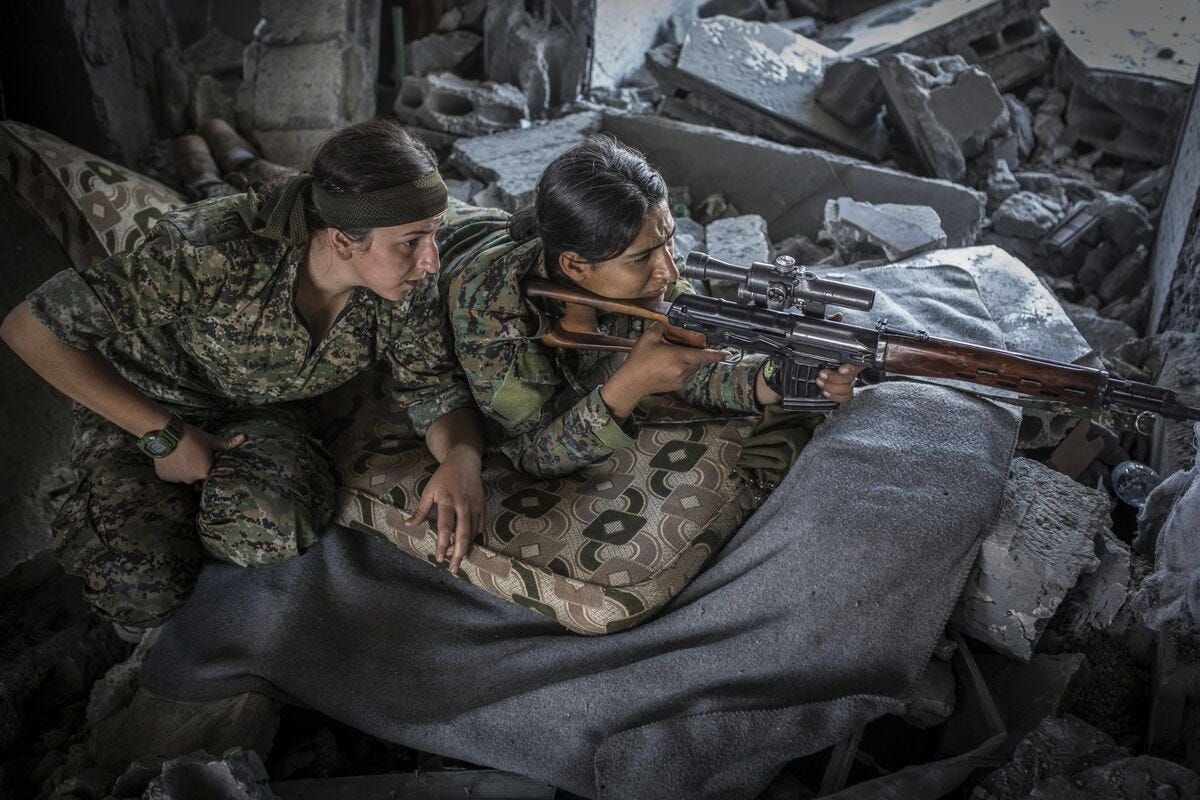
But in the Middle East, self-rule in Rojava faced substantial opposition. Ankara views the SDF as an extension of the banned Kurdistan Workers’ Party (PKK), which has waged a decades-long insurgency against the Turkish state and is proscribed in the United States, the EU, and the UK. The conflict has claimed tens of thousands of lives and remains a major security concern for the Turkish government, which further deters Western allies from formally recognizing the Kurdish-led administration in Syria.
When fighters from the Islamist militant group Hayat Tahrir al-Sham (HTS), led by Ahmed al-Sharaa, seized power in December 2024, Kurds in the northeast feared it would be a matter of time before their autonomy came under threat.
That moment arrived in January, when the US announced an abrupt end to its strategic partnership with the SDF and threw its support behind Al-Sharaa. In a statement, Tom Barrack, the US ambassador to Turkey and envoy for Syria, said the SDF’s role had “largely expired” and welcomed Damascus’s push towards centralization.
Many Kurds felt abandoned by the loss of their powerful ally, leaving them exposed in a region where they have few reliable partners.
Since the peace agreement, government forces have swiftly consolidated their control over the northeast. Within days of the deal, borders and checkpoints in former SDF territory were secured, and Damascus officials began assuming authority over ministries and revenue streams.
For women’s organizations, life has already changed. Speaking with colleagues at Mala Jin women’s centers in territories that have come under government control, Bahiya Mourad consoles those who can no longer go to work.
When she helped open the first women’s center over a decade ago, it was considered shameful for women to discuss domestic disputes publicly. Over time, trust grew, and the centers became safe havens for both men and women. “We are really proud of our work,” she said. “If we return to how we were before, women will experience violence and be valueless.”
Funding poses an immediate challenge. “These institutions want to stay, but how are they going to be funded? That’s a huge question as a lot of the big revenue generators will be in the hands of the central government,” said Isabelle Edmonds, a researcher at the Rojava Information Centre.
For now, the ceasefire is holding across northeast Syria, but in Kurdish-majority areas, urgent discussions are underway. The dismantling of the autonomous administration may mark the end of Rojava as a political project, but the social movement it inspired stands strong. Students at Rojava University, where Layle lectures in art, have grown up studying in Kurdish, debating feminist theory, and watching women run ministries and command battalions.
“All the things we have built, we really believe in,” Layle said. “We will not just give them up.”
As regional tensions escalate following US-Israeli strikes on Iran, Kurdish women in Rojava are planning for what comes next. “We know very well that women’s rights are often the first victim in any political settlement that does not place equality at its core,” says Shera Osey, of the Syrian Democratic Council.
When news of the ceasefire broke, she was meeting fellow activists. The conversation quickly turned to safeguarding their gains. “My hope is that women’s role will not be reduced to slogans, but translated into real partnership in drafting the constitution and making decisions,” she said. “The future we want is a democratic and pluralistic Syria in which women are full partners, not a political margin.”
Middle East Uncovered is powered by Ideas Beyond Borders. The views expressed in Middle East Uncovered are those of the authors and do not necessarily reflect the views of Ideas Beyond Borders.