


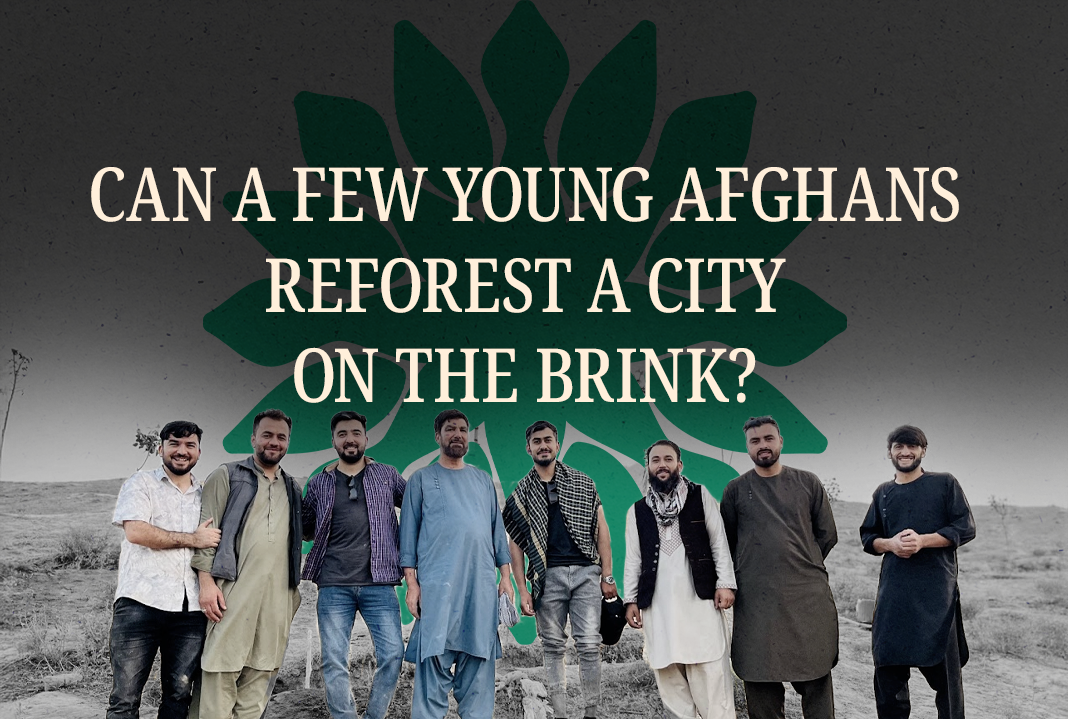
It was the morning of May 25, 2025, when Tamim Alimyar, his brother, and a group of close friends set out for Haji Nabi Hill. On the outskirts of Kabul, the hill is mostly bare and dry for much of the year. But on this day, Alimyar and his friends were on a mission to plant around a dozen trees.
“We had no previous knowledge of gardening, tree planting, or even watering plants,” he said. “But we were passionate about the impact it could have on the environment.”
Alimyar, a 26-year-old civil engineer from Kabul, had spent weeks preparing for the effort. By the end of the day, the group had planted 12 trees and returned home with blistered hands.
Alimyar and his brother, Iqbal, are avid followers of Emran Wadan, an Afghan travel vlogger, YouTuber, and nature explorer. Wadan, who is based in the U.S., recently visited Afghanistan, documenting his journey across the country’s mountains and valleys.
“We used to watch Emran’s videos at home on TV, and my brother would always say, ‘Why isn’t he planting a tree wherever he goes?’” said Alimyar. “It could be a great opportunity for him to plant trees close to these water sources for the good of the country.”
In response, Alimyar told his brother, “Let’s do it. He visited the places, but we can plant the trees.”
And with that, Every Tree for a Hope was born.
Alimyar had no experience planting or caring for trees. “It was a long shot,” he said, but he and his brother decided to share the idea with their friends. “We are civil engineers, a couple of software engineers, a few medical science students, and two economics graduates,” he told Middle East Uncovered.
What united them was a shared passion for promoting a culture of tree planting in Afghanistan and encouraging others to join in. “Imagine if every family plants a tree in Kabul—we will have a much greener future in this city,” Alimyar said.
Afghanistan’s landscapes range from dense forests to arid deserts, from mountain summits to vast plains. But years of war, drought, neglect, and deforestation have severely damaged many parts of its ecosystem. Kabul, in particular, suffers from intense winter pollution, driven largely by the burning of dirty fuels for heat. Trees have been cut down extensively in and around the city, and water levels have dropped to historic lows.
According to a 2024 study, air pollution in Afghanistan contributed to 37,033 deaths in 2019 alone. Many of the country’s environmental challenges stem from a longstanding lack of attention to urban greenery.
Trees, however, can act as natural water reservoirs. A mature tree’s roots can replenish hundreds of liters of groundwater per year. Studies from other semi-arid cities show that soils beneath tree canopies absorb water faster and more deeply than bare or compacted soils, helping more rain reach underground reserves instead of running off. Trees also help reduce urban temperatures by as much as 2–4 degrees Celsius on street level. Asphalt radiates heat, while trees absorb it. Trees can even create micro precipitation, increasing humidity and contributing to rainfall. They provide habitat for wildlife and serve as natural air filters.
It has now been eight months since Alimyar and his friends planted their first tree in Kabul. Since then, they have planted a total of 142 trees—mulberry, Russian willow, pine, cedar, oak, and poplar—in locations including Haji Nabi Township Hills, Sadaat Hufiyani Mosque, Qargha Dam, Sakhi Shrine, and Karte 3.
Their first batch of trees was purchased using 500 Afghan Afghani (AFN) each—around $7.50 USD—and transported using Alimyar’s personal car. After their initial success, an Afghan woman influencer in Germany donated 10,000 AFN ($66) to support the project.
When asked about how people have reacted, Alimyar said, “People have welcomed us warmly everywhere we went.” He added, however, “Although verbal support has been echoed, practical support and financial assistance are yet to be seen.”
Alimyar and his team have two main goals: to plant 100,000 trees in the coming years and to engage schools, mosques, and social media audiences to encourage broader participation—especially during the winter months when planting usually pauses.
But they have already faced obstacles. After their early success in Haji Nabi Hill, local authorities told the group, “Do not plant more trees here. Even the ones you planted were allowed as an exception. Do not increase the number.” Officials claimed the restriction was meant to prevent land grabbing.
Alimyar noted that the culture of planting trees in Afghanistan is still young and has a long way to go. As engineers, the group sought to maximize efficiency by using drip irrigation and homemade water containers that each held about 5 liters of water for each tree. Yet during irrigation runs, they often found missing containers, broken branches, or damaged plants.
“Spreading the culture is as important as actually planting the trees,” Alimyar said. “From a religious perspective, planting a tree is Sadaqeh Jariyah. Whoever plants a tree—for someone who benefits from its oxygen, shade, or fruit—has given ongoing charity.” Sadaqah Jariyah (صدقة جارية) is an Arabic term meaning “ongoing” or “flowing charity” in Islam, referring to a perpetual gift or good deed that continues to benefit people long after it’s given, earning the donor continuous rewards even after death.
He hopes to build on that religious understanding to educate communities, raise awareness, and secure local support for nurturing the trees they plant.
The path forward for Every Tree for a Hope is not easy, but the volunteer team continues to grow, and interest is spreading beyond Kabul. “We have people who contacted us from other provinces like Herat and Sar-e-pul who are interested in implementing this project in their communities,” Alimyar said.
Local nurseries, however, can only provide saplings during certain seasons, and sometimes at high prices. “If we want cheaper trees, then we would need to purchase from the countryside, but then we have to pay for transportation,” Alimyar explained. In Kabul, a typical pine, oak, mulberry, or poplar sapling now costs 60–150 AFN ($0.90–$2.20).
While several donations—mostly from Afghan women abroad—have helped the team buy more trees, the need remains great.
Alimyar expressed frustration about the lack of media attention. “Nobody really paid much attention to our work. We grew our own social media channels to promote our work,” he said. “Aryana TV covered us briefly, but others didn’t pay much attention, unfortunately.”
He believes his journey is just beginning and is seeking guidance from organizations, volunteers, and individuals experienced in agriculture, horticulture, and botany—but as he looks ahead, he remains deeply grateful for those who have supported the project thus far:
“I could not have done this without our early supporters like Anil Ahmad Kakar, Idris Ahmad Mirkhil, Mohammad Idris Alimyar, Mohammad Iqbal Alimyar, Ali Ramin Mahmoodi, and my father, Mohammad Ehsan Alimyar, who physically helped us plant trees. Our team of volunteers—Ikramuddin Jami, Hamed Soltani, Mushtaq Mokhtar, Wafa Amini, Mustafa Taheri, Zakaria Haidari, Zahara Grady, Fazl Ahmad, and Qudratullah Ahmadi—who kindly helped us acquire our branded vests, have been instrumental in this journey. There are many more who are joining our team now, and we thank them for the value they are adding to this community.”
Alimyar regrets that women cannot participate in the outdoor work due to restrictions in Afghanistan under the Taliban. He hopes this will change one day. Still, he emphasized that Afghan women living abroad have been their biggest donors and supporters, and he is deeply grateful to them.
Afghanistan’s ecological and botanical history tells the story of a country long forgotten by its people and its governments. That neglect has often led to disasters that affect everyone. Clean air and water are among humanity’s most basic needs, yet years of environmental degradation and unregulated pollution have made Kabul one of the most polluted cities on Earth.
Alimyar and his team hope to change that—one tree at a time. With each sapling planted and each child taught to care for it, they aim to ensure that future generations in Afghanistan will breathe cleaner air.
Middle East Uncovered is powered by Ideas Beyond Borders. The views expressed in Middle East Uncovered are those of the authors and do not necessarily reflect the views of Ideas Beyond Borders.
