


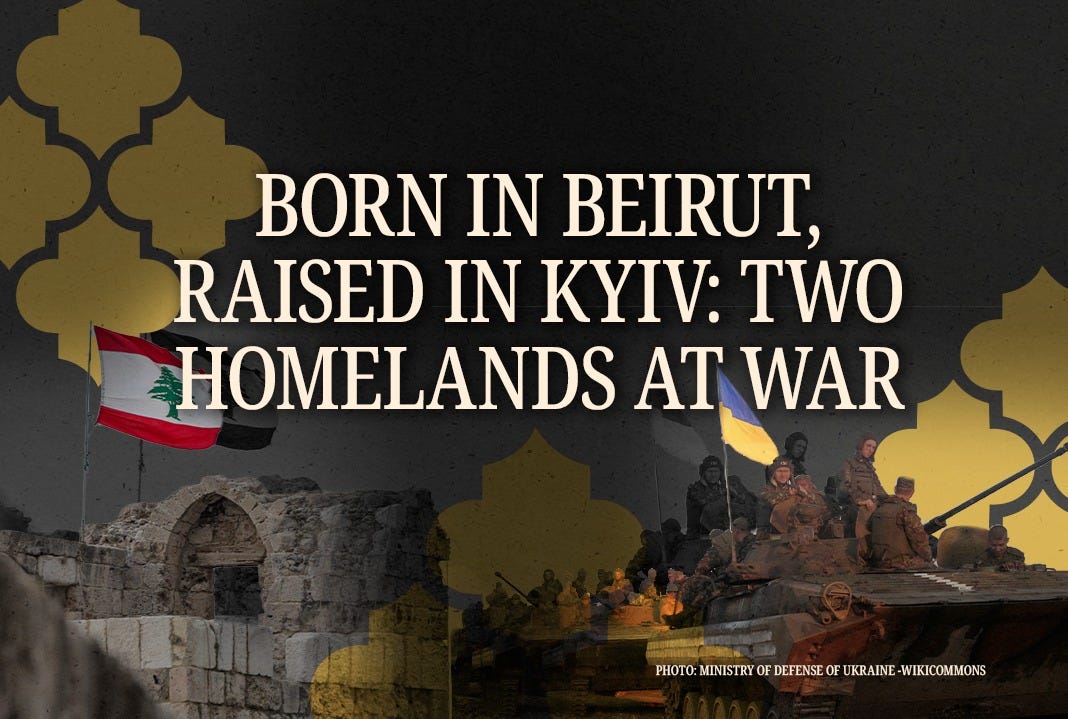
Looking back on her childhood, Jane Hannouch remembers feeling peaceful and free. Born in Beirut and raised in Kyiv until she was nine, she had a dual identity that was both a blessing and a challenge, teaching her to be adaptable and resilient. But nothing could prepare her for the hardship of seeing both her homelands at war in recent years.
“I never imagined that the homes I once considered safe havens would become places marked by fear, trauma, and uncertainty,” said Hannouch, who now lives in Lebanon. “Nothing looks the same anymore.”
The 26-year-old lived the first few years of her life in Kyiv before moving to Lebanon in 2005 to be closer to her father. She maintained the connection to Ukraine and visited often, embracing her Lebanese-Ukrainian identity. Meanwhile, she threw herself into life in Lebanon, discovering the other half of her heritage.
She finds that both Lebanese and Slavic influences enrich her view of life, but it can also be difficult to straddle two cultures. At times, her dual identity left her confused and wondering where she fit in.
Now, after years spent reconciling these differences, recent events have left her adrift. The conflicts in Ukraine and Lebanon have forced her to watch as both her homelands are battered by war.
“Sometimes, I do not fully realize how deeply I am affected by having both of my countries at war,” she said. “The impact often feels invisible, working beneath the surface. There is no certainty about tomorrow.”
Places that once brought her peace and serenity have been scarred by the war between Israel and Hezbollah and Russia’s invasion of Ukraine. She fears for her family, some of whom have faced conscription in Ukraine. “I have not been able to visit since Russia’s invasion in 2022, and it brings me deep sorrow to wonder what will remain when I finally return. Will the places I remember still exist? Or will the memories I treasure still have a physical home?”
As the Russia-Ukraine war enters its fourth year, the conflict has devastated the lives of Ukrainians. Since February 2022, about 10 million people have been displaced. Infrastructure, energy grids, schools, and hospitals have all been targeted by Russia’s military. According to a 2026 UN report, more than 15,000 Ukrainian civilians have been killed as a result of the invasion. The past winter was especially difficult for millions who endured subzero temperatures for days without access to electricity, heating, or water.
Hannouch speaks regularly with elderly relatives in Ukraine but is frustrated that she cannot visit in person. “My family is deeply connected to their homeland. At their age, leaving everything behind and starting over elsewhere is not desirable,” she said.
The stress of worrying about loved ones in Ukraine adds to the pressures of life in Lebanon, where years of financial and political crises have been compounded by war.
The Hamas attacks on October 7, 2023, reignited the decades-old conflict between Israel and the Iran-backed Hezbollah. Following the death of Iranian Supreme Leader Ali Khamenei in a joint U.S.-Israeli strike in early March, Hezbollah intensified its attacks in support of its principal patron, triggering a new escalation in the fighting.
The conflict has deepened the strain on Lebanon, where the economy has been weakened by years of financial and political crises. Massive destruction across southern Lebanon has led to the displacement of more than 1 million people, forcing the state to convert schools into shelters to absorb the waves of people who are now homeless.
“The instability in Lebanon has deeply affected my family,” said Hannouch, who finds it difficult to care for her parents amid rising prices. “Like countless households across the country, we have experienced the burden of economic hardship and uncertainty. Watching that level of stress and responsibility carried by my parents brings me great sadness.”
Lebanon’s severe economic woes have made it even more difficult to absorb the high costs of war. Many of Hannouch’s peers have fled the country in search of better prospects, prompting her to consider leaving.
For now, she has decided to stay. “In times like these, I value every moment. Being together and supporting one another is far more important to me than any opportunity elsewhere,” she said.
Hannouch finds solace in serving others, working with Hope Worldwide, an organization that supports vulnerable individuals and families. Helping people in the local community, she draws on her Christian values to prioritize others’ needs at a time when many people in Lebanon are living below the poverty line.
Following the peace deal announcement between the US and Iran on June 15, hope for a cessation of hostilities between Israel and Hezbollah is slowly beginning to materialize. Despite Israeli refusals to withdraw from the south, many Lebanese families have begun returning to their homes. Peace might finally be on the table, but the threat of another wave of attacks lingers.
While progress is seemingly being made in Lebanon, Russia and Ukraine remain entangled in a war of attrition. As support for Ukraine wavers in Washington, peace talks between Russia and Ukraine have yet to bear fruit. It is unclear whether, and how, peace will materialize in Europe. However, Hannouch believes that there is light at the end of the tunnel.
“My story is one of two homelands, two identities, and the pain of witnessing both nations struggle through conflict,” she said. “Yet it is also a story of resilience, faith, and hope—a belief that even in the darkest circumstances, light can still be found.”
Middle East Uncovered is powered by Ideas Beyond Borders. The views expressed in Middle East Uncovered are those of the authors and do not necessarily reflect the views of Ideas Beyond Borders.