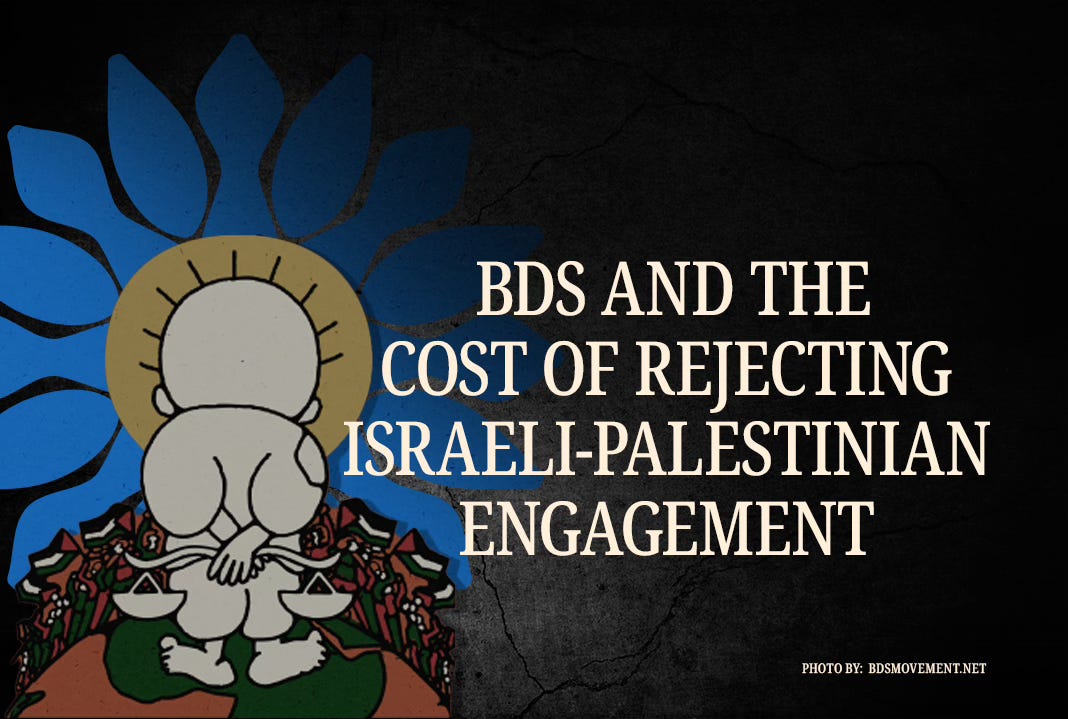
BDS and the Cost of Rejecting Israeli-Palestinian Engagement
A movement built to challenge occupation risks weakening the pathways to peace it claims to support. Without dialogue, what resolution is possible?
In July 2005, the Boycott, Divestment, and Sanctions movement was formally established with a call signed by 170 Palestinian civil society organizations, campaigning for three core demands: ending Israeli occupation of lands captured in 1967, recognition of full equality for Arab citizens of Israel, and the right of return for Palestinian refugees—nearly 7 million people, close to the number of Jewish citizens of Israel—as established under UN Resolution 194.
The movement markets itself as inspired by the international campaign against apartheid South Africa in the late 1950s. But unlike that campaign, which targeted racial segregation inside a single state, BDS operates in a national conflict between two peoples—one that includes issues of borders, competing claims to statehood, and one of the most complex refugee situations in modern history.
During its 21 years of work, BDS has achieved some milestones. It pressured several European pension funds into divesting from companies tied to Israeli settlement activity. In 2018, Airbnb briefly announced it would remove listings in West Bank settlements—the company later reversed that decision after legal complications—and the movement has been effective in raising awareness about Palestinian political rights on Western university campuses.
But alongside those achievements, BDS has built a habit of going after the wrong people, including its calls for boycotting the Oscar-winning film “No Other Land,” which describes the realities of the occupation in the Masafer Yatta villages, calling to boycott the civil society group “Standing Together,” and calling to boycott the West-Eastern Divan Orchestra, co-founded by the Palestinian author Edward Said.”
Its calls for academic and cultural boycotts have drawn serious criticism, including from Iranian American author Arash Azizi, who argued in The Atlantic that such boycotts are both counterproductive and morally misguided. His sharpest point concerns BDS’s treatment of organizations that bring Israelis and Palestinians together. The movement sees this kind of cooperation as “normalization” and pressures supporters to reject it entirely. Practically, this means the people most likely to be boycotted are not Israeli government ministers or settlement builders — they are Israeli citizens who oppose the occupation, and Palestinians who believe engagement is more useful than isolation.
This is where BDS’s position becomes self-defeating. Normalization is a real concern when joint events are used to whitewash ongoing violations. But BDS has expanded the definition until it covers almost any sustained contact between Israelis and Palestinians who are not in conflict. That does not serve Palestinians living under occupation. It simply narrows the space for anyone trying to end it.
The most recent example makes this clear. In December 2025, the UK announced—in partnership with the Alliance for Middle East Peace (ALLMEP), a nonpartisan coalition of nearly 170 NGOs—that it would host a fundraising conference on March 12, 2026, at Lancaster House, as part of its new Middle East Strategy. This came the same year the UK formally recognized Palestinian statehood. Recently, the British government called for an investigation into the killing of five Palestinians by Israeli settlers in the West Bank. ALLMEP’s member organizations lobby against settlement expansion and restrictions on Palestinian movement. The conference is designed to raise funds for Palestinian-Israeli dialogue work—not to normalize the occupation.
BDS rushed almost immediately, labeling the conference a “normalization event” and calling the UK government “complicit in genocide.” By February, it escalated and issued targeted action alerts against Lancaster House itself, where the crowdfunding is set to take place.
At the height of that peace process, the international community invested nearly $44 per capita annually to support civil society, dialogue, and reconciliation infrastructure. For Israelis and Palestinians, the equivalent figure is $2 per capita per year, twenty-two times less. The architecture that helped end one of Europe’s longest conflicts was built through exactly the kind of sustained, funded, people-to-people work that BDS is now campaigning to shut down.
A movement founded to end an occupation should not be in the business of targeting the spaces where Israelis and Palestinians try to build something different. It is possible for two things to be true at the same time: to oppose the military occupation of the West Bank and to call for dialogue between Palestinians and Israelis. Without this dialogue, how does BDS expect this conflict to end?
Middle East Uncovered is powered by Ideas Beyond Borders. The views expressed in Middle East Uncovered are those of the authors and do not necessarily reflect the views of Ideas Beyond Borders.


The adoption of complete antinormalization, drawn directly from the thawabit, signals that nearly all Palestinian activism has been devoured by the Neo-Jihadist purity spiral in the west that still cheers on Hamas for killing so many peaceniks on 10/7. And like all purity spirals, it must now finish running its course into the ground.
https://thegoldenpill.substack.com/p/the-sanewashing-of-by-any-means-necessary?r=31tulb&utm_medium=ios
There is no point in talking to people who think slaughtering 20,000 children is “self-defense.” Boycotts helped apartheid South Africa to crumble and they can do the same to apartheid Israel.