


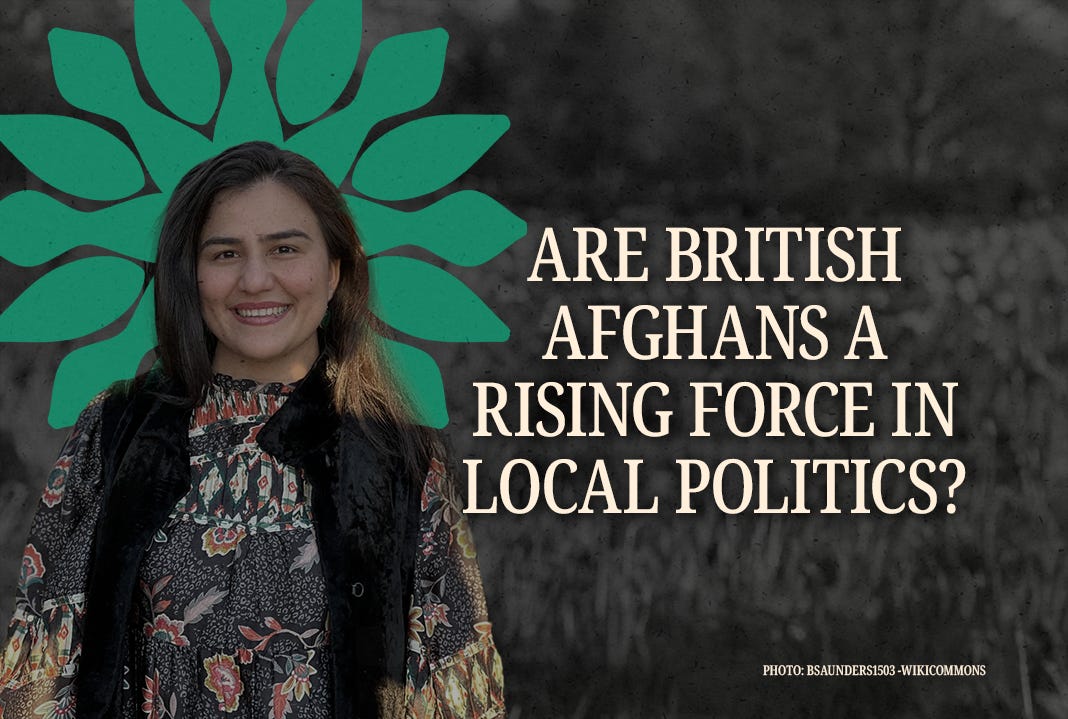
At 10pm on May 7, the polls closed in 24 wards across the London borough of Ealing. In East Acton, Rabia Nasimi had spent the final day on doorsteps, canvassing local residents in her bid to become a Labour Party councilor.
The counting would take all night. After months on the campaign trail, juggling local politics with her job as a civil servant, parenting her two-year-old, and navigating a new pregnancy, exhaustion was setting in.
“The result looked close all night, and I kept telling myself it could go either way,” said the 32-year-old, who hoped to become one of the few members of the British-Afghan community to serve as an elected representative in local government.
As the clock ticked past 3am, counting was still underway. Across the country, results were coming in, indicating damaging losses for the ruling Labour Party. Then, at 4am, the announcement for East Acton came through. Nasimi had won for Labour, alongside Hitesh Tailor and Stephen Donnelly.
Tears welled in her eyes as she realized the result. “It was difficult to take in the emotion of it all. It felt quite surreal,” she said.
Nasimi was among three candidates of Afghan heritage to win seats in the May local elections, alongside Shaira Karimi and Peymana Asad, in what some see as a sign of growing political participation from a historically under-represented community.
Councils in London frequently reflect the city’s multi-cultural population, but Afghans are a relatively small and recent group in the UK, where some minority communities have roots going back more than 50 years.
The recent success of Afghan candidates may be an “important milestone” in a longer process of political integration and representation, said Dr. Parveen Akhtar, senior lecturer in politics and international relations at Aston University.
“Afghan political representation remains relatively limited compared with more established diaspora communities such as those of South Asian heritage, whose political incorporation has developed over several decades,” she said.
Several factors could be driving this shift towards increased political participation as the Afghan community grows more established in the UK.
The Taliban takeover in 2021 shocked diaspora communities, encouraging some British Afghans to pursue more active roles in grassroots activism and local politics.
Watching news footage of families camping outside the airport and people falling from planes in their desperation to escape left many reeling, said Darius Nasimi, a community campaigner and Head of Funding and Partnerships at the Afghanistan and Central Asian Association (ACAA).
“It was shocking. Everyone was speaking about the gradual withdrawal of troops, but nobody thought the Taliban would instantly come back overnight,” he said.
For Peymana Assad, learning about life under the first Taliban regime had a profound impact. She was three when her family left Afghanistan and became refugees in the UK. Growing up in Harrow, one of London’s most diverse boroughs, she has campaigned for more inclusive decision-making in local institutions and became the first person of Afghan origin elected to UK public office in 2018.
She has since been re-elected twice to continue her role as Labour councilor for Roxeth—in 2022 and 2026.
Assad’s interest in local politics began at age 11, after she saw an image of an Afghan woman kneeling in a football stadium with a Taliban soldier holding a gun to her head. “For the first time, it made me think about what it meant to be a refugee, and why I came to this country,” she told Sky News in 2021.
At the time, she had recently returned from a visit to Afghanistan, which coincided with the Taliban takeover. Her British passport was the “only difference” between her and those who weren’t saved, she said, expressing her anger at the way Afghan people have been let down by foreign governments.
The British-Afghan community has grown considerably since Kabul’s collapse, with around 41,600 people arriving from Afghanistan via official evacuation and resettlement routes. Prior to 2021, there were 116,167 people of Afghan heritage registered as living in the UK according to a national census.
The May local elections were a “big moment” that will encourage more young Afghans to pursue political office, said Darius Nasimi.
“Many young people from Afghanistan in the UK feel like they don’t have access to opportunities…to see someone elected from their country makes them feel hope,” he added.
Through his work at the ACAA, a charity founded by his father that supports refugees and migrants in the UK, Nasimi regularly speaks with many young British Afghans. Some have arrived since 2021; others were part of earlier waves—in the early 2000s, following the 2001 war in Afghanistan, and, prior to that, in the 1990s, during the first era of Taliban rule.
“My father has always encouraged us to get into politics; he wants to see us be in a position where we can make a bigger difference and represent the people of Afghanistan,” he said.
The success of the three Afghan Britons elected in May indicates mounting trust in political participation as refugee families become more settled and established in British society.
It suggests that British Afghans are overcoming traditional barriers, including limited access to political networks, underrepresentation in party structures, socio-economic challenges, and a lack of familiarity with political institutions, said Dr. Akhar.
But victory at the polls is just the beginning.
“The key question is not simply whether more Afghan-Britons are elected, but whether they are able to shape policy, influence decision-making and represent the concerns of their communities effectively,” she added.
Long days on the campaign trail while pregnant reminded Rabia Nasimi why it’s vital that public office reflects the realities of people’s lives. “It reinforced that women should not have to choose between public service and motherhood, and I was determined not to let others make those assumptions for me,” she said.
Without the voice of women like Nasimi, who balances a young family with a full-time job as Head of NHS Partnerships at the Department of Health and Social Care, and her duties as a councilor, important perspectives would be lost. “Those lived experiences shape how you connect with residents and advocate on their behalf,” she said during an interview with The London School of Economics and Political Science (LSE), where she earned an MA in Sociology in 2016.
As she begins her first term as a councilor and immerses herself in local issues, Nasimi acknowledges the significance of her position. An Afghan woman taking a seat at the council table sends a powerful message about belonging and participation for a community that has long been absent from Britain’s political institutions. “When people from Afghanistan see someone who shares their background in elected office, I hope it gives them a sense of pride and possibility,” she said. For Nasimi, winning the election feels especially pertinent at a time when women in Afghanistan face severe restrictions on their rights and freedoms. “Seeing women from Afghanistan in public leadership can carry a powerful message,” she said.
For many British Afghans, entering politics is about more than serving their local communities. It is also a response to the country they left behind. As the Taliban has all but eliminated political space in Afghanistan, the voice of its diaspora is beginning to grow. The election of Afghan-born and Afghan-heritage representatives in Britain cannot change conditions in Afghanistan, but it offers a different vision of Afghan leadership—one rooted in participation, representation, and democratic life.
Middle East Uncovered is powered by Ideas Beyond Borders. The views expressed in Middle East Uncovered are those of the authors and do not necessarily reflect the views of Ideas Beyond Borders.
Let’s hope so. All the native British ones suck eggs!