


For many people Riham Namle encountered on a recent delegation to the UK, she was the first Arab-Israeli they had ever met.
Despite Arabs making up around 20 percent of Israel’s population, misconceptions about their place in Israeli society are widespread. “I think a lot of Arabs do feel deeply Israeli,” Namle tells me.
Some audience members struggled to reconcile that reality with what they believed about Israel. “One person asked, ‘Do Arab children have permission to play with Jews because of the apartheid?’” recalls her colleague, Lee Shira Wilson.
The pair were on a fundraiser tour for the Freddie Krivine Institute (FKI) in June, which aims to bring Jewish and Arab children together through sport. Wilson is the director, and Namle is the Arab social activities coordinator.
In one venue they visited in Maidenhead—in the royal borough of Windsor—Namle says a British-Israeli woman approached her after the talk to explain that listening to her had led to a change of heart.
“She said, ‘I didn’t want to come to this because I thought Arabs were all bad people.’ She then said, ‘You changed me and how I think about the conflict.’”
Changing perceptions is central to FKI’s mission.
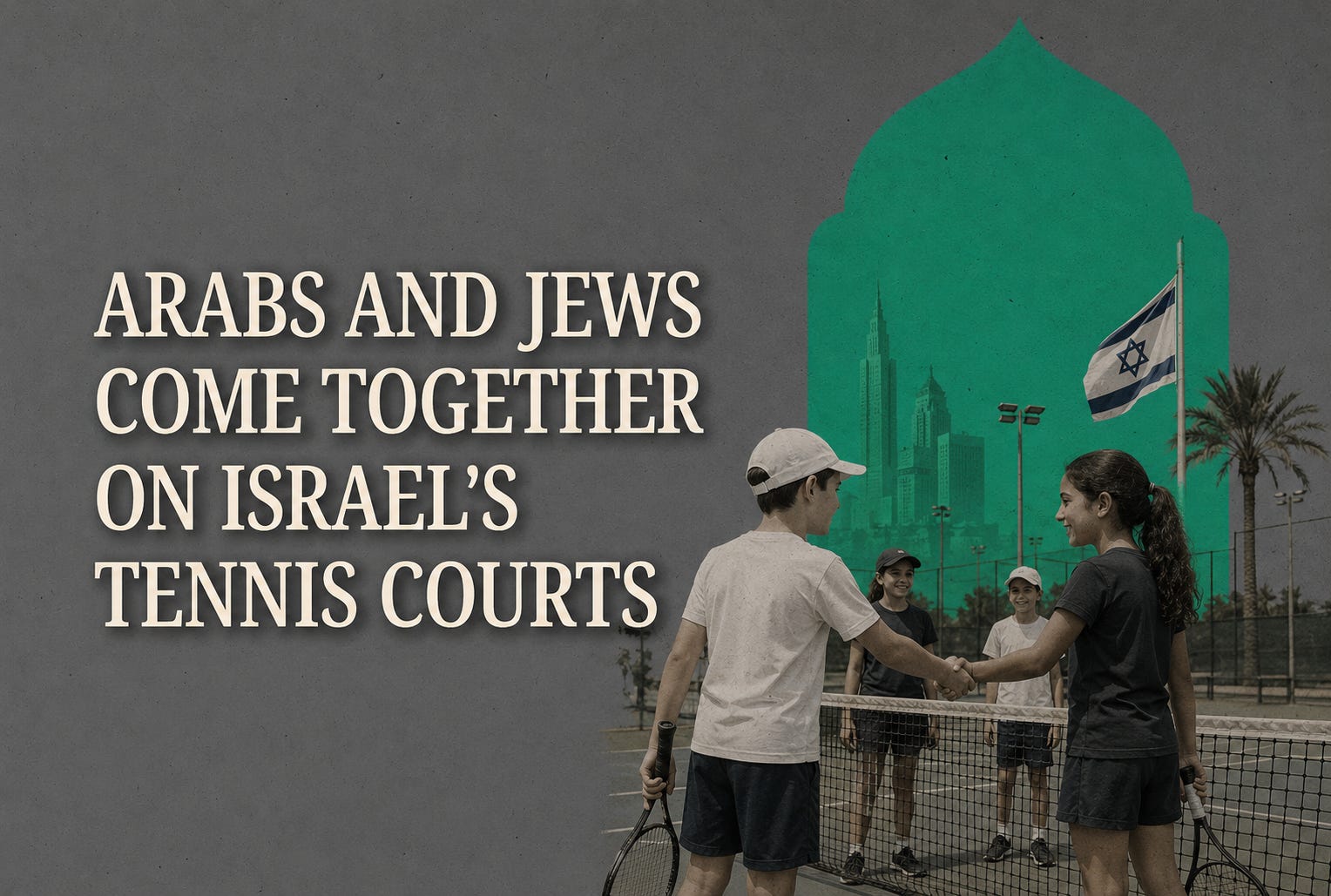
In 2000, Israel’s “Mr. Tennis” Freddie Krivine (a British-born businessman and philanthropist) decided the time had come to bring together young Jewish and Arab children through tennis.
With the Second Intifada in full force, it was certainly a precarious time to launch such a project. Yet over a quarter of a century on, the children continue to attend class.
One of their first tasks was to challenge misconceptions in their respective communities. Before joining the club, the Jewish children thought their Arab counterparts would be violent, says Wilson, while the Arab children thought the Jews would be “snobbish” towards them.
“Some Arab parents didn’t believe I was Muslim,” says Namle. “They asked, ‘Are you really an Arab and a Muslim?’ Because of the way I speak Hebrew fluently and with confidence.”
In Israel, Arab citizens’ limited Hebrew proficiency is considered an obstacle to their socioeconomic integration. Namle says the parents now insist that she speak with their children in Hebrew rather than Arabic to improve their language skills.
“They need to meet different people, and they don’t have other places where they get that opportunity,” she says.
Then came October 7. The attacks saw thousands of terrorists storm southern Israel, killing around 1,200 people and taking 251 hostages. Israel has since waged devastating wars in Gaza, Lebanon, and Iran. For an initiative built on trust between Arab and Jewish children, the new climate made its work immeasurably more difficult.
Yet despite the shock of October 7, a December 2023 survey suggested that the majority of Arabs felt more Israeli, and didn’t believe the Hamas-led attack was a reflection of Arab or Islamic values.
Namle says many Arab citizens feel caught between competing narratives. She recalls how a cousin went to Prague for her studies after October 7 and found the anti-Israel protests intimidating.
“She found the atmosphere scary, so she left Prague,” she says.
While it seemed there was still a willingness from the Arab population to bridge the divide, Jews were less eager.
“Jewish families are still in pain. They felt betrayed by Arab families, because so many left-wing people were killed on October 7. They were the people who helped the people of Gaza. They were friendly with Arabs,” Wilson says, referring to the kibbutzim in the Gaza Envelope, in southern Israel, whose residents previously had good relations with the Palestinians. “So, there’s this whole kind of notion [that] you can’t trust the Arabs, doesn’t matter who they are, they’re just going to stab you in the back.”
It’s tragic, she argues, because daily life in Israel demonstrates how deeply intertwined Jewish and Arab communities remain.
“When you go to hospital, 60 percent of the doctors and the nurses, they’re all from the Arab community, so if you’re going to lie back and be put to sleep and be operated on by Arab doctors, you have to have some trust somewhere. You can’t believe that all Arabs want to kill you, and this is where people are. They’re in a very painful situation right now, and we have to rebuild that hope.”
Change has to start somewhere, and it’s better to start from a young age. Around 150 children attended the program every week, says Wilson, but that has fallen to 80 in the last few months, due to the war with Iran. It has been a frightening time for all, they tell me. Namle spent a fortnight in the shelter with her three children.
“My son was having panic attacks even when he heard the sound of an ambulance siren,” she says.
Meanwhile, Wilson—also a mother-of-three—is concerned about her disabled father who uses a wheelchair.
“It feels like Russian Roulette. One of my kids said ‘I dreamt we died’,” she says. “It’s really stressful.”
For now, the majority of the children attending the program are Arab.
“Some Jewish families have said, ‘Oh wow, are people still going to your classes?’” says Wilson. “People are scared, and they don’t trust one another. The Jewish community has retreated into itself, 100 percent.”
Namle says it’s all unfortunate, adding:
“But I remember that we need to continue, because when people meet and talk to each other, all bad feelings disappear.”
To address the imbalance, FKI has begun partnering with Jewish tennis clubs and bringing Arab children to them. The sessions combine tennis, competition, and a shared meal—small but deliberate efforts to rebuild trust, Wilson explains.
Summer camp is due to begin in a fortnight, and the club will also start planning for a competition later this year.
Wilson adds: “We’re going to be running a doubles competition. Every double has to be a Jew and an Arab, to show that only through partnership can you actually win, and it’s going to be livestreamed by the Israel Tennis Association.”
The initiative receives funding from Israel’s Ministry of Culture and Sport, because “They see the long-term strategy in things like this,” says Wilson. “People don’t realize, there are politicians, and then there are people who actually run the country.”
She says some politicians, without naming names, tend to “whip up hatred and division,” but the people on the ground are trying their best to continue with life, adding:
“In Israel we have a saying: terrible politics, amazing people.”
As more time passes from October 7 and the subsequent war in Gaza, Lee Shira Wilson and Riham Namle will continue to serve up that proverbial tennis ball and hope the answers lie in their work, however difficult the climate becomes.
“At the end of the day,” says Wilson, “no one is going anywhere.”
Middle East Uncovered is powered by Ideas Beyond Borders. The views expressed in Middle East Uncovered are those of the authors and do not necessarily reflect the views of Ideas Beyond Borders.
I am glad to hear about initiatives like this. I also am hopeful the Jewish Israeli community will be amenable to more outreach with the Arab Israeli community as time goes on