


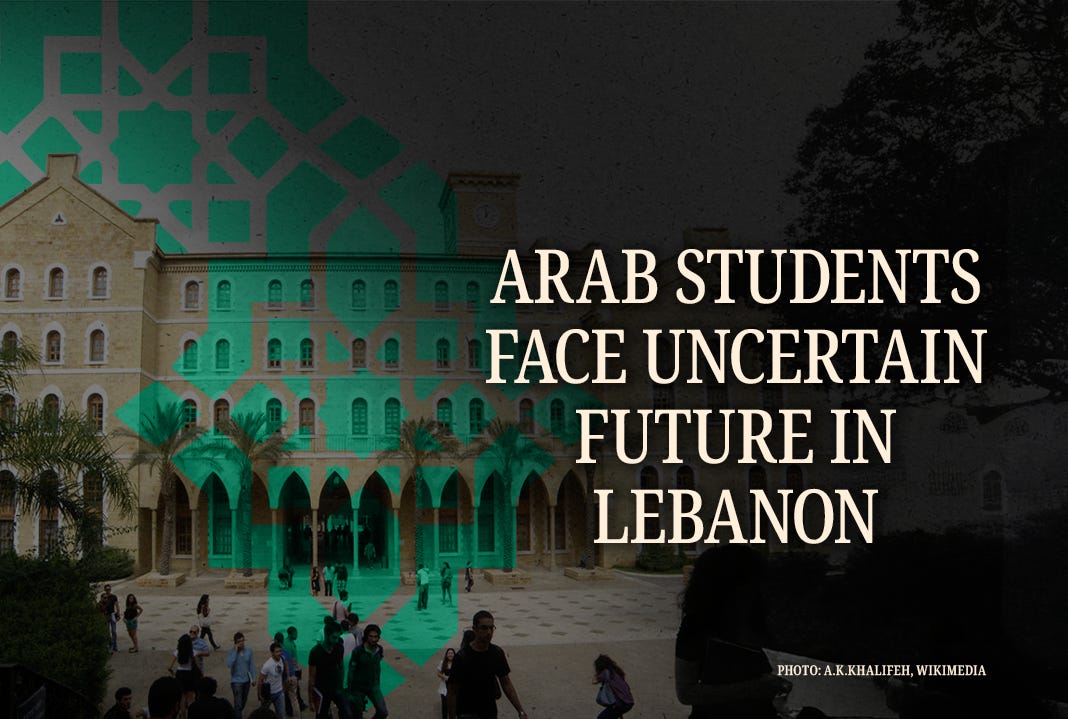
The 2019 uprising, the subsequent collapse of the currency, and the outbreak of COVID-19 shook the state of Lebanon. This trifecta of misfortunes led to major interruptions to the flow of education, especially for international students. Today, the Israeli campaign against Hezbollah has revived similar interruptions, causing institutions to adopt alternative modes of learning.
“There was this point where I seriously thought about dropping out,” said an international student from Libya under US sponsorship. The student, who spoke on condition of anonymity to Middle East Uncovered, is currently pursuing their degree at the Lebanese American University. “One week you’re focused on exams, the next you’re checking the news more than your notes.”
Lebanon’s American institutions of higher learning have long attracted foreign students. The American University of Beirut (AUB) and the Lebanese American University (LAU) carry a long history of delivering quality education. Over the years, both regional and international students have enrolled at either institution. However, the ongoing Israeli strikes have further exacerbated the instability of Lebanon, putting a strain on the delivery of education. For international students, the situation has raised serious concerns.
“The war made me think more seriously about leaving and exploring other options abroad,” added the Libyan student. “Then I realized that even leaving comes with its own uncertainty.”
Israel’s campaign against Hezbollah began after the horrific events of October 7, 2023. The subsequent US-Israeli war on Iran, which resulted in the death of Ali Khamenei in February of this year, further intensified the fighting between Hezbollah and Israel. Southern Lebanon became a hotbed for clashes between the two, leading to major destruction of the south’s infrastructure and displacing over 1 million people. The conflict culminated in the “largest coordinated wave of strikes ” in Lebanon on April 8, tormenting the city of Beirut and triggering shockwaves across the country. The truce, which would ostensibly stop the fighting, did not prevent Israel from continuing its air strikes.
To navigate this series of events, the Lebanese Ministry of Education and Higher Education (MEHE) blended in-person and online learning, hoping to cater to as many individuals as possible. However, these alternative modes of learning made the situation even more unsettling, especially for international students. “Sometimes classes shift online,” said the Libyan student. “Sometimes, you’re physically there, but mentally somewhere else.”
According to the Senior Director of International Services at LAU, Ms. Dina Abdulrahman, 10% of the student population primarily comes from the Southwest Asia and North Africa (SWANA) region. It is unclear, however, how many of these students are under US sponsorship, as Ms. Abdulrahman did not want to disclose that information.
The situation is no different at AUB. Iran’s threats to bomb American institutions in the region have raised a number of concerns for international students. “With threats of bombing the university, it became much worse, especially since I live in dorms on campus,” said an international student from the Middle East under US sponsorship. “This period was very emotionally draining, and it was difficult for me to focus and stay motivated to work on my thesis and my studies,” added the student.
According to AUB’s official website, 17% of the student body is international as of the fall of 2025. The Associate Director of the US-Middle East Partnership Initiative at AUB, Melisa Ajamian, was contacted about the number of students under US sponsorship. Middle East Uncovered did not receive a response.
“I was supposed to attend an important conference that could have helped with my future plans, but because the airspace was closed, I couldn’t travel,” said the student from the Middle East. “That made me start questioning whether Lebanon is even the best option for my education and career.”
International students in Lebanon have faced similar challenges in recent years. The Beirut port blast, “the largest non-nuclear blast in modern history”, impacted a number of international students at the time. The blast, which resulted in the death of 200 people and displaced over 200,000 individuals, caused $15 billion worth of damage.
Amer Haj Ahmad, a Syrian who graduated from LAU, was near the port when the explosion occurred. Haj Ahmad was out celebrating his graduation after enduring a challenging year that started with an uprising and ended with online learning during the pandemic. He was with fellow international students when the blast hit them. “As primitive as this may sound, we were all collectively aligned into thinking about surviving,” said Haj Ahmed to Middle East Uncovered. “The damage was nothing like anything I’ve seen with my own eyes, and it was chaotic navigating Mar Mikhail Street at the time.” He left Lebanon soon thereafter, but the events of that day are seared into his memory. He currently resides in Canada.
The academic year at both AUB and LAU is coming to an end this month, and neither has revealed a strategy for the upcoming academic year, which begins in the fall of 2026. Lebanon’s MEHE has yet to reveal what its plans are for the future of education in the country. Still, the reality on the ground remains precarious for both the students and institutions involved.
“The situation made me see my future as more uncertain and pushed me to think more about stability and security,” added the student from the Middle East at AUB. The same rhetoric was echoed by the student from Libya at LAU. “The situation made me start asking where I can actually build something stable.”
Stability is one of the primary challenges Lebanon faces, and it is unclear whether or not cessation of hostilities between Israel and Hezbollah will take place in the near future. However, interruptions to the educational delivery in Lebanon are likely to persist, impacting both domestic and international students.
Lebanon’s universities still carry academic weight, but for many international students, that is no longer enough. Repeated disruptions—economic decline, explosions, and now war—have made higher education unpredictable and, at times, untenable. As the next academic year approaches without a clear plan, students are left weighing degrees against safety. For some, the question is no longer how to study in Lebanon, but whether to stay at all.
Middle East Uncovered is powered by Ideas Beyond Borders. The views expressed in Middle East Uncovered are those of the authors and do not necessarily reflect the views of Ideas Beyond Borders.
