


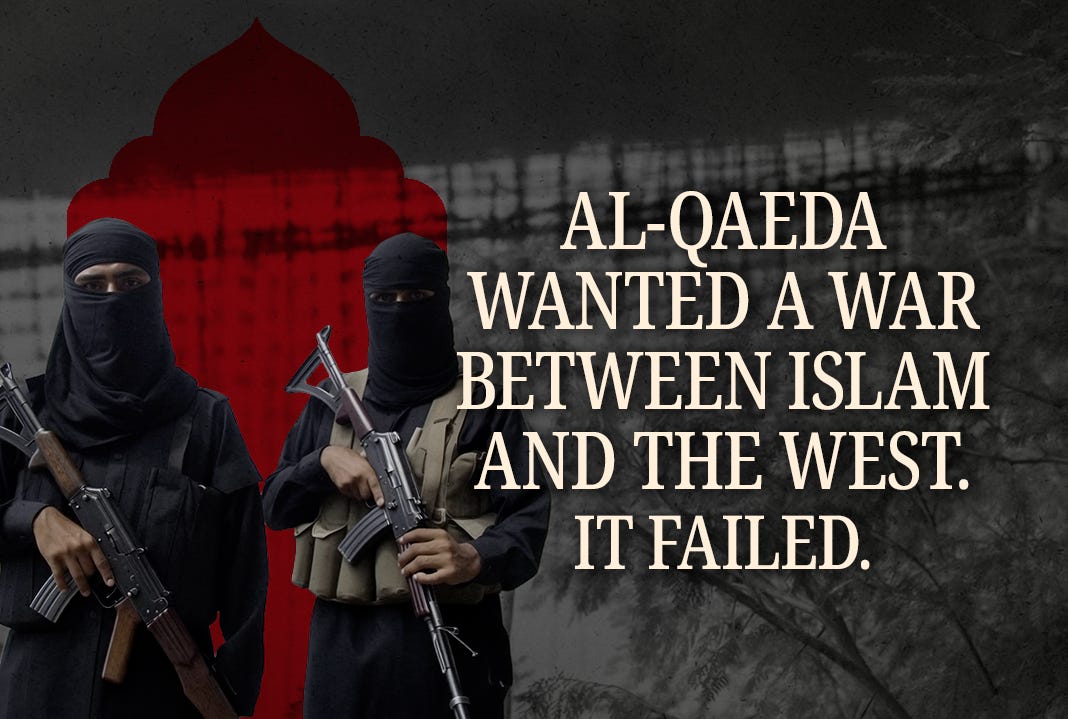
In 2005, Jordanian journalist Fouad Hussein published an account of what he believed to be al-Qaeda’s plan for jihad around the world in the coming years.
He based his book on conversations with al-Qaeda figures. Hussein was jailed alongside Abu Musab al-Zarqawi in 1996 in Jordan for his opposition political activities and critical journalistic work linked to the Arab Ba’ath movement. Al-Zarqawi, who went on to establish al-Qaeda in Iraq during the years of the American invasion in 2003 and infamously beheaded the American hostage Nick Berg, was arrested for attempting to establish a militant cell to pursue jihad in Jordan. He was later killed in an American airstrike in 2006.
Hussein spoke with other al-Qaeda figures while researching this book, too, including Saif al-Adel and Abu Muhammad al-Maqdisi.
Hussein identified that al-Qaeda had a seven-stage plan for jihad, which was later summarized in an article by Der Spiegel promoting Hussein’s book, also in 2005.
The plans lay out clear vision, split into phases, and ultimately lead to the rise of an Islamic caliphate and “definitive victory.”
The first phase was designed “to provoke the U.S. into declaring war on the Muslim world” so as to “awaken” Muslims. This phase was supposed to last from 9/11 up until the invasion of Iraq and the fall of Baghdad, and at the time the book was published, these events had already occurred.
But this phase was built around a foundational error. America did not, in fact, declare war on Islam generally, but on “terror.”
George W. Bush was careful in the wake of 9/11 to define Islam as “ peace”, saying in a speech to an Islamic center in Washington, DC, on September 17th, 2001 that:
“Both Americans and Muslim friends and citizens, tax-paying citizens, and Muslims in nations were just appalled and could not believe what we saw on our TV screens. These acts of violence against innocents violate the fundamental tenets of the Islamic faith. And it’s important for my fellow Americans to understand that.”
The second phase, according to Hussein, al-Qaeda planned to “recruit young men” and pursue jihad in Syria and Iraq, as well as launch attacks against Israel, Turkey, and Jordan. From there, it hoped to produce the collapse of Arab governments in the region. According to Hussein, they aspired that “between 2013 and 2016, Western influence in the Islamic world will be so reduced, and Israel weakened so much, that resistance will not be feared.”
After 2016, they hoped for “total confrontation” and a “fight between the believers and the non-believers.” According to Hussein, al-Qaeda hoped that the rest of the world would be “beaten down by 1.5 billion Muslims,” which would achieve an Islamic caliphate in the region by 2020.
It’s now 2026, and some of these predictions seem to have been quite prescient. Others appear to have been completely wrongheaded.
Al-Qaeda in Iraq—the organization founded by Zarqawi, and which later rebranded itself as ISIS, the Islamic State in Iraq and Sham—undoubtedly did try to found an Islamic caliphate. In fact, they managed to achieve this by 2014, when the group (then led by Abu Bakr al-Baghdadi) announced the foundation of a new caliphate. As the BBC wrote on June 30th 2014:
“Jihadist militant group ISIS has said it is establishing a caliphate, or Islamic state, on the territories it controls in Iraq and Syria.”
It also proclaimed the group’s leader, al-Baghdadi, as caliph and “leader for Muslims everywhere.”
Setting up a state governed under strict Islamic law has long been a goal of many jihadists. But, Iraq’s army continued an offensive to retake the northern city of Tikrit from the ISIS-led rebels.The city was seized by the insurgents on June 11, 2014 as they swept across large parts of north-western Iraq.
This occured sooner than Hussein suggested it would. At its fullest extent, ISIS did control substantial territory in Iraq and Syria, roughly equivalent in size to Portugal, and it was home to an estimated 8 to 10 million people.
The caveat here is that most of this land is empty desert. But there were rivers such as the Tigris and Euphrates, lakes, dams, and major cities such as Mosul and Raqqa.
From there, things did not go as al-Qaeda hoped. Most Muslims worldwide did not accept the new “Islamic caliphate,” and the group lost control of the lands it had won by 2019. Today, it has evolved back into what al-Qaeda originally was—a decentralized global network of militant insurgencies rather than a territorial “caliphate.”
What never materialized was the conflict al-Qaeda had sought to provoke all along—a global confrontation between Muslims and non-Muslims.
Yes, America invaded Afghanistan and Iraq after 9/11, but American governments—including under Bush and Obama—were always careful to differentiate between groups like al-Qaeda and the Taliban on one hand, and Muslims generally on the other.
Yes, al-Qaeda leveraged the chaos of post-invasion Iraq, particularly the civil war between Bashar al-Assad and his opponents, as a way to grab land, power, and establish their theocracy.
A major tripping point, though, was that although there had been a lot of anger directed at the previous Iraqi government, and also with the Assad regime, Iraqis and Syrians living under the caliphate did not like it very much. ISIS in Iraq: The Social and Psychological Foundations of Terror by Munqith Dagher et al interviewed Iraqis who lived under the caliphate:
“Most Sunni Iraqis who experienced the arrival of ISIS, particularly in Mosul, say the group was largely accepted at first, as an alternative to what was viewed as a corrupt, abusive, and sectarian Iraqi state. In retrospect, however, many of the people interviewed about ISIS’s governance thought that although ISIS was superior in some aspects of governance to the Iraqi state, the group largely wore out its welcome through its brutal imposition of an interpretation of sharia that was far more extreme than even relatively conservative Sunni Iraqis were willing to accept.”
It shouldn’t come as a surprise to learn that people living in the 21st century—and in a world with internet access—would not wish to live under a literal interpretation of 7th-century Islam, imposed by masked jihadists who publicly executed those who got in their way.
Medieval-style Sharia law—with hand amputations for theft and the stoning to death of adulterers—is a harsh system for modern people to live under.
It’s equally unsurprising that America under Bush did not fall into the trap of declaring war against Islam, and instead declared war against “terror.”
America as a global hegemon had longstanding relationships with multiple Muslim-majority countries, and Bush’s advisers understood that the balance of power in the region required them to maintain good relations with these states, including with Saudi Arabia, the United Arab Emirates, Egypt, and others.
Whether an American government under Trump would have been so circumspect, well, I am not so sure about that. But President Trump certainly appears to wish to continue positive relations with multiple Muslim-majority countries, especially Saudi Arabia and Qatar.
Hussein’s book does reveal the modus operandi of jihadists. By engaging in extreme violence against their foes, they seek to provoke an extreme reaction that draws the wider world into confrontation with Muslims.
Falling for this kind of provocation is a mistake. Terrorism is designed to make its enemies behave in ways that advance the terrorist’s political project. Al-Qaeda understood that it could never force 1.5 billion Muslims into a global religious war on its own. It needed its enemies to help create one.
That is what makes the distinction between fighting jihadists and treating Islam itself as the enemy so important. Al-Qaeda’s grand strategy depended on collapsing that distinction. Two decades later, refusing to do so is still one of the simplest ways to deny them the confrontation they have always wanted.
Middle East Uncovered is powered by Ideas Beyond Borders. The views expressed in Middle East Uncovered are those of the authors and do not necessarily reflect the views of Ideas Beyond Borders.

The deeper strategic lesson is that terrorism often seeks not only to cause violence, but to shape the reaction that follows. When an adversary can dictate the terms of that reaction, it can influence the conflict far beyond its actual capabilities. Recognizing and denying that strategic leverage is therefore critical.
— Wahidullah Noorzai
Former Senior ANCOP/ANP Officer | Field Strategist | Military & Security Analyst