


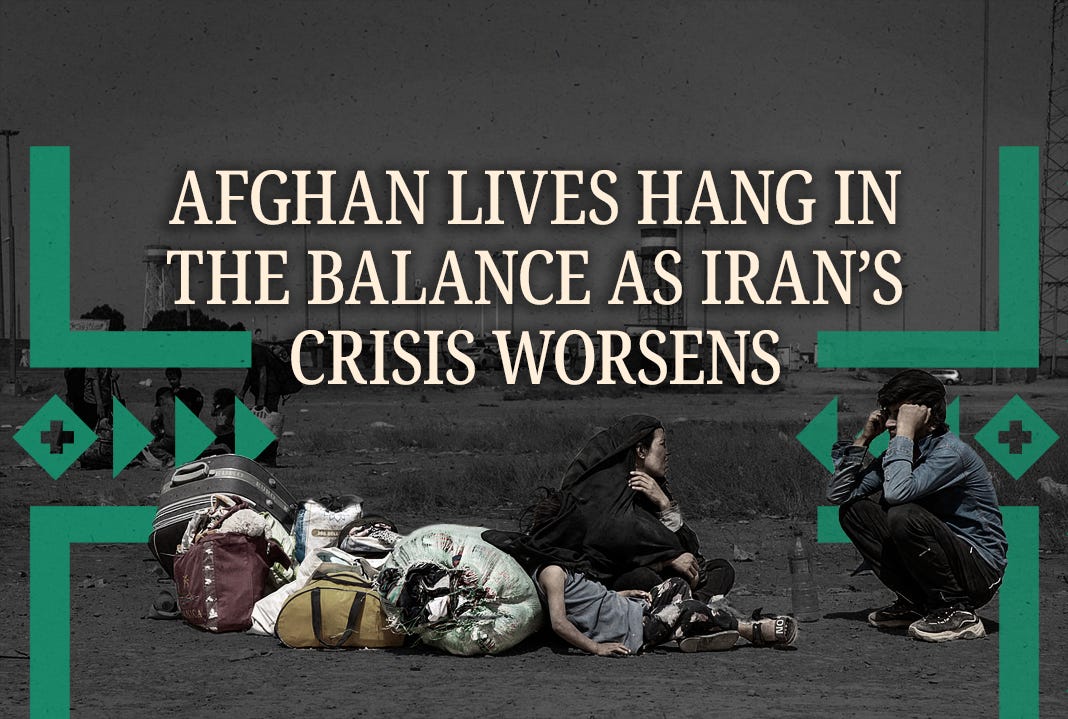
Throughout modern history, struggling nations have often been shaped not only by their own decisions, but by those of their neighbors. For Afghanistan, the dominant external influence has been Iran, whose harsh regime has dictated regional dynamics for over 50 years. Now, with Iran’s grip weakening, Afghanistan faces a pivotal moment: how will the end of Iranian dominance reshape Afghan society and its future?
On December 28th, 2025, nationwide protests erupted in Iran as its currency hit historic lows. Originally peaceful, the protests were violently suppressed, leading to thousands of deaths under an evolving internet blackout.
The Islamic Republic has labeled the protesters as “terrorist elements” and “foreign agents” working for the US and Israel. As domestic tensions rise, there are also reports of US military activity in Doha, possibly preparing for a strike on IRGC targets in Iran, as President Donald Trump has suggested but since walked back. Now, the main question is not if the regime will fall, but when—and what that will mean for Afghanistan in the wake of the Islamic Republic.
In an interview with Middle East Uncovered, Sadiq Amini, a political analyst and founder of the Afghanistan Impact Network, said the Islamic Republic could collapse “very soon,” though he warned that it is hard to predict exactly when. More importantly, he focused on what will happen to Afghan communities living in Iran and the political opposition to the Taliban, now based outside Afghanistan.
Afghans tend to immigrate to Iran in significant numbers due to shared language (Persian/Dari), deep cultural, historical, and religious ties (especially for Shia Hazaras), geographic proximity, and established ethnic networks, making Iran a primary destination for refuge and work. But many live under unstable and restrictive conditions. They are allowed only low-wage work and face unpredictable policies, leaving their situation vulnerable. Despite mass deportations, millions of refugees and exiled ex-military personnel remain in Iran.
Amini compared how Western countries and the Islamic Republic treat Afghan refugees:
“In countries like the United States or Canada, Afghan refugees arrive with documents, mobility, access to schooling, and bank accounts—they are treated with dignity and given opportunities to rebuild their lives. In Iran, however, our people have lived without proper papers, limited access to education or work rights, and constant precarity.”
In the best-case scenario, a new leadership in Iran would seek to prove its legitimacy by abandoning the old system’s harsh methods. In this situation, Afghans could gain better protections, clearer residency rules, and a public commitment to respect human rights, including those of migrants. If the new regime actively seeks to align with international norms, these improvements might be more substantial and enduring for Afghan refugees living in the country. Amini said that many Iranian opposition figures understand exile firsthand, since they have relied on Western countries for safety and the opportunity to organize. This experience could lead to a more compassionate approach toward Afghans who have nowhere else to turn.
However, revolutions are rarely simple. The first year after a regime falls is typically characterized by strong security forces, economic problems, and a rush to demonstrate control. For Afghans, a regime change in Iran could mean sudden changes to their legal status, access to services, or even forced returns. In this setting, refugees can become targets—not because they caused problems, but because blaming them is easy and popular. Deportations, raids, and “documentation campaigns” are often presented as nation-building, while scapegoating takes the place of real leadership.
Afghan refugees are not passive in the face of these shifts; they confront both immediate risks and the broader repercussions of changes in Iran.
These consequences are most obvious in Afghanistan itself.
For years, Iran’s relationship with the Taliban was kept quiet and only became clear after the fall of the Islamic Republic of Afghanistan in 2021. Although the Taliban and the Islamic Republic have different religious beliefs, Amini says their relationship is not about shared faith but about shared interests. If this is correct, then a new government in Iran could lead to major changes in these alliances, says Amini:
“The relationship between Iran and the Taliban today is not about faith or shared values—it is fundamentally ideological and based on shared hatred of the West and America’s presence in the region. They cooperate where their interests align, not because they trust each other. If Iran’s current regime falls and is replaced by a leadership committed to human rights and real democracy, that transactional relationship would fundamentally change, shifting from cooperation to conflict and support for Afghan aspirations against the Taliban.”
The Taliban are not concerned with Iranian democracy per se. What concerns them is having a neighbor they cannot control. Amini explained that the Taliban have long seen Afghan exiles—especially former soldiers and security staff in nearby countries—as a serious threat. So far, the Taliban has not commented on the situation in Iran, likely because of their alignment.
Exile is not just about escape; it can also mean regrouping. In Afghanistan’s recent history, political change has often come through refugee movements. Amini mentioned the first Taliban regime, when an Afghan government in exile was formed as Kabul fell. Later, with US support after 9/11, that government returned and took power in Kabul. Amini told Middle East Uncovered that while a unified government in exile does not yet exist, it could form if Iran were to become free.
If a new government in Iran allows Afghan civil society, former security staff, and political groups to organize openly, the Taliban will see this as a threat from a neighboring base. They are likely to react as authoritarian regimes often do: by pressuring nearby countries to limit exiles, infiltrating diaspora groups, and using threats or violence to weaken opposition. Amini noted that exile communities already face these dangers, and that mass deportations in the region have often been used as a way to pressure groups that might resist.
I asked Amini about recent remarks by some former Afghan politicians who, despite living in exile, have voiced support for the Islamic Republic. He cautioned against taking such statements at face value, arguing that these figures have long put their own interests—and those of foreign governments—ahead of Afghanistan and its people, whether in Iran or elsewhere. According to Amini, their apparent alignment with the Islamic Republic is driven less by principle than by personal gain. Even so, he said, many of them appear to recognize that this political trajectory is nearing its end and is likely to fail.
A new Iran could become a better neighbor for Afghans, but during a period of instability, it could also become more dangerous. The outcomes for Afghan refugees will depend on how new authorities choose to exercise power—whether they extend rights and protection, or continue practices of exclusion and scapegoating. What matters most is not what leaders say, but what institutions do: how new authorities direct security forces, whether migrants receive legal protection, and whether refugees are treated as persons or merely as numbers.
It’s been more than a week since Iran went silent, and I’ve been unable to reach friends, family, or colleagues. I remain hopeful they will contact me once they can. Some of my Persian friends in the West have family members stranded due to airport closures and are extremely concerned about their well-being.
The international community and Afghan advocates should pay close attention to early signs and public statements from Iran’s new leaders about Afghan migrants. These issues are not minor—they are the first signs of what kind of Iran is taking shape.
For Afghans living in Iran, the urgent question is whether a new Iran, now or in the future, will empower them to help shape change in their homeland or further restrict them. For the Taliban, the issue is whether they can keep the Afghan diaspora divided and fearful, or whether Iran’s transformation will unite exiles and alter Afghanistan’s trajectory. The Islamic Republic’s inevitable collapse is not confined to Iran—it carries the potential to redefine Afghanistan’s future in the region.
Middle East Uncovered is powered by Ideas Beyond Borders. The views expressed in Middle East Uncovered are those of the authors and do not necessarily reflect the views of Ideas Beyond Borders.

I have lots of Afghan friends, this is terryfing.