


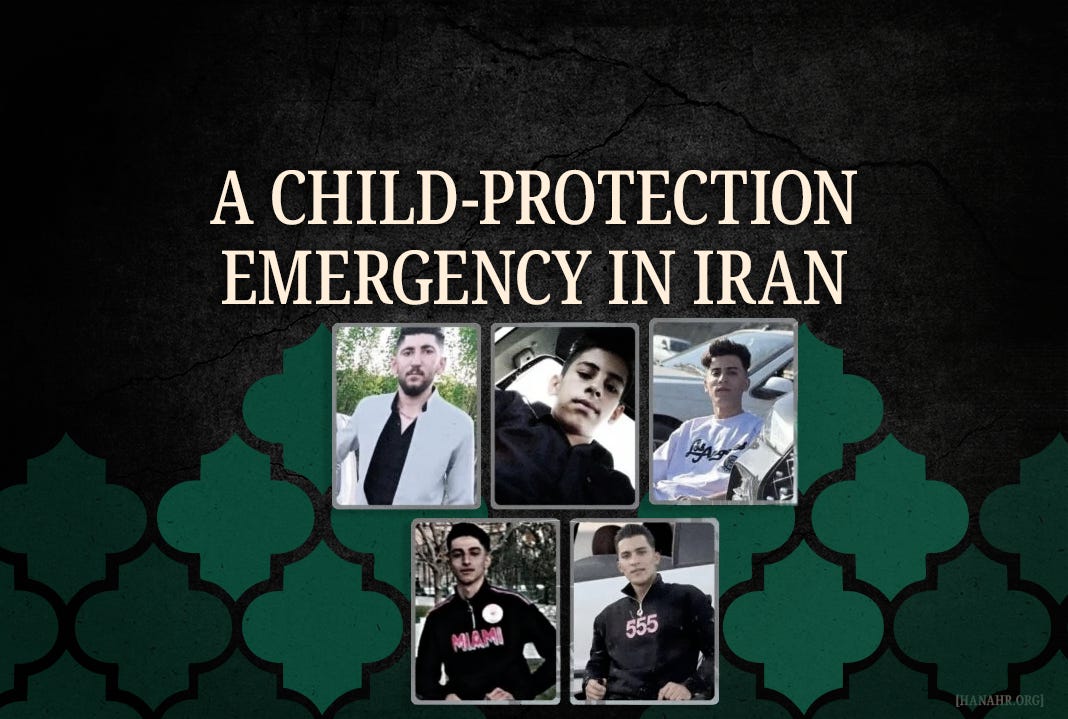
Across Iran, children are disappearing into detention centers and returning home traumatized—or not returning at all.
The state has responded to public anger with lethal force, mass arrests, and intimidation designed to silence dissent. Families are frantically searching for missing relatives. Names are circulated, then disappear. Basic questions have become too dangerous to ask.
This is a national emergency. It is also more specific and more alarming: a child-protection crisis unfolding in real time. In the current crackdown, children are not being spared. They are being deliberately swept up.
In recent weeks, children and adolescents have been arrested in disturbing numbers. Some are detained without their families knowing where they are held, which authority arrested them, what charges are claimed, or what procedures are being applied. This uncertainty is deliberate—it is part of the punishment.
Families describe the same nightmare: a teenager leaves home and does not return; a phone goes unanswered; parents move from one office to another, only to encounter denial, threats, or humiliation. Even asking for information can invite retaliation.
HANA Human Rights Organization, of which I am the director, has documented arrests of minors aged 15, 16, and 17, including in Ilam and Kurdistan. Among the arrests are Rezgar Amani, Amirali Abdian, Artin Sohrabi, and Raman Eghbali. Children are being drawn into a security system built to intimidate rather than safeguard.
Arbitrary detention punishes more than the child. It intimidates entire communities. The state has made it clear that no one is too young to be treated as a threat.
Outside Iran, an arrest is often described in procedural terms. A person is detained, questioned, and processed. In Iran’s security environment, detention carries far greater risk. For minors, those risks are acute. Children in custody lack the power and protection available to adults. They are especially vulnerable to intimidation and coercion when held in legal limbo, denied family contact, and blocked from legal counsel.
Some are isolated, threatened, or pressured to sign statements they do not understand. Others are coerced into forced “confessions” later used to justify punishment or propaganda. Even without visible injuries, the damage can be lasting: trauma, fear of authorities, disrupted education, and a lasting sense that the state can enter any home at will and remove a child without cause.
A government that uses the disappearance of children to control society inflicts long-term harm.
Arrests alone would constitute a serious violation. But the crackdown has also taken children’s lives.
Human rights organizations report that minors have been killed during protests after security forces opened fire on crowds. These were civilian spaces. The Islamic Republic will use whatever level of violence it deems necessary to stamp out dissent, even when children are present.
No government can plausibly claim legitimacy when children are killed for being present in public life.
Iran has faced this moment before. During the Woman, Life, Freedom protests of 2022, large numbers of protesters were killed, including many children. The world watched, officials denied responsibility, and accountability never followed. The result is visible today. When violence goes unpunished, it is repeated. The regime has routinely acted with impunity. Why would it choose to show restraint now?
Iran is a State Party to the United Nations Convention on the Rights of the Child. Under international law, anyone under 18 is a child entitled to special protection. Detention must be a last resort and for the shortest possible period. Children must be protected from coercion and kept in contact with their families.
These safeguards exist because children cannot defend themselves against abuses of power.
Iran’s domestic law includes similar protections. Under Article 9 of Iran’s Civil Code, treaty obligations carry legal force. Article 287 of the Code of Criminal Procedure provides that children should be released to their parents or legal guardians and that detention during the preliminary investigation should be exceptional.
Yet detention has become a default response to protest, including for minors. It is hasty, opaque, and completely unaccountable.
Children do not enter protest spaces in pursuit of violence. They enter because they live the same reality as their parents: economic hardship, humiliation, and political suffocation. Many are not active participants. They are students leaving school, teenagers caught in chaotic conditions, or bystanders fleeing gunfire.
In today’s Iran, a child’s mere presence can be treated by authorities as grounds for suspicion. Personal devices are seized as evidence, and casual expressions are reclassified as security offenses.
When minors are processed as security cases, long-standing social and legal boundaries erode. Age, family ties, and the expectation of protection no longer function as limits on state power.
The immediate priority must be to protect children already in custody and prevent further harm. Any state claiming legality must take the following steps without delay:
Disclose the location of every detained minor and confirm their legal status.
Guarantee immediate family contact, including communication and visitation.
Ensure access to legal counsel from the earliest hours of detention.
End the use of security detention facilities for children and apply lawful alternatives.
Investigate allegations of ill-treatment, including threats, coercion, and psychological pressure.
These are the minimum safeguards required to prevent abuse. The world must treat this as a child-protection emergency.
International responses to Iran often arrive too late. The world waits for more footage, more names, and more deaths. But we are on day ten of the regime’s internet blackout with limited lines of communication inside the country. By the time statements are issued, a child has already been forced into silence or a family has already buried its dead.
Governments with diplomatic leverage, United Nations mechanisms, and child rights bodies should press for the disclosure of detainees’ identities and locations, the guarantee of family contact, and independent monitoring of detention conditions.
Children have no role in security confrontations and should not be treated as such.
A state’s claim to authority depends in large part on its treatment of children during periods of unrest. Current practices in Iran fall woefully short of that standard. And the devastating consequences range from disrupted education, lasting psychological harm, and, in some cases, the loss of children’s lives.
Middle East Uncovered is powered by Ideas Beyond Borders. The views expressed in Middle East Uncovered are those of the authors and do not necessarily reflect the views of Ideas Beyond Borders.

The Architecture of a Crisis Manufactured by Hostile Foreign Powers.
An exclusive exposé on the hidden forces, intelligence networks, and propaganda machinery fueling turmoil in Iran.
https://felixabt.substack.com/p/the-architecture-of-a-crisis-manufactured