


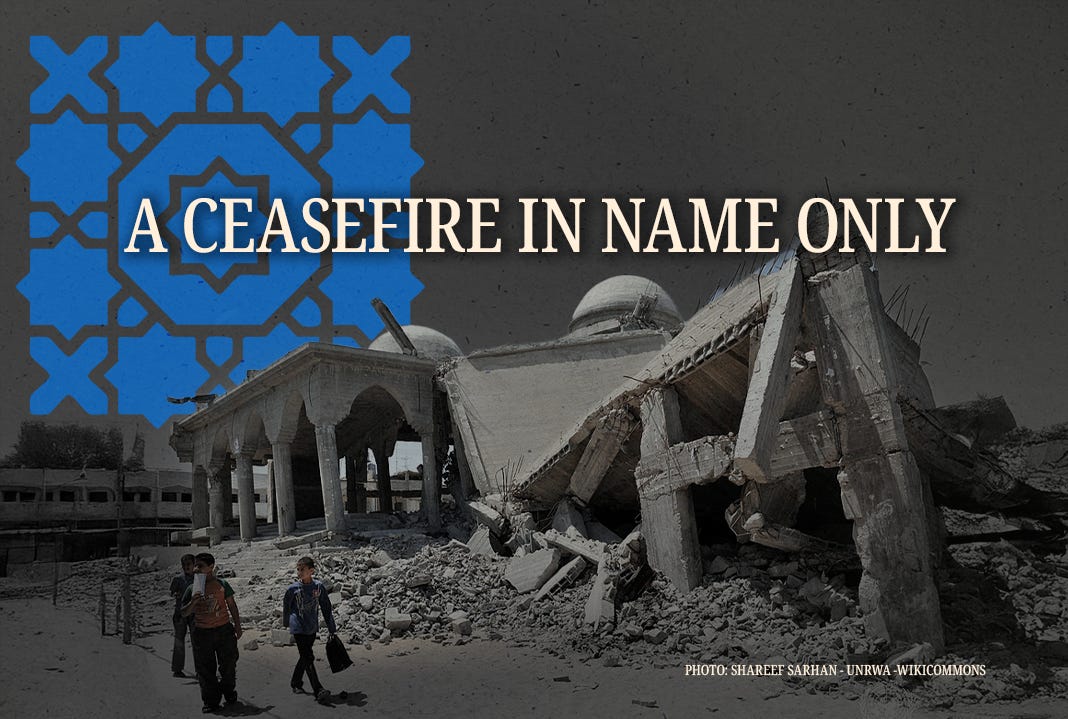
Ceasefires ought to be judged not by the documents that are signed but by the reality they create on the ground. Eight months after the agreement was signed in Sharm el-Sheikh, that reality bears little resemblance to the agreement’s stated goals. Israeli military operations have continued, reconstruction has yet to begin, and civilians are still confined to a devastating day-to-day reality. Taken together, the agreement may have reduced the intensity of the fighting, but it has yet to deliver on its promises.
The agreement, brokered under the Trump administration, was designed to unfold in three phases. The first phase called for a comprehensive cessation of military operations, humanitarian relief, the restoration of essential infrastructure, and the gradual withdrawal of Israeli forces from parts of Gaza.
But what happened in practice?
According to the Gaza Media Office, between the ceasefire and April 2026, Israel carried out 1,109 bombardments and shelling incidents across Gaza, killing 1,027 Palestinians and injuring 3,280 others.
The Israeli Defense Forces (IDF) claim that these strikes were carried out in response to violations by Palestinian armed factions.
The continued bombardment has had consequences beyond the immediate human toll. It has made it nearly impossible for the ceasefire to achieve its broader purpose: allowing Gaza to begin recovering from more than two years of war. Among the central commitments of the agreement’s first phase were the rehabilitation of Gaza’s water, electricity, and sewage infrastructure, alongside the restoration of hospitals, bakeries, and major roads. Eight months later, little of that work has begun.
Much of Gaza now functions without the infrastructure that makes modern civilian life possible. According to the United Nations, nearly 1.7 million people are living in displacement tents or temporary shelters, with 88 percent residing in improvised camps after Israeli military operations destroyed or damaged nearly 76.6 percent of Gaza’s housing stock.
Around 90 percent of Gaza’s water and sanitation infrastructure has been destroyed or damaged. Severe restrictions on electricity and fuel have crippled water treatment and distribution systems, forcing families to ration water between drinking, cooking, and washing while many displacement camps remain surrounded by untreated sewage.
Skin diseases have become one of the most widespread public health challenges in Gaza’s displacement camps. According to UNRWA, the first four months of 2026 alone saw more than 70,000 reported cases of ectoparasitic infestations, including scabies and lice, conditions that thrive where overcrowding, poor sanitation, and limited access to clean water persist. Women, children, and elderly residents often live without adequate privacy, sanitation facilities, or basic protection from disease.
The ceasefire also envisioned the withdrawal of Israeli forces from designated areas of Gaza. Instead, the territory accessible to Palestinian civilians has steadily contracted.
At the beginning of the ceasefire, Palestinians were already confined to less than half of Gaza’s 365 square kilometers. Nearly two million people were concentrated within that limited space while much of the remainder remained under Israeli military control.
Since then, that area has become even smaller.
In May 2026, Prime Minister Benjamin Netanyahu announced that Israel controlled approximately 60 percent of Gaza and instructed the military to expand that control further.
That’s 13,699 people per square kilometer living within a confined land area of 146 square kilometers. Creating a situation of Tokyo-like density but packed into a small, almost completely destroyed area.
Residents across Gaza described waking to find that the yellow concrete blocks marking the ceasefire line had shifted overnight, leaving them inside a free-fire zone, where the Israeli military could consider any Palestinian person or vehicle a legitimate target. At least 77 Palestinians have reportedly been shot on sight after ending up on the wrong side of the yellow line or even in its vicinity.
The continued bombardment, the prevention of basic civilian rehabilitation, the denial of essential human needs, and the expansion of Israel’s territorial occupation all indicate that the government’s policy of war and collective punishment did not change; it merely slowed.
Senior members of Israel’s governing coalition, including National Security Minister Itamar Ben-Gvir and Finance Minister Bezalel Smotrich, have repeatedly advocated permanent Israeli settlements in Gaza and what they describe as the “voluntary emigration” of Palestinians. When considered alongside continued military operations, stalled reconstruction, and the expansion of Israeli-controlled territory, these statements raise difficult questions about whether the ceasefire is failing to achieve its intended goals—or whether a different political objective has increasingly come to shape events on the ground.
A ceasefire is meant to do more than reduce the intensity of war. It is supposed to create the conditions for civilians to rebuild their lives and rehabilitate from the two-year nightmare. Eight months after the agreement was signed, those conditions are still out of reach. On paper, Gaza should be taking its first steps toward recovery. On the ground, Gaza does not look like a territory healing from conflict. It looks like one in which the conflict has continued under a different set of rules.
Middle East Uncovered is powered by Ideas Beyond Borders. The views expressed in Middle East Uncovered are those of the authors and do not necessarily reflect the views of Ideas Beyond Borders.
A ceasefire is not an end to the war
A ceasefire has a fundamental function.. this one was clear demilitarized gaza Israel leaves
Hamas did not demiliterize os rebuilding its forces and so the war will return to a more kinetic form
After that the same ceasefire option will return to gaza and once again it can choose its path
Same with hizbullah in the north
Suicidal empathy is much reduced post 2023 in Israel for those who don’t want to survive and those western countries that cut off munitions and weapons in an 8 front war have little leverage on the Israeli conscious