

1,735 Days Without a Classroom
Shut out of school, Afghan girls face collapsing mental health, a sharp rise in child marriage, and a healthcare system starved of the women who keep it alive.

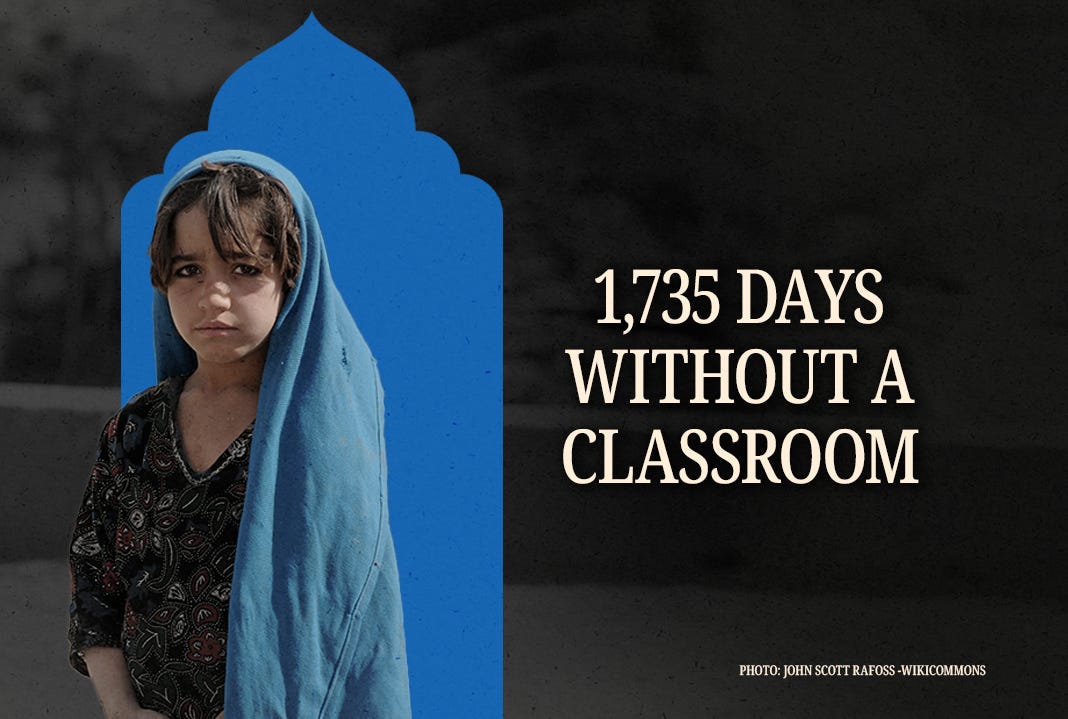
One thousand, seven hundred and thirty-five. That is the number of days Afghan girls have been shut out of their classrooms, and it climbs every morning. The count began in September 2021, when the Taliban reopened schools for boys and left the gates locked for their sisters. A girl who was eleven that autumn has now lost the whole of her secondary education, the years that quietly decide whether a person grows into a doctor or is handed over as a bride. She will not get those years back. There is no makeup exam for a stolen childhood.
Afghanistan holds a distinction no country should want: it is the only place on earth where girls are forbidden to study past primary school. This did not happen by accident or by drift. Since 2021, the Taliban have signed more than seventy decrees peeling away the right of women and girls to learn, to work, to travel, even to be seen in public. UNICEF now estimates roughly 2.2 million teenage girls are kept out of the classroom, a figure that grows every year the policy remains in effect. What looks from a distance like a broken school system is, up close, a cage built on purpose.
Ask what this does to a child, and the answer comes back in numbers that are hard to sit with. Researchers in Herat, the city my own life is bound to, surveyed girls locked out of education and published their findings in the Journal of Public Health: close to 88 percent showed signs of depression, and almost half said they had thought about ending their lives. A separate UN Women study found that 68 percent of Afghan women described their mental health as bad or very bad, and that many knew at least one woman or girl who had attempted suicide. Afghanistan is now among the very few countries where women die by suicide more often than men. Take a girl’s future from her, and you do not simply close a school. You begin to close off her reasons to keep going.
An empty desk is rarely left empty for long. Sooner or later, it is traded for a wedding. For twenty years, schooling was the strongest barrier the country had against child marriage, and the Taliban has spent four years tearing it down. Before 2021, roughly 28 percent of Afghan women were married before they turned eighteen. The UN estimates that the education ban on its own has pushed the risk of child marriage up by a quarter, and a 2023 survey found the rate had climbed toward 39 percent.
The logic in a ruined economy is merciless: a daughter who cannot study is recast as a cost to offset and a walwar payment (bride price) to collect. In May this year, the regime made it official, issuing a decree that writes child marriage into law and treats a girl’s silence as she reaches puberty as her consent. The same men who will not let her finish the seventh grade have decided she is old enough to be married off without being asked.
The cruelty of this does not stop with one generation. It reaches into the next. In December 2024, the Taliban closed the final corridor that had stayed open to women, banning them from training as midwives and nurses. Afghanistan already loses a woman to pregnancy or childbirth roughly every two hours, one of the worst maternal death rates anywhere in the world. By emptying those training rooms, the government has cut off an estimated 36,000 future midwives and thousands of nurses from the women who will one day be in labor with no one skilled beside them. In a society where many women will not, or cannot, be treated by a male doctor, shutting women out of medicine becomes a slow death sentence for mothers and infants not yet born.
There is a financial bill too, in a country that can least afford one. UNICEF reckons the secondary-school ban drained at least half a billion dollars from the economy in a single year, and that letting just one cohort of girls finish school could have added 5.4 billion. Stretch the ban on higher education out to 2066, and the projected loss climbs to around 9.6 billion dollars. Lock away half a nation’s talent, and it cannot hope to stand on its own feet. The Taliban are not only erasing girls; they are dismantling the future every Afghan was promised.
And still the world keeps pulling out a chair for them. At the Doha talks this spring, Taliban envoys waved away the question of girls’ schooling as an “internal domestic matter.” Too many diplomats let it pass and turned back to the subject of frozen assets. So, I will say again what I have said for years: diplomacy without women is betrayal. Every negotiation that files gender apartheid under “later,” as a footnote to be revisited once the serious business is done, tells the girls of Herat and Kabul and Kandahar that their disappearance is a fair price for someone else’s quiet. That is not peace. It is patience with a crime.
The clock runs on, 1,735 days and rising. We are long past the point of not knowing; the evidence sits in plain view. The only question left is whether the world will treat it as the emergency it is. Gender apartheid should be named and written into law as a crime against humanity. There should be no recognition, no released billions, no ordinary relations with this regime until the school gates open again. Someone must pay for the underground classes and protect the women teaching in them at the risk of their freedom. And the rest of us must refuse, on every single one of these days, to glance away.
Behind each statistic in this piece is a girl at a window, doing the quiet arithmetic of the years being taken from her. She is still there. She is still waiting. And what she is owed from the rest of us is not one more day of silence.
Middle East Uncovered is powered by Ideas Beyond Borders. The views expressed in Middle East Uncovered are those of the authors and do not necessarily reflect the views of Ideas Beyond Borders.
 | A guest post by
|
Afghanistan should be treated like the world treated Apartheid-South Africa. It should be shunned and boycotted. But mysogenism is not considered as revolting as racism. Thus is tragic and disgusting.
Utterly heart-breaking!