


Some exhibitions make sense before you have even read the text on the wall. You walk in, look around, and understand why these works have been brought together. At “Under One Sky,” that connection becomes clearest at the back of the gallery.
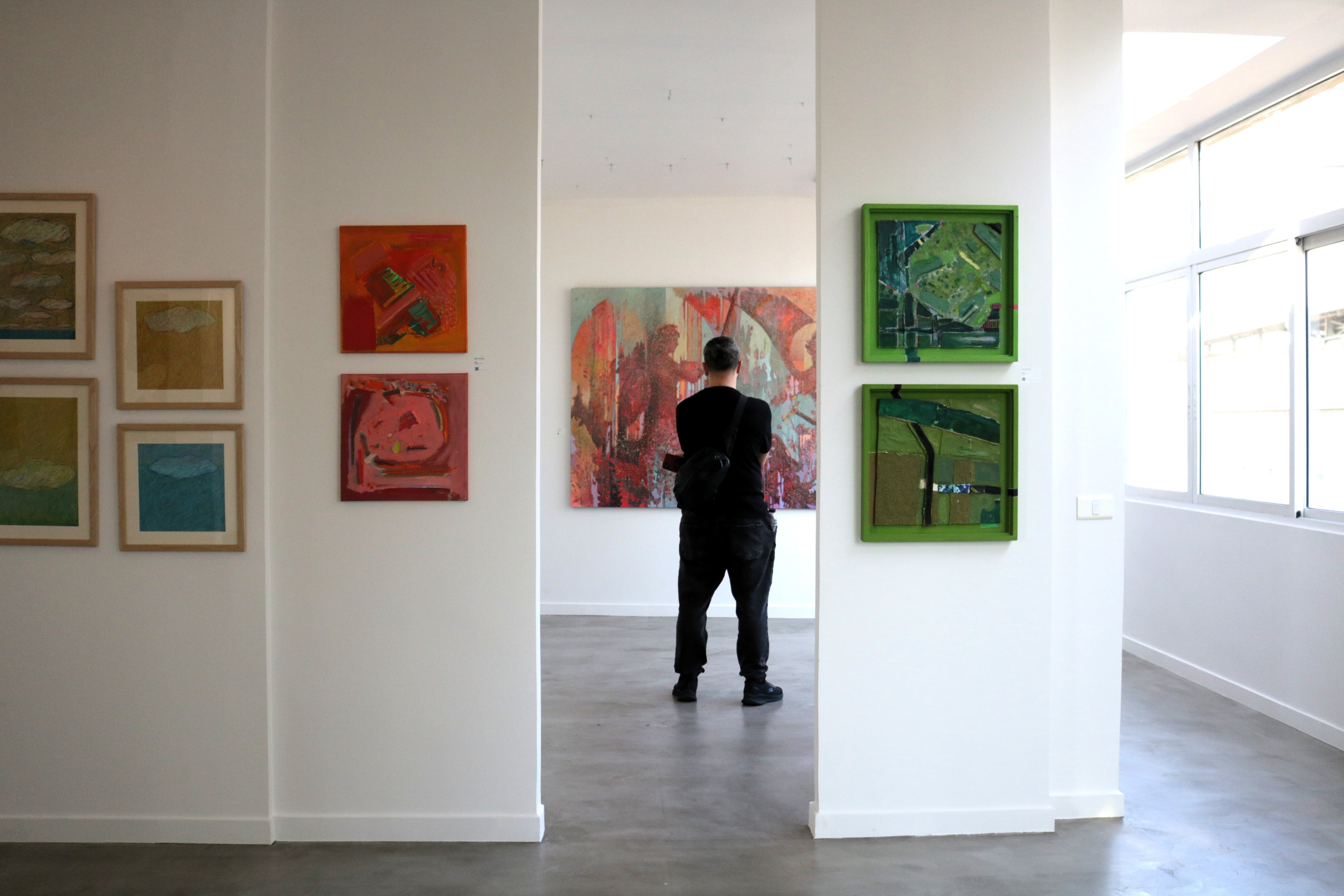
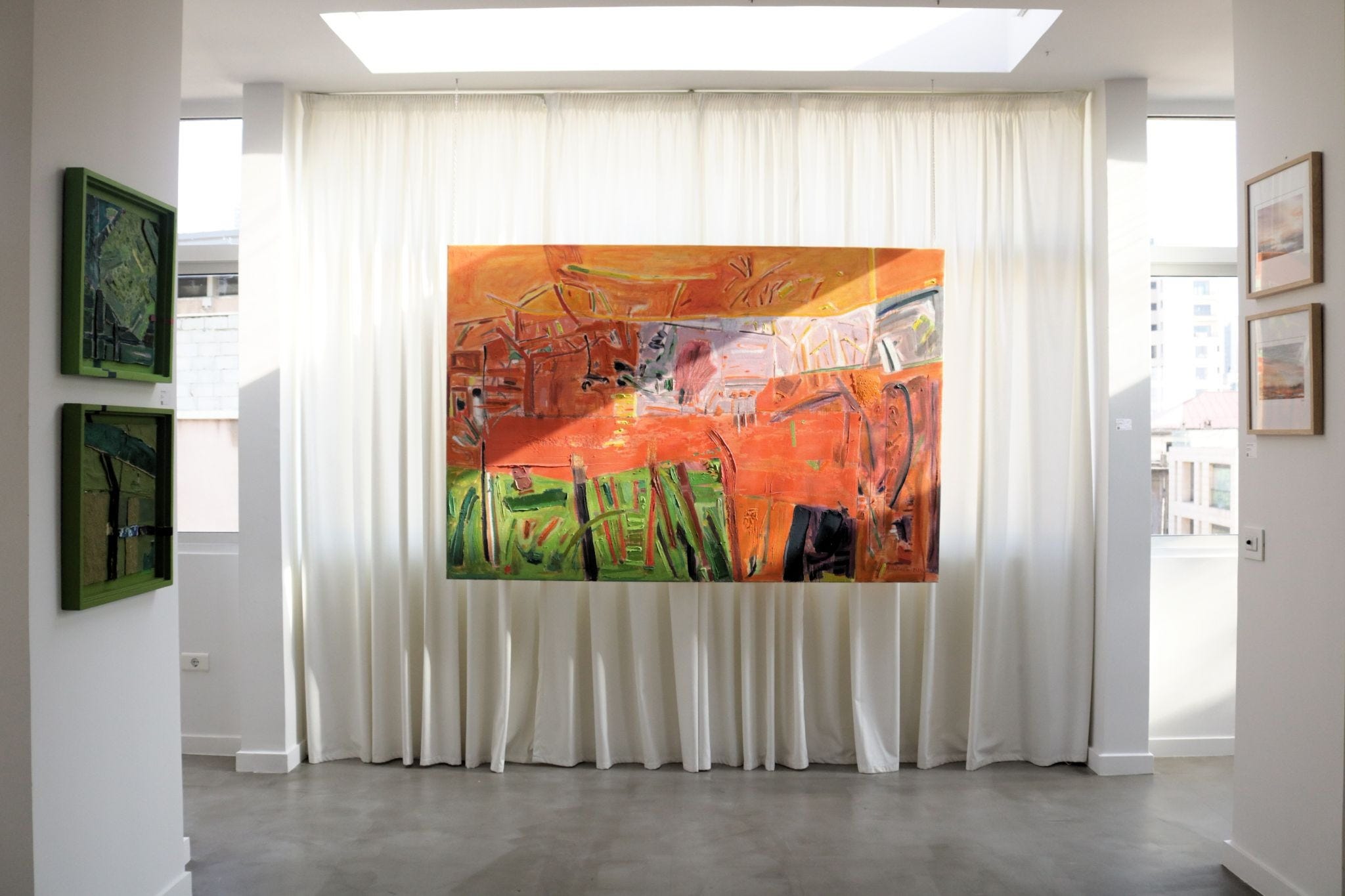
Hanging against a curtain is Hussein Hussein’s “What Land Retains,” a mixed-media work measuring 150 x 250 cm. It takes up almost the entire wall, with layers of red, green, blue, orange, and earthy tones that pull you toward it, refusing to be passed by quickly.
The painting takes on a deeper meaning once you learn the conditions under which it was made.
Hussein created it inside the gallery itself during the war, when the space became an open studio for artists displaced from their homes in the south. The canvas gave him the opportunity to return to larger works after months of being limited to smaller pieces.
It was difficult trying to paint while the crisis unfolded around him.
“What affected me most was the constant uncertainty and movement, the possibility of having to leave, return, and relocate again, which weighed heavily on my state of mind and changed my relationship with painting,” he told Middle East Uncovered.
Inside No Chef in the Kitchen, painting offered Hussein an escape from the chaos unfolding around him. He says that knowing he was there for one purpose, to paint, gave him “a sense of stability and peace,” turning the studio into “a temporary space of calm and concentration, even in the middle of uncertainty.”
Hussein describes his work through memories of Lebanon, bringing together war, nature, mythology, and the long history of the land. Among its references are Sour, the Arabic name for the ancient city of Tyre, and Alisar, the Phoenician princess who, according to legend, left Tyre and founded Carthage. “What does the land remember? I was trying to remember everything,” he says.
The exhibition grew from the need to give displaced artists somewhere to return to their practice. As curator Bahjat Darwish explains, “The first criterion was we wanted some of the artists who were displaced to have a space to come and work.”
From there, the exhibition expanded. “Many other friends and artists who are not from the south showed a lot of support and appreciation and also offered to exhibit with the artists from the south,” he says. Artists from the Beqaa and Beirut soon joined.
Project coordinator Mowie Aoun was involved in shaping the project’s first stage. “The idea was to give them a space to come back and practice their art, meet other people, and give them a spark again,” he says.
For Ali Houssein, coming together is exactly what the title represents. “‘Under One Sky’ is a beautiful thing. It connects Lebanon from south to north and the Beqaa. Artists gather in one hall.” Many of the artists did not know each other before working together in the space.
His own work comes from the landscape around him. “I’m a son of the south. I’m a son of nature,” he says. He paints houses, the sea, and the environment he knows, describing the eye as a mirror through which he reflects his surroundings.
The war disrupted that relationship. Ali left his village during the conflict and returned to find himself overwhelmed by what had happened. “Now, if I laugh, I laugh maybe in the face, but inside us, there’s sadness. A lot of sadness,” he says. “Sadness inside us lives in us. We can’t get rid of it.”
“War is on everything, on stones, on houses. Houses are a cultural image, on olives, on trees,” he added.
For Hussein, the exhibition also offered a way of placing southern artists within a wider artistic landscape. “[Bahjat] is doing a very important work trying to show that we in the south have important artists who are not visible,” Hussein says.
The exhibition’s diversity is impossible to miss. Aida Halloum has been painting for 30 years, yet doesn’t paint for any one purpose. “I’m not working for an exhibition or for a subject. I work because I love my work,” she says.
What she wants from the viewer is just as direct: “I want them to enjoy the work. It’s like when you hear Fayrouz sing.” For Halloum, painting is its own form of communication. “It’s a language; it’s not a story, it’s a language that is seen by the public. The painting is a language that is seen by the public.”
Her understanding of the exhibition comes down to what happens when those different languages finally come together. “When you have 17 artists working at the same time on something they love, as a viewer, you see the 17 differences,” she explains. “This is what diversity is all about.”
Kawthar Ballouk’s work comes from a more immediate place. She chose her painting because “it reflects the displacement and exhaustion in Lebanon, especially in the south, but also the hope of finding safety in our homeland.” She hopes visitors will “pause for a moment to reflect on what we are going through.”
For Ballouk, those emotions are also what allow people to connect through art. “My work reflects universal emotions like fear, pain, loss, and hope, feelings that anyone can understand, regardless of their background,” she says.
Hussein sees the same connection, but views it differently. A painting can cross a language barrier and still be understood: “I can be from a country in Lebanon and draw something that has nothing to do with someone in Siberia. But they feel the same feeling.”
That is how the works begin to connect with one another. Ali brings the south through houses, sea, and nature. Halloum wants the painting to be experienced like music. Ballouk brings displacement, fear, loss and hope. Hussein turns the land’s history into colors and symbols.
Darwish sees that variety as part of what happened naturally around the exhibition. “It was a true act of coming together that brought the artists,” he says. “There was a snowball effect where a number of things came together.”
During the residency, young aspiring artists came into the space to paint alongside them, and students from AUB’s Next Step program worked with Mirna Mshantas on a collaborative piece that later became part of the exhibition.
“Art is the softest form of power,” Darwish says. “It influences people, it inspires people, and this is how people can come together.”
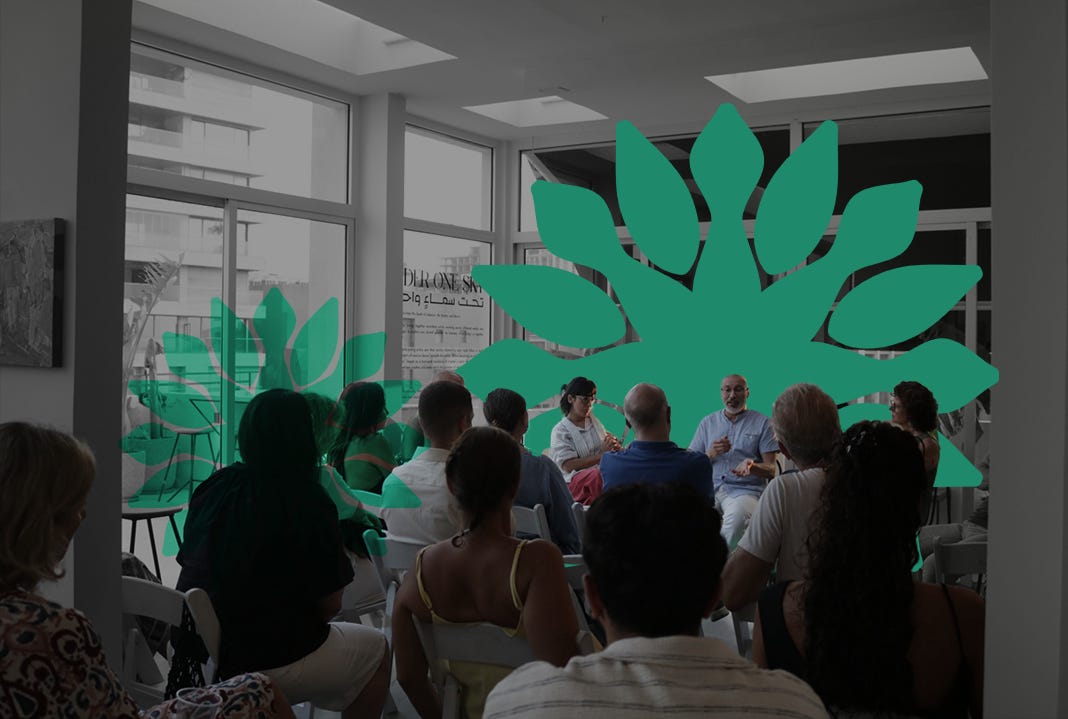
The exhibition hosted a panel on August 21. Darwish opened the discussion before allowing several artists to take over. They discussed their work, how they got here, and what it felt like to collaborate.
Hussein spoke about his path from electronics to art and the uncertainty that changed his relationship with painting. Other artists shared personal stories behind their works, bringing the conversations that had taken place inside the studio into the room with the audience.
“In times of war, in times of destruction, in times of displacement, what brings us together?” he questioned.
“To get together is our first instinct,” he added. “And sometimes we forget this.”
17 artists arrived at No Chef in the Kitchen with different histories, places, and styles of painting. For a few weeks, they shared the same studio. Now, their works are on display in the room where they found solace in the midst of conflict.
“Under One Sky” is the second arts & culture project of the Dar Zefta Foundation under its Creative Community Development initiative in the south. The WYLD Project (Women and Youth Leading Development) is implemented by Live Love Lebanon under the Women Empowerment Hub in Lebanon (WE-HUB), a project funded by the European Union and implemented by Expertise France in partnership with GIZ. The project was hosted and executed with the support of No Chef in the Kitchen. It is open at the Emile Rayess Building, 6th Floor, Pasteur Street, Saifi, and has been extended through Sept. 7.


Middle East Uncovered is powered by Ideas Beyond Borders. The views expressed in Middle East Uncovered are those of the authors and do not necessarily reflect the views of Ideas Beyond Borders.
